
Wednesday, March 11, 2026

F1: The Movie (2025) [PG-13] ****/*****
A film review by James Berardinelli for ReelViews.net, June 26, 2025.

When it comes to the nuts and bolts of car racing movies, there’s a tendency to follow the trends and tropes of the wider sports film genre in which they form a sub-category. The difference is that when Robert Redford steps to the plate or Sylvester Stallone delivers a punch, the stakes tend to be more personal than permanent. Golfers, basketball players, and sluggers generally don’t have to worry about being carted away in a body-bag; the specter of the Grim Reaper is one thing that differentiates F1:The Movie and all its car-racing contemporaries from most sports films. Sometimes in car racing, it’s not so much about crossing the finish line first but living to race another day.
There’s a lot of dramatic potential inherent in this kind of movie but F1 is less interested in developing new tracks than in doing the best it can with existing ones. Ehren Kruger’s by-the-numbers screenplay could have been churned out using AI – the film’s human element aspects are perfunctory and familiar and the narrative rarely veers from the expected trajectory. Those who see F1 shouldn’t expect any surprises or twists and the collaborative involvement of the FIA (the sports’ governing body) takes a lot of possibilities off the table. All that being said, director Joseph Kosinski delivers an experience on par with his earlier mega-hit, Top Gun: Maverick, without the benefit of nostalgia or Tom Cruise. The Grim Reaper’s hovering presence helps with the tension but F1 mostly delivers because of the easygoing charm of Brad Pitt, the energetic camerawork of Claudio Miranda, and the loud, intense score by Hans Zimmer. The movie often pushes the viewer to the point of sensory overload, and that’s where its strength lies. Good luck replicating that at home.
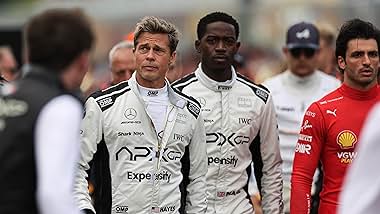
To the extent there’s a non-technical anchor grounding the story, it’s the antagonistic relationship between the two drivers who represent the ne’er-do-well Apex Grand Prix team (APXGP): over-the-hill veteran Sonny Hayes (Pitt) and up-and-coming Joshua Pearce (Damson Idris). Both could use Sinatra’s rendition of My Way as their theme song. Hayes is recruited by his old buddy, Ruben Cervantes (Javier Bardem), the current owner of APXGP, to come out of retirement and give Formula 1 racing one more chance. After initially demurring, Sonny has a change of heart and shows up with his megawatt smile, self-deprecating attitude, and cocky sense of self-assurance – all things that irritate Pearce, the team’s #1 driver. A rivalry develops, fueled by Sonny’s initial track failures. As board member Peter Banning (the always-oily Tobias Menzies) hovers like a vulture, Ruben begins doubting the sanity of his Hail Mary. Sonny might have been a potential star before a near-fatal accident, but that was 30 years ago. Meanwhile, as Sonny tries to build a rapport with the pit crew and other behind-the-scenes members of the team, his flirtations with the chief engineer, Kate McKenna (Kerry Condon), heat up.
It’s a credit to both Pitt and Damson Idris that the fractious relationship between Sonny and Joshua has the force and immediacy it does given the hackneyed nature of the material. Their chemistry transcends the thinness of what’s on the written page. Likewise, there’s an easygoing camaraderie between Sonny and Ruben and genuine sparks between the will-they-or-won’t-they pair of Sonny and Kate. I appreciated that the movie keeps the romantic elements mostly in the background. It adds a dash of flavor without interfering.

Unsurprisingly, F1 shines during the action sequences. As is often the case with racing movies, the events themselves aren’t cinematic (given the length associated with races) but the crashes are. Kosinski’s approach is to home in on big moments, using a variety of camera angles and expert editing techniques to keep the viewer engaged. He also leans heavily on Zimmer’s score, which is suitably overblown for the material, helping to top off the film’s adrenaline-and-testosterone cocktail.
In terms of recent racing movies, I’d put this one a slight notch below James Mangold’s 2019 Ford v. Ferrari, but at least on par with some of the other high-profile efforts like Ron Howard’s 2013 Rush. The effectiveness of the film’s overall aesthetic cannot be understated: what F1 lacks in narrative development it more than compensates for with its thrill-ride aspects. Watching the film, you may not believe you’re in a racing car but you will feel like you’re doing more than passively sitting in a theater seat. [Berardinelli's rating: 3 stars out of 4]
Labels: action, auto-racing, Brad Pitt, drama, sport
IMDb 76/100
MetaCritic (critics=68, viewers=75)
RottenTomatoes (critics=82, viewers=97)

There’s a lot of dramatic potential inherent in this kind of movie but F1 is less interested in developing new tracks than in doing the best it can with existing ones. Ehren Kruger’s by-the-numbers screenplay could have been churned out using AI – the film’s human element aspects are perfunctory and familiar and the narrative rarely veers from the expected trajectory. Those who see F1 shouldn’t expect any surprises or twists and the collaborative involvement of the FIA (the sports’ governing body) takes a lot of possibilities off the table. All that being said, director Joseph Kosinski delivers an experience on par with his earlier mega-hit, Top Gun: Maverick, without the benefit of nostalgia or Tom Cruise. The Grim Reaper’s hovering presence helps with the tension but F1 mostly delivers because of the easygoing charm of Brad Pitt, the energetic camerawork of Claudio Miranda, and the loud, intense score by Hans Zimmer. The movie often pushes the viewer to the point of sensory overload, and that’s where its strength lies. Good luck replicating that at home.
To the extent there’s a non-technical anchor grounding the story, it’s the antagonistic relationship between the two drivers who represent the ne’er-do-well Apex Grand Prix team (APXGP): over-the-hill veteran Sonny Hayes (Pitt) and up-and-coming Joshua Pearce (Damson Idris). Both could use Sinatra’s rendition of My Way as their theme song. Hayes is recruited by his old buddy, Ruben Cervantes (Javier Bardem), the current owner of APXGP, to come out of retirement and give Formula 1 racing one more chance. After initially demurring, Sonny has a change of heart and shows up with his megawatt smile, self-deprecating attitude, and cocky sense of self-assurance – all things that irritate Pearce, the team’s #1 driver. A rivalry develops, fueled by Sonny’s initial track failures. As board member Peter Banning (the always-oily Tobias Menzies) hovers like a vulture, Ruben begins doubting the sanity of his Hail Mary. Sonny might have been a potential star before a near-fatal accident, but that was 30 years ago. Meanwhile, as Sonny tries to build a rapport with the pit crew and other behind-the-scenes members of the team, his flirtations with the chief engineer, Kate McKenna (Kerry Condon), heat up.
It’s a credit to both Pitt and Damson Idris that the fractious relationship between Sonny and Joshua has the force and immediacy it does given the hackneyed nature of the material. Their chemistry transcends the thinness of what’s on the written page. Likewise, there’s an easygoing camaraderie between Sonny and Ruben and genuine sparks between the will-they-or-won’t-they pair of Sonny and Kate. I appreciated that the movie keeps the romantic elements mostly in the background. It adds a dash of flavor without interfering.
Unsurprisingly, F1 shines during the action sequences. As is often the case with racing movies, the events themselves aren’t cinematic (given the length associated with races) but the crashes are. Kosinski’s approach is to home in on big moments, using a variety of camera angles and expert editing techniques to keep the viewer engaged. He also leans heavily on Zimmer’s score, which is suitably overblown for the material, helping to top off the film’s adrenaline-and-testosterone cocktail.
In terms of recent racing movies, I’d put this one a slight notch below James Mangold’s 2019 Ford v. Ferrari, but at least on par with some of the other high-profile efforts like Ron Howard’s 2013 Rush. The effectiveness of the film’s overall aesthetic cannot be understated: what F1 lacks in narrative development it more than compensates for with its thrill-ride aspects. Watching the film, you may not believe you’re in a racing car but you will feel like you’re doing more than passively sitting in a theater seat. [Berardinelli's rating: 3 stars out of 4]
Labels: action, auto-racing, Brad Pitt, drama, sport
IMDb 76/100
MetaCritic (critics=68, viewers=75)
RottenTomatoes (critics=82, viewers=97)
Blu-ray
James Berardinelli's original review
Comment by FB Friend Miki Tokola:
While I agree it was an entertaining movie with lots of dramatic F1 racing, it was not an accurate depiction of current-day F1 racing. The production prioritized hero moments over the strict regulatory environment of the FIA, F1’s ruling body. Three examples are: diving into the inside of a corner from a significant distance back, weaving under braking, and off-track overtaking. All of these are violations of the rules and would result in penalties or disqualification. Another unrealistic element was showing the cars dancing around each other rather than staying on the ideal racing line around the apex of the corner.
I also enjoyed the movie and appreciated the efforts the production team went to include real racing drivers and locations into the movie. It’s important to remember it’s dramatic, exciting fiction and not representative of the driving one would see if you watched a real F1 race.
James Berardinelli's original review
Comment by FB Friend Miki Tokola:
While I agree it was an entertaining movie with lots of dramatic F1 racing, it was not an accurate depiction of current-day F1 racing. The production prioritized hero moments over the strict regulatory environment of the FIA, F1’s ruling body. Three examples are: diving into the inside of a corner from a significant distance back, weaving under braking, and off-track overtaking. All of these are violations of the rules and would result in penalties or disqualification. Another unrealistic element was showing the cars dancing around each other rather than staying on the ideal racing line around the apex of the corner.
I also enjoyed the movie and appreciated the efforts the production team went to include real racing drivers and locations into the movie. It’s important to remember it’s dramatic, exciting fiction and not representative of the driving one would see if you watched a real F1 race.
A Complete Unknown (2024) [R] ****
A film review by James Berardinelli for ReelViews.net on Dec. 23rd, 2024.

If one was going to cite a movie title for truth in advertising, it might be James Mangold’s Bob Dylan bio-pic, A Complete Unknown because, at the end of the proceedings, it’s an apt description of the main character. The reason it clear: Mangold doesn’t set out to present a comprehensive look at the singer, nor does it offer a probing psychological portrait. It doesn’t pander or seek to lionize. Instead, it’s a picture of an era and an exploration of Dylan’s impact on those around him. To the extent that it offers insights into the musician, it can be summed up succinctly by quoting Joan Baez (Monica Barbaro): he’s an asshole.
Although Dylan (played in the movie by Timothee Chalamet) was not officially involved in any aspect of the production – his name is absent from the end credits – he apparently was given an opportunity to read the script and responded by providing notes. A Complete Unknown’s take on Dylan is far from complimentary – he’s more of antagonist than protagonist – so the real-life Dylan presumably agrees with this perspective. That’s somewhat reminiscent of Robbie Williams’ self-portrait in Better Man (although Chalamet does not play Dylan as a chimpanzee).
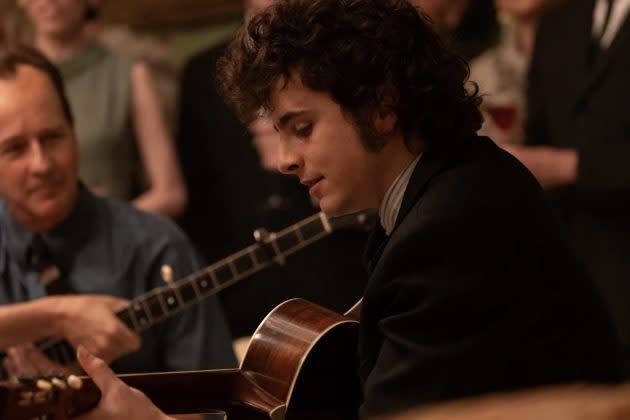 A Complete Unknown follows Dylan through a roughly four-year period, beginning in 1961 with a visit to the Greystone Park Psychiatric Hospital to meet his idol, Woody Guthrie (Scoot McNairy), and ending in 1965 following his controversial performance at the Newport Folk Festival, where his decision to perform using electric instruments is met with boos and jeers. In between, he has off-again/on-again relationships with two women, Sylvie Russon (Elle Fanning, based on real-life paramour Suze Rotolo, whose real name wasn’t used at Dylan’s request) and singer Joan Baez (Monica Barbaro), and approaches fame and fans with an inscrutable façade. He befriends Pete Seeger (Edward Norton), who gives him some of his early breaks, and Johnny Cash (Boyd Holbrook). And he allows his career to be guided by his pushy manager, Albert Grossman (Dan Fogler).
Although the movie features many of Dylan’s best-known songs, all performed by Chalamet with a better-than-passable imitation of the singer’s nasal intonations, it’s not a jukebox film or a traditional musical. Instead, it’s a drama that features music. The singing comes in logical places during studio recordings and live performances. There are no instances when characters spontaneously break into song and no choreographed dance sequences. Mangold approaches Dylan’s music much the same way that he approached that of Johnny Cash in Walk the Line.
At his best, Dylan is impassive and unfeeling. At his worst, he’s dismissive and cruel (although he probably doesn’t see the latter). He repeatedly hurts Sylvie and his relationship with Joan is such that she calls him an asshole on one occasion and a jerk on another. He shows minimal affection to anyone and turns his back on a woman who admits to loving him because he hasn’t known her that long. He is deaf to the desires of fans and afflicted with delusions of grandeur.
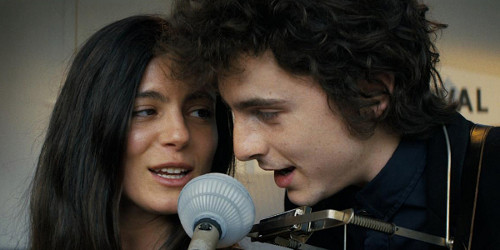
Tasked with portraying this version of Dylan, Chalamet goes full method. For two hours, he is Dylan, recapturing the look, mannerisms, attitude, and vocal inflections of the early ‘60s musician. As always with a performance like this, questions arise regarding how much of this is acting and how much is imitation. Ultimately, it doesn’t matter because A Complete Unknown gets us to believe that we’re watching Dylan wandering around ‘60s New York City. Mangold gets the details right, creating a place that’s both recognizable and alien at the same time.
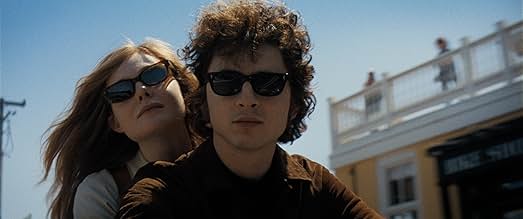
Having an affinity for Dylan isn’t necessary for A Complete Unknown to work. That’s because the movie is more about Dylan within the context of a time period than about Dylan as an individual. One could argue that he’s more of a presence than a character. We don’t know much about his past and Mangold never attempts to get into his mind or explore his motivations. Dylan comments in the film that people make up their own histories and backgrounds all the time. (Shades of The Joker in The Dark Knight.) His birth name is Robert Zimmerman but he changed it because he liked the way Dylan sounded. The screenplay uses TV news announcers as a way to pin scenes to certain critical historical events (like the Cuban Missile Crisis and JFK’s assassination).
An appreciation of Dylan’s catalog – especially his earlier songs – will enhance the movie’s effectiveness. (The title comes from a line in Like a Rolling Stone.) Still, those hoping to gain insight into this peculiar and prickly embodiment of genius will find that desire unsatisfied. A Complete Unknown isn’t shallow but the screenplay makes no attempt to psychoanalyze its subject. If there’s something to be learned, it’s how uncomfortable it could be to enter this man’s orbit. His music is iconic and speaks to many but, from the first scene to the last, he remains A Complete Unknown. [Berardinelli's rating: 3 stars out of 4]
Labels: biography, drama, music, Sixties
IMDb 73/100
MetaCritic (critics=70, viewers=72)
RottenTomatoes (critics=82, viewers=95)
Blu-ray
Berardinelli's original review
Bob Dylan wrote Boots of Spanish Leather, recorded it on August 7th, 1963, and released it on his 1964 album The Times They Are A-Changin'. The folk song is structured as a dialogue between lovers separating, often linked to his relationship with Suze Rotolo. It is noted for its poetic, bittersweet tone.

Although Dylan (played in the movie by Timothee Chalamet) was not officially involved in any aspect of the production – his name is absent from the end credits – he apparently was given an opportunity to read the script and responded by providing notes. A Complete Unknown’s take on Dylan is far from complimentary – he’s more of antagonist than protagonist – so the real-life Dylan presumably agrees with this perspective. That’s somewhat reminiscent of Robbie Williams’ self-portrait in Better Man (although Chalamet does not play Dylan as a chimpanzee).
A Complete Unknown follows Dylan through a roughly four-year period, beginning in 1961 with a visit to the Greystone Park Psychiatric Hospital to meet his idol, Woody Guthrie (Scoot McNairy), and ending in 1965 following his controversial performance at the Newport Folk Festival, where his decision to perform using electric instruments is met with boos and jeers. In between, he has off-again/on-again relationships with two women, Sylvie Russon (Elle Fanning, based on real-life paramour Suze Rotolo, whose real name wasn’t used at Dylan’s request) and singer Joan Baez (Monica Barbaro), and approaches fame and fans with an inscrutable façade. He befriends Pete Seeger (Edward Norton), who gives him some of his early breaks, and Johnny Cash (Boyd Holbrook). And he allows his career to be guided by his pushy manager, Albert Grossman (Dan Fogler).Although the movie features many of Dylan’s best-known songs, all performed by Chalamet with a better-than-passable imitation of the singer’s nasal intonations, it’s not a jukebox film or a traditional musical. Instead, it’s a drama that features music. The singing comes in logical places during studio recordings and live performances. There are no instances when characters spontaneously break into song and no choreographed dance sequences. Mangold approaches Dylan’s music much the same way that he approached that of Johnny Cash in Walk the Line.
At his best, Dylan is impassive and unfeeling. At his worst, he’s dismissive and cruel (although he probably doesn’t see the latter). He repeatedly hurts Sylvie and his relationship with Joan is such that she calls him an asshole on one occasion and a jerk on another. He shows minimal affection to anyone and turns his back on a woman who admits to loving him because he hasn’t known her that long. He is deaf to the desires of fans and afflicted with delusions of grandeur.
Tasked with portraying this version of Dylan, Chalamet goes full method. For two hours, he is Dylan, recapturing the look, mannerisms, attitude, and vocal inflections of the early ‘60s musician. As always with a performance like this, questions arise regarding how much of this is acting and how much is imitation. Ultimately, it doesn’t matter because A Complete Unknown gets us to believe that we’re watching Dylan wandering around ‘60s New York City. Mangold gets the details right, creating a place that’s both recognizable and alien at the same time.
Having an affinity for Dylan isn’t necessary for A Complete Unknown to work. That’s because the movie is more about Dylan within the context of a time period than about Dylan as an individual. One could argue that he’s more of a presence than a character. We don’t know much about his past and Mangold never attempts to get into his mind or explore his motivations. Dylan comments in the film that people make up their own histories and backgrounds all the time. (Shades of The Joker in The Dark Knight.) His birth name is Robert Zimmerman but he changed it because he liked the way Dylan sounded. The screenplay uses TV news announcers as a way to pin scenes to certain critical historical events (like the Cuban Missile Crisis and JFK’s assassination).
An appreciation of Dylan’s catalog – especially his earlier songs – will enhance the movie’s effectiveness. (The title comes from a line in Like a Rolling Stone.) Still, those hoping to gain insight into this peculiar and prickly embodiment of genius will find that desire unsatisfied. A Complete Unknown isn’t shallow but the screenplay makes no attempt to psychoanalyze its subject. If there’s something to be learned, it’s how uncomfortable it could be to enter this man’s orbit. His music is iconic and speaks to many but, from the first scene to the last, he remains A Complete Unknown. [Berardinelli's rating: 3 stars out of 4]
Labels: biography, drama, music, Sixties
IMDb 73/100
MetaCritic (critics=70, viewers=72)
RottenTomatoes (critics=82, viewers=95)
Blu-ray
Berardinelli's original review
Bob Dylan wrote Boots of Spanish Leather, recorded it on August 7th, 1963, and released it on his 1964 album The Times They Are A-Changin'. The folk song is structured as a dialogue between lovers separating, often linked to his relationship with Suze Rotolo. It is noted for its poetic, bittersweet tone.
Monday, February 2, 2026
Downhill Racer (1969) [M] ****
A film review by Roger Ebert for Chicago Sun-Times on Dec 22, 1969.

Some of the best moments in Downhill Racer are moments during which nothing special seems to be happening. They’re moments devoted to capturing the angle of a glance, the curve of a smile, an embarrassed silence. Together they form a portrait of a man that is so complete, and so tragic, that Downhill Racer becomes the best movie ever made about sports — without really being about sports at all.
The champions in any field have got to be, to some degree, fanatics. To be the world’s best skier, or swimmer, or chess player, you’ve got to overdevelop that area of your ability while ignoring almost everything else. This is the point we miss when we persist in describing champions as regular, all-round Joes. If they were, they wouldn’t be champions.
This is the kind of man that Downhill Racer is about: David Chappellet, a member of the U.S. skiing team, who fully experiences his humanity only in the exhilaration of winning. The rest of the time, he’s a strangely cut-off person, incapable of feeling anything very deeply, incapable of communicating with anyone, incapable of love, incapable (even) of being very interesting.
Robert Redford plays this person very well, even though it must have been difficult for Redford to contain his own personality within such a limited character. He plays a man who does nothing well except ski downhill — and does that better than anyone.
But this isn’t one of those rags-to-riches collections of sports clichés, about the kid who fights his way up to champion. It’s closer in tone to the stories of the real champions of our time: Sandy Koufax, Muhammad Ali, Joe Namath, who were the best and knew they were the best and made no effort to mask their arrogance. There is no humility at all in the racer’s character: Not that there should be. At one point, he’s accused by a fellow American of not being a good team man. Another skier replies: Well, this isn’t exactly a team sport.
It isn’t; downhill racing is an intensely individual sport, and we feel that through some remarkable color photography. More often than not, races are shot from the racer’s point of view, and there are long takes that nearly produce vertigo as we hurtle down a mountain. Without bothering to explain much of the technical aspect of skiing, Downhill Racer tells us more about the sport than we imagined a movie could.
The joy of these action sequences is counterpointed by the daily life of the ski amateur. There are the anonymous hotel rooms, one after another, and the deadening continual contact with the team members, and the efforts of the coach (Gene Hackman in a superb performance) to hold the team together and placate its financial backers in New York.
And there is Chappellet’s casual affair with Carole Stahl (Camilla Sparv), who seems to be a sort of ski groupie. She wants to make love to him, and does, but he is so limited, so incapable of understanding her or anything beyond his own image, that she drops him. He never does quite understand why.
The movie balances nicely between this level, and the exuberance of its outdoor location photography. And it does a skillful job of involving us in the competition without really being a movie about competition. In the end, Downhill Racer succeeds so well that instead of wondering whether the hero will win the Olympic race, we want to see what will happen to him if he does. [Ebert's rating:4 stars out of 4]
Blogger's note: When you watch the film you will notice that in German ski racing, in the starting countdown (... three, two, one) the term zwo is used, instead of zwei, for the number two, as in drei, zwo, eins. This is a specific safety measure, designed to insure that zwei (two) is not misheard as drei (three).
Labels: drama, Robert Redford, romance, sport
IMDb 63/100
Metacritic (critics=89, viewers=74)
RottenTomatoes (critics=85, viewers=57)
Blu-ray
Roger Ebert's original review
Bridgerton (Season 4 - 2026) [TV-MA] ****

Lady Violet Bridgerton (Ruth Gemmell) is hosting the first ball of the season, and it is a masquerade. Her second son, Benedict (Luke Thompson) attends, meets and falls for a lovely young woman, but she leaves before the midnight unmasking, and refuses to give him her name. So, in Cinderella and the Prince fashion, he begins to search the kingdom for her, having only her glove to identify her.
It turns out that the young woman is Sophie Baek (Yerin Ha), a maid in the household of her stepmother and her two daughters. When her stepmother discovers that Sophie has attended the ball uninvited and in her gown and slippers, she is thrown out of the house.
By coincidence Benedict finds her working at the Cavender estate, rescues her, and eventually brings her to the Bridgerton London home where he prevails upon his mother to hire her, still not realizing she is the young woman he fell for at the masked ball.
The chemistry between Luke Thompson and Yerin Ha is palpable, and of course there are the obligatory twists and turns, but there is a positive ending to this love match. In fact I would rank season four with Benedict and Sophie as engaging and as satisfying as season two with Anthony (Jonathan Bailey) and Kathani (Simone Ashley).
The chemistry between Luke Thompson and Yerin Ha is palpable, and of course there are the obligatory twists and turns, but there is a positive ending to this love match. In fact I would rank season four with Benedict and Sophie as engaging and as satisfying as season two with Anthony (Jonathan Bailey) and Kathani (Simone Ashley).
Tuesday, January 27, 2026
Downton Abbey: The Grand Finale (2025) [PG] ****
A film review by James Berardinelli for ReelViews.net on Sept 11, 2025.
Downton Abbey: The Grand Finale, like 2019’s Downton Abbey and its 2022 sequel Downton Abbey: A New Era, is comfort food for fans. And there are plenty of them: an estimated 120 million viewers worldwide regularly watched the TV series at its peak. Of course, not everyone who tuned in during 2013 is likely to head to a theater a decade later to revisit these characters, but there remain enough devoted followers to have made the previous two films successful (even though the second earned only about half as much as the first).
Current thinking is that this will be the final Downton Abbey feature—at least, that’s what the title suggests. Then again, the same claim was made after A New Era, so whether this truly is the last dance for these beloved characters will depend on two things: how well the film performs at the box office and whether enough of the cast and crew are willing to reunite once more.
The downside of leaning so heavily on fan service is that it inevitably shuts out a broader audience. There is no conceivable reason why anyone unfamiliar with Downton Abbey would choose to see this film—and if they did, they would likely drift into sleep from a mix of confusion and boredom. The lightweight narrative all but demands prior familiarity. It is, at heart, a hangout movie for the Upstairs, Downstairs crowd. To its credit, the storyline is better tailored to the characters than that of A New Era, but there is only so much that can be accomplished in a two-hour runtime. The big screen is not the ideal format for these figures; they require time and space to let their arcs unfold. If Downton Abbey is to continue, a new television series would be a far better option than a fourth film.
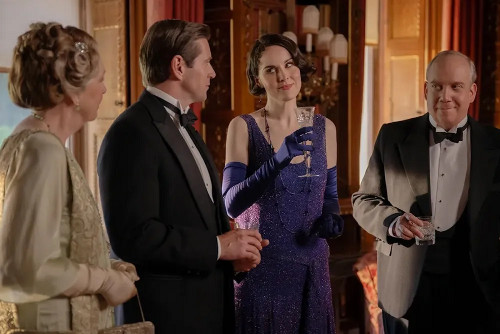
With the exception of the late Violet Crawley (played by the late Dame Maggie Smith) and the absent Henry Talbot (Matthew Goode), Lady Mary’s (Michelle Dockery) no-good husband, most of the familiar TV and film regulars return—though some enjoy meatier roles than others. The two-pronged narrative focuses on the Crawley family’s financial struggles following the 1929 stock market crash and Lady Mary’s difficulties as a social pariah after her divorce from Henry. Among the upstairs contingent are Robert Crawley (Hugh Bonneville), his wife, Cora (Elizabeth McGovern), their daughter, Edith (Laura Carmichael), with her husband Bertie (Harry Hadden-Paton), son-in-law Tom Branson (Allen Leech), and Mary’s former mother-in-law, Isobel (Penelope Wilton). Downstairs, the ensemble includes the formidable butler Charlie Carson (Jim Carter), lady’s maids Phyllis Baxter (Raquel Cassidy) and Anna Bates (Joanne Froggatt), valet John Bates (Brendan Coyle), housekeeper Elsie Hughes (Phyllis Logan), and cooks Beryl Patmore (Lesley Nicol) and Daisy Parker (Sophie McShera). Also joining the cast are Paul Giamatti, reprising his role from the series as Cora’s brother, Dominic West (from A New Era), and newcomers Alessandro Nivola (as American Gus Sambrook), Joely Richardson (as Lady Petersfield), and Arty Fruoushan (as Noel Coward).
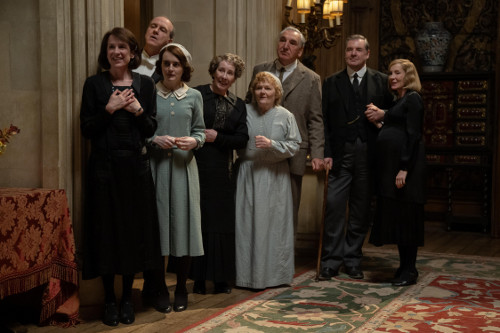
There isn’t a great deal to say about The Grand Finale. The dialogue no longer crackles the way it once did, a shortcoming that can largely be attributed to the absence of Maggie Smith, who consistently had the best lines and delivered them with just the right amount of vinegar. Smith, who was granted the chance to portray Violet’s on-screen death in A New Era before her own passing in 2024, is sorely missed—even if a prominently displayed portrait gives her character a lingering presence.
As much as screenwriter and series creator Julian Fellowes tries to provide every character with a reason to appear, many are reduced to little more than a handful of lines before they enter stage right and exit stage left. Only Mary, Robert, Cora, and Edith are afforded truly substantial roles. Michelle Dockery and Hugh Bonneville both shine, as does Jim Carter, even in a scaled-back performance. Paul Giamatti is a welcome presence, contributing a healthy dose of comedic relief, while Alessandro Nivola is deliciously smarmy in his turn.
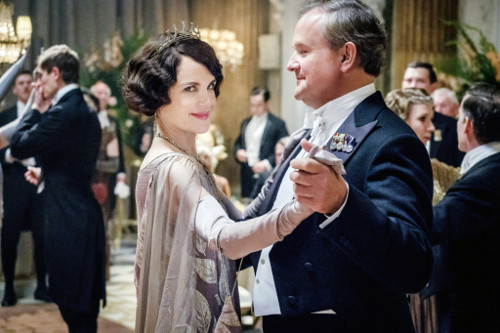
Having seen every episode of the six-season TV series and both films, I’m ready to let go. The movies, though never narrative masterpieces, have fulfilled their purpose: they’ve given fans the chance to reconnect with beloved characters while offering nearly everyone on-screen a sense of closure. Could the story continue? Certainly. But in many ways, that would be a shame. While there is some appeal in exploring how these characters might navigate the Great Depression and the approach of the Second World War, such arcs could never be properly developed within the confines of a feature film. The Grand Finale should be what its title promises: an elegant farewell. [Berardinelli's rating: 2.5 stars out of 4]
Labels: drama, period

Current thinking is that this will be the final Downton Abbey feature—at least, that’s what the title suggests. Then again, the same claim was made after A New Era, so whether this truly is the last dance for these beloved characters will depend on two things: how well the film performs at the box office and whether enough of the cast and crew are willing to reunite once more.
The downside of leaning so heavily on fan service is that it inevitably shuts out a broader audience. There is no conceivable reason why anyone unfamiliar with Downton Abbey would choose to see this film—and if they did, they would likely drift into sleep from a mix of confusion and boredom. The lightweight narrative all but demands prior familiarity. It is, at heart, a hangout movie for the Upstairs, Downstairs crowd. To its credit, the storyline is better tailored to the characters than that of A New Era, but there is only so much that can be accomplished in a two-hour runtime. The big screen is not the ideal format for these figures; they require time and space to let their arcs unfold. If Downton Abbey is to continue, a new television series would be a far better option than a fourth film.
With the exception of the late Violet Crawley (played by the late Dame Maggie Smith) and the absent Henry Talbot (Matthew Goode), Lady Mary’s (Michelle Dockery) no-good husband, most of the familiar TV and film regulars return—though some enjoy meatier roles than others. The two-pronged narrative focuses on the Crawley family’s financial struggles following the 1929 stock market crash and Lady Mary’s difficulties as a social pariah after her divorce from Henry. Among the upstairs contingent are Robert Crawley (Hugh Bonneville), his wife, Cora (Elizabeth McGovern), their daughter, Edith (Laura Carmichael), with her husband Bertie (Harry Hadden-Paton), son-in-law Tom Branson (Allen Leech), and Mary’s former mother-in-law, Isobel (Penelope Wilton). Downstairs, the ensemble includes the formidable butler Charlie Carson (Jim Carter), lady’s maids Phyllis Baxter (Raquel Cassidy) and Anna Bates (Joanne Froggatt), valet John Bates (Brendan Coyle), housekeeper Elsie Hughes (Phyllis Logan), and cooks Beryl Patmore (Lesley Nicol) and Daisy Parker (Sophie McShera). Also joining the cast are Paul Giamatti, reprising his role from the series as Cora’s brother, Dominic West (from A New Era), and newcomers Alessandro Nivola (as American Gus Sambrook), Joely Richardson (as Lady Petersfield), and Arty Fruoushan (as Noel Coward).
There isn’t a great deal to say about The Grand Finale. The dialogue no longer crackles the way it once did, a shortcoming that can largely be attributed to the absence of Maggie Smith, who consistently had the best lines and delivered them with just the right amount of vinegar. Smith, who was granted the chance to portray Violet’s on-screen death in A New Era before her own passing in 2024, is sorely missed—even if a prominently displayed portrait gives her character a lingering presence.
As much as screenwriter and series creator Julian Fellowes tries to provide every character with a reason to appear, many are reduced to little more than a handful of lines before they enter stage right and exit stage left. Only Mary, Robert, Cora, and Edith are afforded truly substantial roles. Michelle Dockery and Hugh Bonneville both shine, as does Jim Carter, even in a scaled-back performance. Paul Giamatti is a welcome presence, contributing a healthy dose of comedic relief, while Alessandro Nivola is deliciously smarmy in his turn.
Having seen every episode of the six-season TV series and both films, I’m ready to let go. The movies, though never narrative masterpieces, have fulfilled their purpose: they’ve given fans the chance to reconnect with beloved characters while offering nearly everyone on-screen a sense of closure. Could the story continue? Certainly. But in many ways, that would be a shame. While there is some appeal in exploring how these characters might navigate the Great Depression and the approach of the Second World War, such arcs could never be properly developed within the confines of a feature film. The Grand Finale should be what its title promises: an elegant farewell. [Berardinelli's rating: 2.5 stars out of 4]
Labels: drama, period
Flashdance (1983) [R] ***
A film review by Roger Ebert for rogerebert.com on April 19, 1983.

I have a friend who has a simple test for a movie: Is this movie as interesting as the same things would be, happening in real life? A lot of movies aren’t, and Flashdance sure isn’t. If this movie had spent just a little more effort getting to know the heroine of its story, and a little less time trying to rip off Saturday Night Fever, it might have been a much better film.
My friend’s simple test applies to this movie in another way: The movie is not as interesting as the real-life story of Jennifer Beals, the young Chicago actress who stars in it. Beals graduated a year ago from Francis Parker School. She already had launched a career as a model (covers on Town & Country and Vogue), after being discovered by Chicago super-photographer Victor Skrebneski. She enrolled in Yale, took some acting classes in New York, went to an audition, and won this role
The irony is that her story, simply and directly told, might have been a lot more interesting than the story of Flashdance, which is so loaded down with artificial screenplay contrivances and flashy production numbers that it’s waterlogged. This is one of those movies that goes for a slice of life and ends up with three pies.
Jennifer Beals plays Alex, an 18-year-old who is a welder by day, and a go-go dancer by night, and dreams of being a ballet star, and falls in love with the Porsche-driving boss of the construction company, played by Michael Nouri.
These are a lot of character details even if she didn’t also have a saintly old woman (Lilia Skala) as a mentor, a big slobbering dog as a friend, a bicycle she rides all over Pittsburgh, a loft the size of a sweatshop, a friend who ice skates (Sunny Johnson), and the ability to take off her bra without removing her sweatshirt. This poor kid is so busy performing the pieces of business supplied to her by the manic screenwriters that she never gets a chance to develop a character.
Meanwhile, the movie has a disconcerting way of getting sidetracked with big dance scenes. The heroine works in the most improbable working-class bar ever put on film, a joint named Mawby’s that has a clientele out of the Miller’s TV ads, stage lighting reminiscent of Vegas, go-go dancers who change their expensive costumes every night and put on punk rock extravaganzas and never take off all their clothes and never get shouted at by the customers for not doing so.
Flashdance is like a movie that won a free 90-minute shopping spree in the Hollywood supermarket. The director, Adrian Lyne, and his collaborators race crazily down the aisles, grabbing a piece of Saturday Night Fever, a slice of Urban Cowboy, a quart of Marty and a box of Archie Bunker’s Place. The result is great sound and flashdance, signifying nothing. But Jennifer Beals shouldn’t feel bad. She is a natural talent, she is fresh and engaging here, and only needs to find an agent with a natural talent for turning down scripts. [Ebert's rating: 1.5 stars out of 4 =37.5%]
Labels: drama, music, romance
IMDb 62/100
MetaCritic (critics=39, viewers=67)
RottenTomatoes (critics=37, viewers=61)
Blu-ray

My friend’s simple test applies to this movie in another way: The movie is not as interesting as the real-life story of Jennifer Beals, the young Chicago actress who stars in it. Beals graduated a year ago from Francis Parker School. She already had launched a career as a model (covers on Town & Country and Vogue), after being discovered by Chicago super-photographer Victor Skrebneski. She enrolled in Yale, took some acting classes in New York, went to an audition, and won this role
The irony is that her story, simply and directly told, might have been a lot more interesting than the story of Flashdance, which is so loaded down with artificial screenplay contrivances and flashy production numbers that it’s waterlogged. This is one of those movies that goes for a slice of life and ends up with three pies.
Jennifer Beals plays Alex, an 18-year-old who is a welder by day, and a go-go dancer by night, and dreams of being a ballet star, and falls in love with the Porsche-driving boss of the construction company, played by Michael Nouri.
These are a lot of character details even if she didn’t also have a saintly old woman (Lilia Skala) as a mentor, a big slobbering dog as a friend, a bicycle she rides all over Pittsburgh, a loft the size of a sweatshop, a friend who ice skates (Sunny Johnson), and the ability to take off her bra without removing her sweatshirt. This poor kid is so busy performing the pieces of business supplied to her by the manic screenwriters that she never gets a chance to develop a character.
Meanwhile, the movie has a disconcerting way of getting sidetracked with big dance scenes. The heroine works in the most improbable working-class bar ever put on film, a joint named Mawby’s that has a clientele out of the Miller’s TV ads, stage lighting reminiscent of Vegas, go-go dancers who change their expensive costumes every night and put on punk rock extravaganzas and never take off all their clothes and never get shouted at by the customers for not doing so.
Flashdance is like a movie that won a free 90-minute shopping spree in the Hollywood supermarket. The director, Adrian Lyne, and his collaborators race crazily down the aisles, grabbing a piece of Saturday Night Fever, a slice of Urban Cowboy, a quart of Marty and a box of Archie Bunker’s Place. The result is great sound and flashdance, signifying nothing. But Jennifer Beals shouldn’t feel bad. She is a natural talent, she is fresh and engaging here, and only needs to find an agent with a natural talent for turning down scripts. [Ebert's rating: 1.5 stars out of 4 =37.5%]
Labels: drama, music, romance
IMDb 62/100
MetaCritic (critics=39, viewers=67)
RottenTomatoes (critics=37, viewers=61)
Blu-ray
The Flight of the Phoenix (1965) [PG] ****
A film review by Dr. Svet Atanasov for Blu-ray.com on Feb. 16, 2022.

Robert Aldrich's The Flight of the Phoenix arrives on Blu-ray courtesy of Criterion. The supplemental features on the disc include exclusive new program with filmmaker Walter Hill and film scholar Alain Silver; exclusive new program with biographer Donald Dewey on actor James Stewart; and vintage trailer. In English, with optional English SDH subtitles for the main feature.
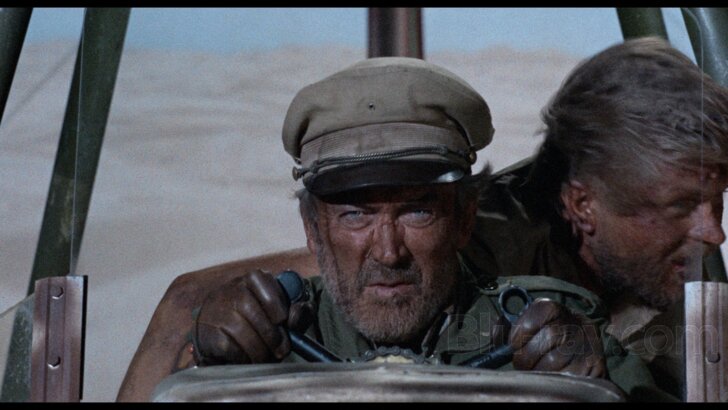
Robert Aldrich gathered an excellent cast of international stars for this ambitious adaptation of Elleston Trevor's popular novel The Flight of the Phoenix. Despite a strong promotional campaign, however, the film did not meet studio expectations and was considered a flop. But since its release in 1965 it has evolved into something of a minor genre classic, and in 2004 John Moore even directed a loose remake for Twentieth Century Fox, titled Flight of the Phoenix and starring Dennis Quaid.
James Stewart plays the veteran pilot Frank Towns who is forced to crash land an old plane transporting oil rig workers deep into the heart of the Libyan Desert. A few of the passengers die when the plane hits the sand dunes, but the rest survive. After they bury the dead, they figure out that they have enough water for a little over ten days.
Towns takes full responsibility for the accident and tries to keep the morale up, but eventually some of the men begin questioning his authority. The first to do so is Captain Harris (Peter Finch), who thinks that waiting for a rescue mission with a limited supply of water means certain death. But the nearest oasis is more than hundred miles away and reaching it seems impossible. Nevertheless, Harris leaves the camp, and is soon after followed by Trucker Cobb (Ernest Borgnine). Meanwhile, another survivor, Heinrich Dorfmann (Hardy Kruger), announces that he is an aircraft designer and knows how to use parts of the broken plane to build a new one. Towns immediately confronts Dorfmann and declares that his plan is ridiculous, but when he describes exactly what he intends to do it becomes obvious that he could in fact succeed. However, for his plan to work Dorfmann needs everyone to get involved and follow his instructions. This immensely complicates the situation, and even after the interference of his loyal assistant, Lew Moran (Richard Attenborough), Towns refuses to see Dorfmann as anything else but an egoistic challenger who should not be trusted. While the two men openly clash and question their technical knowledge and credibility, the water supply continues to shrink.
The film is loosely broken into three uneven segments, the longest being the second one. It is in this segment that Aldrich gives each actor a chance to shine and introduces a couple of interesting what-if scenarios.
The visuals are quite wonderful and, more importantly, feel authentic. The construction of the new plane certainly looks like a very challenging project, but it is not difficult to accept that it can be made to function exactly as described by Dorfmann. The only questionable element of the project is the final phase, where the exhausted men must drag the new plane to the location chosen by Dorfmann and then test it.
Despite using the same material, Aldrich and Moore's films have very different identities. Aldrich's film has a quasi-documentary appearance and its characters certainly emerge as mortals who must roll the dice and hope that they get a chance to survive. So, there is some real drama and tension in it. Moore's film is more of a show-off piece with all the whistles and bells big-budget Hollywood productions are known for.
Labels: adventure, drama
IMDb 75/100
RottenTomatoes (critics=86, viewers=81)
Blu-ray
Criterion Films catalog entry
Blogger's comment:
In the 1840s John Stringfellow and William Henson patented designs for an Aerial Steam Carriage, a large monoplane design intended for passenger travel. In 1851 Stringfellow, working after his partnership with Henson had ended, successfully flew a small, steam-powered model aircraft, powered by a lightweight steam engine. The aircraft flew 600 meters (2,000 feet) before hitting an obstacle.
Friday, January 23, 2026
Alfie (2004) [R] ***
A film review by James Berardinelli for ReelViews.net

For me, there's a litmus test for remakes: are they sufficiently different and/or interesting in their own right that their existence is easily defended? Admittedly, it's a lot easier to argue the case for a new version of Alfie (to today's audiences, the 1966 original could be considered obscure) than Psycho, but somehow the film doesn't work as well as it should. The problem is one of context. Although director/screenwriter Charles Shyer changes the setting from '60s London to '00s New York, he otherwise stays relatively faithful to the approach (if not the specific text) of Lewis Gilbert's version. The first Alfie occurred during the birth pains of the sexual revolution, when one-night stands were the expected norm for virile young men. Applying that mindset to the AIDS era, when one-night stands can become games of Russian roulette, doesn't work. Cosmetic updates to the title character can't change the fact that Alfie is a relic lifted from one era and dropped into another one.
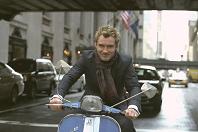 Having said that, however, it is necessary to point out that Jude Law does a solid job, although he's essaying a person who generates limited audience sympathy. Law does not attempt to ape Michael Caine, but makes the character his own. (Along with The Ipcress File, Alfie is the film that cemented Caine's reputation. It's odd that he doesn't have a cameo in this remake - maybe he learned a lesson from Get Carter.) Like Caine, Law seems comfortable breaking the fourth wall and addressing the audience directly. When Gilbert used the device some 40 years ago, it was fresh, but, by 2004, it is clichéd. Not to mention that it emphasizes Alfie's smugness and narcissism, making him less likable.
Shyer has never found a remake he didn't like. His recent resume is dotted with re-dos. He was involved in new versions of Father of the Bride, Father's Little Dividend (called Father of the Bride Part II so as to not confuse audiences), Once Upon a Crime..., and The Parent Trap. None of these films showed remarkable qualities, so anyone with a degree of familiarity with Shyer's career should have known about what to expect from Alfie. The original Alfie came out at precisely the right time. The remake is 40 years too late.
The storyline is one of simple karma. Throughout the first half of the film, Alfie plays the perfect womanizer, a fashion whore who goes after every pretty FBB (face, boobs, bum) he sees, without concern for the consequences. These include Dorie (Jane Krakowski), a lonely wife whose husband hasn't touched her in five months; Lonette (Nia Long), his best friend's girl; Julie (Marisa Tomei), his quasi-girlfriend who has a son Alfie adores; Nikki (Sienna Miller), who makes a convenient companion on the second loneliest night of the year (Christmas Eve); and Liz (Susan Sarandon), a confident older woman who knows what she likes. Shortly after the midpoint, the tables are turned, and Alfie discovers some hard truths about how he has been treating the opposite sex. By the end of the movie, he hasn't found happiness, but he has discovered humility. During the closing scenes, one can imagine that Charles Chaplin's Smile was written for this character (Smile, though your heart is breaking…).
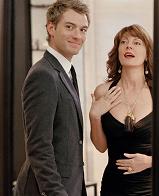 Aside from Law, there aren't any standout performances. None of the women have large roles, and even the best of them (Sarandon, Miller) struggle to escape the stereotype confines in which the script pigeonholes them. As Marlon, Alfie's best/only friend, Omar Epps doesn't fare any better. Epps has one memorable moment, and it's more his facial expression than his words that make it work. Tomei is surprisingly subdued, and wears a hairdo that one could argue is paying homage to the era in which the original Alfie debuted.
Having expressed some negative thoughts about the film, however, I have to admit that Alfie grew on me. Once we get past all the smart-aleck asides offered up by the title character, and begin to get to know the real Alfie, the movie becomes more engaging. Certain individual scenes are surprisingly effective, such as Alfie's bathroom chat with an older gentlemen (who advises: Find someone to love and live every day as if it was your last), his farewell to Nikki, and the result when he finally brings flowers to a woman. Alfie shouldn't have a happy ending, and it doesn't. Thankfully, Shyer doesn't force something into the film that wouldn't fit.
Alfie has the requisite moments of pathos and humor that allow the movie to be enjoyed on some level, even if the main character occasionally feels like a walking, talking anachronism. Those who demand a sympathetic character to appreciate a film may not have a favorable feeling. I'm more open to ambiguous protagonists and anti-heroes, so this aspect didn't bother me. Still, this is a mixed bag - passable entertainment made palatable largely by Law, but the question of Why? more than What's it all about? still lingers where this remake is concerned. [Berardinelli's rating: 2.5 out of 4 stars = 62%]
Blogger's observation: Alfie's self-assessment in the final scene goes like this:
I used to think I had the best end of the deal. What have I got? Really? Some money in my pocket. Some nice threads. Fancy car at my disposal. And I'm single. Yeah. Unattached. Free as a bird. I don't depend on nobody. Nobody depends on me. My life's my own. But I don't have peace of mind. And if you don't have that, you've got nothing.
Labels: comedy, drama, romance
IMDb 62/100
MetaCritic (critics=49, viewers=59)
RottenTomatoes (critics=48, viewers=51)
DVD
Love Again (2023) [PG-13] ***
A film review by Brian Orndorf for Blu-ray.com on May 5, 2023.

Mira (Priyanka Chopra Jonas) is a children’s book author struggling to come up with an idea for her latest project, still lost in the grieving process two years after the death of her boyfriend, John (Arinze Kene). She lives with her sister, Suzy (Sofia Barclay), still reminded of the man she loved, trying to work through her thoughts by texting his number, sharing her feelings with the void. Rob (Sam Heughan) is a newspaper music critic struggling to get over being dumped by his longtime girlfriend, fighting to focus on an assignment to interview Celine Dion. He receives a new phone from his boss, with the number transferred from John’s old account, allowing Rob to receive Mira’s intimate messages of sadness. Rob eventually meets Mira at the opera, sparking an immediate attraction to the woman, and their dates turn into a relationship, though the writer can’t bear to tell his love about the messages, complicating their union.


Mira purges her feelings into texts for John’s number, confessing her fears and sadness, unaware that these messages are being received by Rob, who’s also managing heartbreak, but more pressing professional matters are found with his mission to chat with Dion, who appears in the film as a Yoda-type figure wise in the ways of love and loss. Love Again settles into sitcom-y territory with the mix-up, but Strouse fights plasticized plotting as much as possible, giving the feature over to the leads, who manage to create semi-real people in the face of ridiculousness. There’s some degree of warmth in Love Again, but it’s challenged by formula, with Rob assigned two pals at work to act as his guide into technology and human contact, giving the picture a few stabs at humor it doesn’t really need.

Rob can’t believe what’s happening with Mira, with the pair growing closer, sharing protected parts of their lives and bits of basketball-themed philosophy. He’s in possession of knowledge that will surely destroy his new relationship, and Love Again lines up with the usual in nonsense communication issues, but Strouse handles it all to the best of his ability. He has to make something accessible and familiar for fans of the subgenre, which isn’t welcome, but Love Again carries initial care for profound situations of pain, finding ways to address the reality of the mourning process without completely losing itself to cliché. [Orndorf's rating: 3 stars out of 5]
Labels: comedy, drama, romance
IMDb 5.9/10
MetaCritic (critics=32, viewers=53)
RottenTomatoes (critics=30, viewers=91)
Blu-ray
Brian Orndorf's original review
Blu-ray review by Kenneth Brown (3/5 stars)
Searching for Bobby Fischer (1993) [PG] *****
A film review by James Berardinelli for ReelViews.com

Searching for Bobby Fischer is based on the true life story of Josh Waitzkin who, at the age of sixteen, is currently (1993) the highest-ranked American player under eighteen. It isn't just Josh's tale, however. The name and image of the mysterious chess genius Bobby Fischer infiltrate this movie. Fischer is as much an icon to this game as Babe Ruth is to baseball.
How important are games to the American way of life? Have they become so crucial that we lose sight of the people playing them? And at what point does the need to win become so important that the game ceases to be fun? These are some of the questions that Searching for Bobby Fischer probes. It certainly can't answer them, but the film offers fodder for thought as it explores Josh's early career and examines the relationship between the young chess master and his sports writer father, Fred Waitzkin (Joe Mantegna).
Josh starts playing chess because it fascinates him. As soon as Fred recognizes his son's gift, however, he begins to apply subtle pressure. Winning becomes important -- perhaps too important -- and Josh is afraid that to fail at the game is to risk losing his father's love. It's then that chess becomes a burden and he stops enjoying it.
Josh has two mentors -- the street-smart Vinnie, who teaches him to play the opponent, not the board; and Bruce Pandolfini, a man who has suffered an unspecified loss in an unnamed competition, but knows the game inside out. Each has a different perspective to offer, and Josh learns from them both. One lesson, however, he is unable to take to heart -- he cannot hate his opponents, no matter how much they despise him. We never learn exactly what demons haunt Pandolfini, and it's a credit to this film that it doesn't make them explicit. There are enough clues that they can be guessed at, and Searching for Bobby Fischer relies upon the intelligence of its audience to put the pieces together.
The two key relationships explored by this film are those of Josh and his father and Josh and his teacher. While Fred never stops loving his son, he becomes obsessed by the need to win. This kind of pressure is too much to put on a young boy, no matter how gifted he is. Like Fred, Pandolfini loses sight of his young charge's innocence and age, and tries to mold him into a chess-playing machine. In some sense, the coach is fighting the ghosts of his past through Josh. It isn't until the end of the film that he is finally able to accept and love his student for who he is.
Ben Kingsley and Joe Mantegna do excellent jobs bringing their characters to life. These are men with faults, but it's those imperfections that enable us to empathize with them. Neither actor has an overabundance of screen time with which to develop a personality, but good performers can do a lot with an economy of scenes. Having only a handful of appearances, Laurence Fishburne faces an even more difficult challenge, but he nevertheless manages to convince us that he's Josh's true friend, concerned more about the boy's happiness than his success. Joan Allen, despite often being relegated to the background, gives a convincing portrayal of a mother who cares so much about her son's well-being that she's willing to take him away from his father, if necessary, to assure it.
When casting Searching for Bobby Fischer, the production team decided that instead of choosing a young name actor who might know little or nothing about chess, they would choose someone who was a chess player first and an actor second. Realism was important to the film makers -- they wanted chess-playing viewers to be spared the indignity of watching someone faking playing the game. In Max Pomeranc, an excellent choice was made. Not only is he an experienced chess player, but he acquits himself admirably in the role of Josh. He's not the best child actor to grace the screen, but he avoids the awkward obviousness of many.
Searching for Bobby Fischer is an intensely fascinating movie capable of involving those who are ignorant about chess as well as those who love it. The focus of the film is less on the actual game than it is on the people, emotions, and pressures surrounding Josh. It is a tale of human trials and triumph, not a sports movie that panders to a certain segment of the population. Chess may not be the most exciting activity to watch, but Searching for Bobby Fischer makes for engaging entertainment. [Berardinelli's rating: 3 stars out of 4]
Labels: biography, chess, drama
IMDb 73/100
MetaCritic (critics=89, viewers=74)
RottenTomatoes (critics=98, viewers=85)
Berardinelli's original review
NOTE: Robert James Fischer (March 9, 1943-January 17, 2008) was an American chess Grandmaster and the eleventh World Chess Champion. He passed away at age 64 due to kidney failure, in Reykjavik, Iceland. He was a renowned child prodigy who became a world-renowned figure after winning the 1972 World Chess Championship against Boris Spassky.
Joshua Waitzkin (born December 4, 1976) is an American former chess player, martial arts world champion, and author. As a child, he was recognized as a prodigy, and won the U.S. Junior Chess championship in 1993 and 1994. He stopped playing competitive chess because he lost his love for the game, feeling alienated by the immense pressure, external expectations (fueled by the film Searching for Bobby Fischer), and a coaching style that forced him to play defensively against his natural, creative style. He felt disconnected from the pure joy of the game, leading him to abandon high-level play to pursue martial arts (Tai Chi Chuan) and focus on broader principles of learning, as presented in his book The Art of Learning.
Subscribe to:
Comments (Atom)