Pages

Showing posts with label Eleanor Parker. Show all posts

Saturday, October 5, 2019

Valley of the Kings (1954) [NR] ***


An edited film review by Andrew Wickliffe for thestopbutton.com on 11 April 2006.

Eighty-six minute movies are not supposed to be boring. Eighty-six minute sound films anyway. Valley of the Kings manages to be boring in the first twelve minutes. Even those twelve minutes are boring. It takes the film until just over the halfway point to actually get moving. Not interesting, not good but moving. There are three action scenes back-to-back: a sandstorm, a Bedouin duel, and a fist-fight atop a giant Egyptian statue. The film tries to start with action too: a horse-drawn buggy chase within the first six minutes. But chases are hard enough to do in cars, much less buggies.

Valley of the Kings was filmed on location in Egypt, so I imagine those visuals were much of the prospective appeal, but the writing’s bad, in multiple ways, and the director doesn’t know how to make the visuals work for the film. They’re background instead of attraction and the film still tries to replace content with them. At eighty-six minutes, it’s hard for a film to take much responsibility, and Valley of the Kings tells the story of the archeological proof of Joseph in Egypt (something archeology has yet to prove), and it’s a deep subject. A lot has to go on, and nothing goes on in Valley of the Kings. It tries to be a few films - one about this search for evidence, another about an adulterous relationship, and yet another (action-filled one) about the intrigue of grave-robbing, illegally selling antiquities and counterfeiting them. In the end, it doesn’t take any of these subjects seriously and there’s little to hold the film together except, of course, the locations - which are excellent in the second half - and Robert Taylor. Valley of the Kings is Taylor and Eleanor Parker’s second of three films together (for MGM). Their first, Above and Beyond, was great. This one manages to waste Parker by changing her character in the third act. She becomes positively unlovable in the last three scenes, then the film expects the audience to embrace her. She has a cuckold, played by Carlos Thompson, but the opening credits tell us the film stars Taylor and Parker. Taylor is getting the girl, so there aren’t many surprises once it gets going. Taylor is great in the film and would have been even better had to been serious film about archeology or adulterous affairs.

The film has a lot respect for the Muslim characters it portrays, much more respect then they get today in films - even in culturally sensitive films. It’s a reasonably important footnote in the history of American perspective of Muslims (Islamic fundamentalism hadn’t come around yet) and they’re treated with more respect than the European character.

Valley of the Kings isn’t terrible, thanks to the second half, but Robert Pirosh is a bad writer and a bad director. Of the two problems, the writing hurts the film most. With a good script and another twenty minutes, Valley of the Kings would still not be as good as Above and Beyond, but it wouldn’t be so middling. [Wickliffe’s rating: * out of 4 stars (25/100)

Credits: Directed by Robert Pirosh; screenplay by Pirosh and Karl Tunberg, from a book by C.W. Ceram; director of photography, Robert Surtees; edited by Harold F. Kress; music by Miklos Rozsa; released by Metro-Goldwyn-Mayer.

Starring: Robert Taylor (Mark Brandon), Eleanor Parker (Ann Barclay Mercedes), Carlos Thompson (Philip Mercedes), Kurt Kasznar (Hamed Backhour), Victor Jory (Tuareg Chief), Leon Askin (Valentine Arko, Antique Dealer) and Aldo Silvani (Father Anthimos).

Labels: action, adventure, Eleanor Parker, romance


Friday, July 26, 2019

Interrupted Melody (1955) [NR] ****


A film review by Andrew Wickliffe for thestopbutton.com on 9 Feb 2006.

Interrupted Melody is an interesting example of economic storytelling. The film covers about ten years, has a number of strong character relationships, but moves gently through all of it. It’s got moments where there isn’t any dialogue, just the look between characters, it’s got a great love story - and, even better, a great struggling marriage. Director Curtis Bernhardt deserves a lot of the credit - for example, he knows just how long to let these scenes go, and the first date between Eleanor Parker and Glenn Ford does better in five minutes what most films - most good films - spend twenty doing. It’s not just Bernhardt though. Interrupted Melody was co-written by Sonya Levien, who also worked on The Cowboy and the Lady and it had similarly perfect pacing.

Most of Interrupted Melody is a showcase for its actors, whether it’s Parker or Ford or even a young (and good-looking) Roger Moore. The film’s structure varies in focus - for instance, there’s a large part where Ford is the protagonist over Parker - but manages the transitions back and forth beautifully. So beautifully, in fact, I don’t even recall the first transition. The second, later one, I still do.

Besides being Parker’s best performance (probably, at least in the lead), Interrupted Melody has a great Glenn Ford performance. Ford never gets the proper respect - search for him on IMDb and the first title to come up is Superman, but he’s really good, especially in this, mid-1950s period of his career. Interrupted Melody is available on DVD, and it occasionally is shown on Turner Classic Movies. Wickliffe’s rating: **** out of 4 stars.

Blogger’s comment: In 1956, Eleanor Parker was nominated for an Oscar for Best Actress in a Leading Role for her performance in this film

CREDITS
Directed by Curtis Bernhardt; written by William Ludwig and Sonya Levien; directors of photography, Joseph Ruttenberg and Paul Vogel; edited by John D. Dunning; produced by Jack Cummings; released by Metro-Goldwyn-Mayer.

Starring Glenn Ford (Dr. Thomas King), Eleanor Parker (Marjorie Lawrence), Roger Moore (Cyril Lawrence), Cecil Kellaway (Bill Lawrence), Peter Leeds (Dr. Ed Ryson), Evelyn Ellis (Clara), Walter Baldwin (Jim Owens), Ann Codee (Madame Gilly), Leopold Sachse (Himself) and Stephen Bekassy (Count Claude des Vignaux).

Labels: biography, drama, Eleanor Parker, Fifties, music, romance


Friday, July 12, 2019

The Sound of Music (1965) [G] *****


A film review by Casey Broadwater for blu-ray.com on Nov. 3, 2010.


Hollywood insiders called it The Sound of Money when it started raking in loads of box office cash. Leading man Christopher Plummer, thinking it was too sentimental, referred to it as The Sound of Mucus. Influential film critic Pauline Kael even deemed it a sugar-coated lie that some people seem to want to eat. But let's set the cynicism aside for a moment. It may be syrupy, and it's definitely a Hollywood cash cow - even now, 45 years after its release - but has there ever been a film more sincerely joyful, more wide-eyed and earnestly optimistic than The Sound of Music? (If there has, I haven't seen it.) It's easy to be wary about unbridled hope, but this movie musical - the eighth and final collaboration between Richard Rodgers and Oscar Hammerstein II, the greatest composer/lyricist duo of the 20th century - comes by it honestly. There's no pandering here, no wink-wink irony, no sense of kitsch or camp. The Sound of Music genuinely believes in the possibilities of love, the certainty of good's triumph over evil, and the redeeming, transcendent power of song. Critics can scoff and cynics cringe, but there's a reason audiences world-over have been singing along with the film since 1965.

The based-on-a-true-story is almost universally familiar by now. Broadway star Julie Andrews plays Maria, a good-natured but troublemaking postulant at a convent in the Austrian Alps. Perhaps troublemaking is an overstatement. In the song Maria, sung by her wimple-wearing supervisors, we learn that Maria's main offenses are waltzing on the way to Mass, whistling on the stair, and - gasp! - singing in the abbey. Knowing that she's A flibbertigibbet! A will-o'-the-wisp! A clown! and perhaps too flighty to become a proper nun, the Mother Abbess (Peggy Wood) puts Maria on probation and sends her to Salzburg to serve as the governess of the seven von Trapp children, aged five to sixteen. Their father, Georg (Christopher Plummer), is a widower and former Navy captain, a hardcore disciplinarian who orders his kids around with the aid of an impossibly shrill whistle. Maria, of course, takes a different tact, winning the children over with song, sewing play clothes out of old drapes, climbing trees, going on mountaintop picnics, and putting on puppet shows. The captain's heart is slowly opened when he sees the change in his children, and he breaks off his engagement with the coldly shrewd Baroness Schraeder (Eleanor Parker) to marry Maria. Alas, there's trouble in paradise. These are the last golden days of Austria in the 1930s, and the Nazi threat looms over the Alps like a thundercloud. Don't worry, though, this is The Sound of Music, not Schindler's List, and despite a tense climax that finds the von Trapps hiding from SS foot soldiers in the abbey cemetery, the dénouement is pure - literal and figurative - escapism.

Every junction, twist, and turn of the plot is accompanied by song, and the musical numbers are so memorably infectious, there ought to be an auditory branch of the Centers for Disease Control working around the clock on an antidote for the inevitable ailment of getting these tunes stuck permanently in your head. Nearly every song has since become a bonafide classic, from the title track - which finds Maria, arms outstretched, spinning in euphoria - to Climb Every Mountain, the inspiration closer. In between, there's My Favorite Things, an ode to joyful list-making, Do-Re-Mi, a veritable music lesson, and The Lonely Goatherd, a lyrical tongue twister if there ever was one. And let's not forget the fact that most people think Edelweiss is an actual Austrian folk song, and not a brilliant creation of Rodgers and Hammerstein. There's an air of abject wholesomeness that pervades all of the music - which led Pauline Kael to controversially say, we have been turned into emotional and aesthetic imbeciles when we hear ourselves humming the sickly, goody-goody songs - but delve into the subtext of Hammerstein's lyrics and you'll find slight shades of passion, and even sex, as when eldest daughter Liesl (Charmian Carr) sings, I am sixteen, going on seventeen, innocent as a rose. Since when were the delicate, sensual petals of a rose considered innocent? Still, this is family-friendly stuff all around, and while it may be overly sweet, I don't think it's fair to say it's sickeningly so. Not every film needs to be a gritty, philosophically loaded, emotionally exhausting drama.

The Sound of Music is, at the very least, well-made fluff, but it's frequently much more than that. The film is exhilarating from the first frames, as Director Robert Wise takes us on an aerial tour of the Alps, culminating in a helicopter shot that swoops down on a twirling Julie Andrews right as she erupts into song. Wise has a keen sense of mise-en-scène, and all of his compositions emphasize depth and movement, particularly his arrangements of the seven von Trapp children. The kids themselves come across as precocious, but never obnoxious, and when Christopher Plummer's steely eyes soften at the sound of their singing, even the most hardened moviegoer is likely to break into an insuppressible smile or even shed a tear. The movie is essentially engineered to make you feel good, to make your heart swell, and whether or not you think this is manipulative or superficial, it's certainly effective. I can think of few better cures for the blues than spending 174 minutes with The Sound of Music. Yes, at nearly three hours long - thanks to reprises of just about every song - the film would seem to run the risk of sagging in the middle, but it surprisingly never does, floating along instead on its own glee-filled effervescence. And the source of this bubbly propulsion is Julie Andrews, who practically radiates joy and goodness. It's easy, maybe even fashionable among critics, to dislike The Sound of Music, but we could all stand to be a little bit more like Maria, waltzing, whistling, and singing our way through life.

Labels: biography, Cinderella-story, drama, Eleanor Parker, family, musical, romance


Monday, July 1, 2019

The Seventh Sin (1957) [NR] ****


A film review by Andrew Wickliffe for thestopbutton.com on Sept. 1, 2017.

The Seventh Sin has three problems. The first is the third act; it’s too rushed. Given the constraints of the film production – a shot-in-Hollywood production about a cholera outbreak in a rural Chinese town – there’s not so much to be done about it. The film has a limited cast, especially once the action moves from Hong Kong to that town, and the roles are restrictive. The second problem is Miklós Rózsa’s music. It’s occasionally perfectly good melodramatic stuff, but Rózsa also has a lot what he must have considered Chinese themes. Regardless of their origin, they come off as trite or condescending and completely alien to the film’s narrative. They’re as patiently false as the rear screen projection shots, only without the actors there to get the scenes through.

The third problem is the big one. It keeps The Seventh Sin down, even when everything else is working (though, obviously, not much of Rózsa’s score). Leading man Bill Travers is awful. He’s mediocre at the start, seemingly unable to fully handle the part of a vindictive cuckold, but once he actually has some character development to essay, Travers butchers it even worse.

Now on to the good. Lead Eleanor Parker. She starts the film desperately unhappy, floundering, angry, and completely transforms through her experiences. The Seventh Sin is front-loaded. The most dramatic story stuff is at the beginning, when dull Travers learns Parker’s having an affair with charming Jean-Pierre Aumont. By the time Travers drags Parker to the cholera outbreak, there’s not much drama left. They’re both resigned and burned out. Parker’s already gone through one entire dramatic arc with the character and then she has to build another one, only without any outside incitement. Despite Travers singlehandedly turning the tide of the cholera epidemic, The Seventh Sin is all about how Parker experiences it and how that experience changes her. And a lot of her experience is just sitting around miserable.

Sometimes she does have George Sanders, playing an Englishman who’s settled in the town to occasionally run an import and export business, but mostly to get drunk and snoop into people’s personal lives. He finds a kindred spirit in Parker and much of the second act involve his attempts to discover her secrets and then what to do with those discoveries.

All of Parker’s development comes in these quietly composed wide shots; she’s often alone in them, negotiating her place in space. When someone else comes into the shot – specifically Travers – it’s an intrusion. The subdued tension explodes. Parker argues magnificently in the film. The script never really gives Sanders a chance to keep up, which seems a missed opportunity (but not once the narrative plays out). At the beginning of the film, Travers actually does hold his ground for a moment or two but he quickly gets lost. It’s impossible to imagine how The Seventh Sin would’ve turned out with a better performance in his role.

While Ronald Neame gets the sole directing credit, Vincente Minnelli directed much of it – most of it? And given that Neame left because he (incredibly and stupidly) disliked Parker’s performance, maybe Minnelli was responsible for all the great direction of Parker.

Besides Parker and Sanders (who plays a soulful drunk just like he’s a soulful drunk), Aumont is pretty good. Françoise Rosay is excellent as a Mother Superior who gives Parker quite a bit of advice; it’s mostly from a humanistic standpoint, not a religiously influenced one, which makes the scenes particularly effective.

Good black and white photography from Ray June. He does a lot better with the matte paintings than with the rear screen projection.

Karl Tunberg’s script holds strong for almost the entire film, until the third act rush. That last minute stumble is mostly Tunberg’s fault, but Minnelli or Neame could’ve tried to do something to save it. The finale manages to have Parker in every second but lose the character’s depth. Her personal journey becomes perfunctory, which is a big problem given it’s the entire picture. And most of the picture is quite good. Except Travers. Travers is terrible. [Wickliffe’s rating: *** out of 4 stars]

Labels: drama, Eleanor Parker, tragedy


Sunday, June 30, 2019

Lizzie (1957) [NR] ****


Lizzie is a film I consider to be far ahead of its time, Eleanor Parker plays a twenty-five year old woman with multiple personality disorder. She has two clearly distinct personas, and a third which only begins to emerge under hypnosis. Her daytime persona is Elizabeth, a neurotic young woman who works in administration at a museum. She is continually exhausted, with sleepless nights, headaches and other aches and pains which she cannot explain. Her nighttime persona is Lizzie, a reckless, wanton slut who emerges after dark, applies makeup, pulls her hair up and goes out to the local bar to drink and pick up men. While Elizabeth doesn’t know Lizzie exists, Lizzie knows all about Elizabeth, and her goal is to destroy Elizabeth and take over her body. She even writes Elizabeth crude notes, taunting her and threatening to kill her.

Elizabeth lives with her alcoholic Aunt Morgan, played by Joan Blondell. Director Hugo Haas is charming as Walter, the concerned next door neighbor who enjoys flirting with Aunt Morgan, recognizes that Elizabeth needs help and recommends his psychiatrist friend, Dr. Wright (Richard Boone). Eventually, Elizabeth agrees to see Dr. Wright, and under hypnosis he discovers Lizzie and a third persona, Beth, a calm, serene, positive, well-adjusted persona who had remained hidden up to that point and whom Dr. Wright believes is Elizabeth’s true self. Once Dr. Wright has discovered all three personas he decides to try to uncover the event or events in Elizabeth’s past that lie at the core of her multiple personality disorder so that the anxious and reckless personas may be discarded. He is an appealing and sympathetic character, and has a warm, professional relationship with Elizabeth.

In one hypnotherapy session, Elizabeth remembers a day at the beach involving her pre-teen self, her sluttish mother and her mother’s crude boyfriend Robin. This session begins to reveal the source of Elizabeth’s disorder; her mother’s boyfriend resents her and talks about getting rid of her so he and her mother can travel to Mexico.

The film’s pivotal scene occurs at the end of the film when Aunt Morgan, Walter and Dr. Wright stage a 26th birthday party for Elizabeth, which is intended as a reenactment of her 13th birthday party. At that earlier party Elizabeth and her mother had had an argument and Elizabeth had pushed her mother into a chair causing her weakened heart to fail. Then, later that same afternoon, her mother’s boyfriend Robin had followed Elizabeth into her bedroom and had (off-screen) sexually abused her. When Elizabeth finally brought these repressed memories to her conscious mind, it allowed her to understand that she was not responsible for her mother’s death or her abuse at the hands of her mother’s boyfriend. As a result, the depressed Elizabeth and the sluttish Lizzie personas were weakened, and the serene, well-adjusted Beth emerged and became the dominant persona. In resolving Elizabeth’s multiple personality disorder in this way, the script is consistent with psychotherapy modalities that claim that bringing repressed memories to the conscious thinking level will allow them to be understood and then discarded, so they no longer control us.

Parker's persona transformations are subtle and distinct, and she gives Lizzie and Elizabeth much more depth and poignancy than you'd expect given the rather banal script and mediocre direction. As an actress she was always able to channel the vulnerability of the women she played, which makes her particularly suited to this role.

While Eleanor Parker had the talent and appeal of a movie star, she never developed a recognizable star persona like, for example, Julie Andrews. Whether playing Maria in The Sound of Music, or Mary Poppins, you always knew you were watching Julie Andrews. The same was true of Barbara Streisand and Jennifer Aniston. But Parker was not interested in developing a star persona. She preferred to disappear into her character, seemingly becoming a new woman with each film. She could not be typecast, because no one knew what her type was. The fact that her best-remembered role was the Baroness in The Sound of Music is a testament to her success. Acknowledging this, Doug McClelland’s 1989 biography is titled: Eleanor Parker: Woman of a Thousand Faces.

Parker was also intensely guarded about her personal life and felt that if she kept her anonymity, then she had done her job well. Her filmography includes 79 films and three Oscar nominations, and it’s ironic that, had she bothered to develop a recognizable star persona, she might have been nominated more often, and possibly even won an Oscar.

1957 was a year for multiple personalities and while Joanne Woodward won an Oscar for her performance in The Three Faces of Eve, Eleanor Parker was not even nominated for her role in Lizzie. That's a pity because Parker's performance is noteworthy and possibly Oscar worthy.

Labels: drama, Eleanor Parker


Friday, June 28, 2019

Above and Beyond (1952) [NR] ****


A film review by Bea Soila for FlickersInTime.com on Sept. 27, 2015.

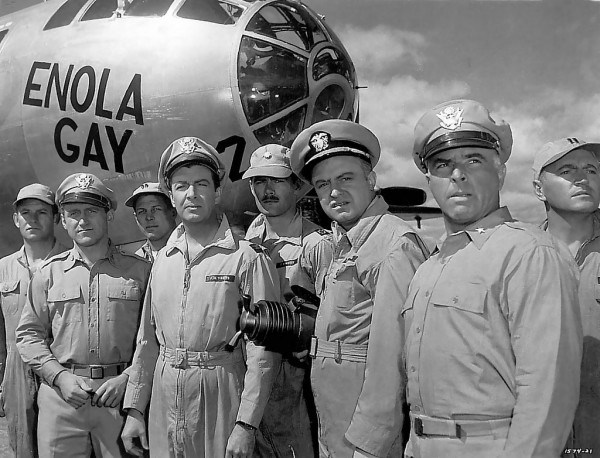
This account of the preparation to drop the first atomic bomb seems to have been pretty heavily fictionalized. There’s also some propaganda. Nevertheless, it’s quite watchable.

The story is told in flashback from the point of view of Lucey Tibbets (Eleanor Parker), who is nervously awaiting the return of her husband from a bombing mission to Japan.
Maj. Gen. Vernon Brent is looking for a good pilot to head the ultra-secret Operation Silverplate that will test the B-29 bomber which is slated to drop the atomic bomb. He finds his man in Lt. Col. Paul Tibbets (Robert Taylor), who has just been denied promotion for questioning his commanding officer. Tibbets is just barely cleared and posted to Wendover Field, Utah. He is expected to keep strict discipline over his men, who are forbidden at the point of summary shooting to enter restricted areas without a pass. Few know the actual purpose of the testing.  In all this, Tibbets is assisted, and closely watched, by Security Officer Maj. Bill Uanna (James Whitmore) the only other person who knows the details of the mission.

Uanna eventually decides that it best to move all the wives of the men to Wendover, where they can be better controlled via confinement to the base. He discourages Tibbets from bringing Lucey however. The pregnant Lucey is thus left to give birth on her own in Washington. Lucey has had no more than seven weeks with her husband during their entire five-year marriage, and after the couple’s second son is born she insists on moving to Wendover.


When she gets there, she finds that the wives and men resent her husband mightily. They figure their mission could not be anything very serious if it is headed by a mere lieutenant colonel like Tibbets and if the wives are being allowed on base. They see Tibbets as overly heavy-handed and self-important. Lucey defends her husband and then begins to change her mind. He refuses to tell her anything about anything he does and keeps ordering her to stay out of his business. The marriage is strained practically to the breaking point.

I don’t care much for Robert Taylor in his matinee idol persona, but I do like him when he plays a tough guy. Here he is definitely a grim, overly controlled tough guy and is very good. Eleanor Parker has the thankless role of asking many inane questions and refusing to accept anything at face value but she is good at it too. We are reminded over and over that the bomb’s purpose is to end the war fast and avoid massive additional casualties on both sides, but this is not too preachy or heavy handed.


Above and Beyond was nominated for Academy Awards in the categories of Best Writing, Motion Picture Story and Best Music, Scoring of a Dramatic or Comedy Picture.

Labels: action, biography, drama, Eleanor Parker, history

Thursday, June 20, 2019

Of Human Bondage (1946) [TV-PG] ****


Of Human Bondage is a slow-paced, but intriguing film, loosely based on W. Somerset Maugham's novel about how the obsessive nature of romantic love has the power to destroy us. The film opens in Paris where Paul Henreid’s character, Philip Carey, has decided to give up trying to become an artist after two years of failure, and return to London to study medicine, which will be paid for by a trust fund. He meets author Nora Nesbitt (Alexis Smith) in the first scene, and they later become good friends in London. Upon first arriving in London, Philip goes to a tea house with a fellow student and becomes wildly infatuated with a sluttish, promiscuous waitress named Mildred Rogers (Eleanor Parker), who does not return his affection and, in fact treats him with callous disdain.

While Nora tries unsuccessfully to interest Philip in her, he becomes totally obsessed with Mildred, although he know she hates him. She rejects him in favor of Emil Miller (Richard Aherne), another tea house patron, who gets her pregnant and then abandons her. Mildred then goes to Philip, who introduces her to his friend Harry Griffiths (Patric Knowles) and the two have a brief affair. Even after Mildred turns to prostitution, Philip cares for her and her baby daughter, and allows her to call herself Mrs. Philip Carey. Only after Mildred trashes his apartment and burns his last £80, leaving him destitute and unable to complete medical school does Philip realizes what a fool he has been.

The third act is the most positive one. Philip is warmly accepted into the loving family of his old friend Athelny (Edmund Gwenn) who offers to help him find a job. However, it is only after recovering from a case of pneumonia and watching Mildred die in a hospital bed following her daughter’s death that Philip is finally released from his obsession and becomes aware that Athelny’s teenage daughter Sally (Janis Paige) is in love with him. Philip proposes to Sally and the film ends happily in what might be considered a Hollywood ending.

The eternal theme of Of Human Bondage is that, if we love someone intensely enough, we should be able to overcome their indifference, disdain or outright hatred. An entire body of literature, motion pictures and television has been devoted to this theme in which either we succeed and the person returns our love, or we fail and are miserable. One example is Jane Austen’s classic Pride & Prejudice, in which Miss Elizabeth Bennett disdainfully explains to Mr. Darcy that nothing could tempt her to marry the man who has ruined, perhaps forever, the happiness of a most beloved sister. Of course we know that Darcy’s extraordinary acts of kindness and compassion eventually win over Elizabeth.

Carrying the theme one step further is the concept of knowing someone is infatuated with you and keeping them on the hook while you pursue romance elsewhere. Mildred did this to Philip in Of Human Bondage, keeping him on the hook while having other affairs.

The point is that while we know that irrational, obsessive love has the power to destroy us, there is no rational argument that can be made to dissuade us while we are in its grip. And as in the case of Philip Carey, only a life-threatening illness, Mildred Roger’s death and the fresh new love of Sally Athelny could free him.

Paul Henreid and Eleanor Parker both play their parts incredibly well. Eleanor Parker is especially good playing against type, unlike the sweet, lovely young woman she had played in many early roles, especially in The Very Thought of You (1944). In fact, Parker didn’t even look like the same person. Her ability to disappear into a role was noted by Doug McClelland in his 1989 biography of her, titled Eleanor Parker: Woman of a Thousand Faces.

Eleanor Parker (1948)

Labels: drama, Eleanor Parker

Saturday, February 8, 2014

Eleanor Parker: An Obituary by Ronald Bergan for The Guardian, 10 Dec. 2013


Versatile actor best known for her roles in The Sound of Music and Of Human Bondage


Eleanor Parker as Baroness Schraeder with Christopher Plummer as Captain Von Trapp in The Sound of Music, 1965. Photo: Allstar / 20th Century Fox / Sportsphoto


In the Hollywood of the 1940s and 50s, when typecasting was an essential constituent of stardom, Eleanor Parker, who has died aged 91, never gained the recognition she deserved, because she refused to be pigeonholed. It means I've been successful in creating the characters that I've portrayed – that I'm not just a personality who is seen in a variety of roles. Dana Andrews, her co-star in Madison Avenue (1962), called her the least heralded great actress.

The 1957 film Lizzie is almost a reflection of her career. Parker plays three separate and distinct characters hidden inside one woman – the shy, self-effacing Elizabeth; the wanton, sluttish Lizzie; and the normal, positive, well-adjusted Beth – and switches brilliantly from one to the other. Parker was always able to be convincing in these three sorts of characters. She was naive as the girl in love with Ronald Reagan in The Voice of the Turtle (1947). In it, Reagan whispers to her: You're very sweet. I don't know what goes on in that funny little head of yours, but you're very sweet.

In contrast, she was the cockney waitress Mildred Rogers in Of Human Bondage (1946), who obsesses Paul Henreid as the tormented medical student in the first remake of the Somerset Maugham story. I can't help it, he cries. Even though I've despised her, I yearned for her madly. How can there be a greater torture in this world to love and at the time condemn? She's in my blood.

In her third persona, Parker was the sophisticate, as in the role for which she is best known by a later generation, the wealthy and glamorous Viennese socialite Baroness Elsa Schraeder, love rival of Maria (Julie Andrews) for the hand of Naval Captain Georg Von Trapp (Christopher Plummer), in The Sound of Music (1965). I'm sure you'll make a very fine nun, she tells Andrews, tartly. Almost two decades before, Errol Flynn said to her in Escape Me Never (1947): I hate to repeat the obvious, but you are beautiful. There's something so cool and lovely about you; you're like edelweiss.

Parker was born in Cedarville, Ohio, the youngest of three children. Her father was a teacher of mathematics, and her family had no theatrical background. Yet, at a young age, she started performing in plays at school. Already a beauty in her teens, she studied at the Rice Summer theatre in Martha's Vineyard in Massachusetts. While she was there, an agent from 20th Century-Fox offered her a screen test, which she declined in favor of continuing her education. After she graduated from high school, she studied at the Pasadena Playhouse, where a Warner Bros scout spotted her, and she was again asked to do a screen test. She refused. Finally, in 1941, aged 19, she was ready, and called Warners, who signed her to a contract.

Her film debut was in a small part in the Flynn epic They Died with Their Boots On (1941), but she was cut from the final release print. However, she soon had a few ingénue roles. On the set of Mission to Moscow (1943), she met Lieutenant Fred Losse, a navy dentist, and they were married soon afterwards. The marriage lasted for two years.

Parker was kept busy at Warners throughout the 1940s, her first major starring part being in Between Two Worlds (1944), based on the 1924 play Outward Bound. It involves a group of passengers on a mysterious boat who find they are dead and must now face the after-life. Parker gave a sensitive portrayal of a woman who, refusing to be separated from the man she loves (Henreid), has joined him in suicide.

Parker gave another touching performance in Pride of the Marines (1945) as the girlfriend of a war hero (John Garfield) who is blinded fighting on Guadalcanal. But her greatest challenge to date was as the ruthless Mildred in Of Human Bondage (1946), not only because Bette Davis in the same role 12 years previously was still in some people's minds but because Parker had to reveal a nasty side, which she did with relish, especially in the scene where she smashes up a room with a poker. She tried to perfect her cockney accent for the role. "I got a book dealing with the dialect… and I pretty well wore it out."

Parker made another reasonably successful attempt at an English accent (this time a posh one) in The Woman in White (1948), a respectable Hollywood adaptation from the Wilkie Collins mystery.

Her stardom assured, Parker married Bert Friedlob, a would-be film producer, in 1946. Although she took some time off to have two daughters and a son, she was still fairly active on screen. She received the first of her three Oscar nominations for the wrongly convicted prisoner in Caged (1950), in which she clearly defines the gradual changes in the pregnant prisoner's character, from innocence to corruption. By the time she leaves prison, we see by her walk, her attitude, and even her voice, how life inside has affected her.

In 1950, Parker decided not to renew her contract with Warners and went freelance. Among her best roles in the 1950s was as loving wife to detective James McLeod (Kirk Douglas) in Detective Story (1951), revealing to him that she had an abortion when she was young, before they met. Variety commented that she plays the wife with a dignity and emotional depth. For this comparatively short part, Parker was again nominated for an Oscar.

At MGM, she came into her own in a number of their finest productions. In Scaramouche (1952), she is Lenore, the fiery travelling performer of whom Stewart Granger's character says: When you are placid, you are beautiful. When you're angry, you are superb! Parker was then paired with Robert Taylor in three movies, one of which was a comedy western, Many Rivers to Cross (1955). She co-starred with William Holden in John Sturges' superior western Escape From Fort Bravo (1953). Holden introduced her to her third husband, Paul Clemens, an artist, with whom she would have a son.

One of Parker's greatest roles was as the polio-afflicted Australian dramatic soprano Marjorie Lawrence in Interrupted Melody (1955). With her voice dubbed by Eileen Farrell in the opera sequences, Parker brought superb emotional power to the part. Again, she was nominated for an Oscar. There followed another string of challenging and contrasting roles: Frank Sinatra's possessive wife in The Man With the Golden Arm (1955); the unhappy wife in The Seventh Sin (1957), based on Maugham's The Painted Veil; the handsome widow angling for Sinatra in Frank Capra's A Hole in the Head (1959) and the long- suffering wife of a wealthy Texas land baron (Robert Mitchum) in Vincente Minnelli's Home from the Hill (1960).

Apart from The Sound of Music, many of Parker's films in the 1960s were inconsequential. She kept being referred to as an old lady as the agent of an over-ambitious actor (Stephen Boyd) in The Oscar (1966), which gives some indication of how Hollywood treated stars moving into middle age.

As films dried up, Parker turned to television. She appeared in a wide variety of shows, including the series Bracken's World (1969-70). One of her last appearances was in a TV movie called Dead on the Money (1991), a performance of which the New York Post wrote: Parker as a matriarch flashes so much style with just a cold calculating smile that it's a shame the veteran actress hasn't found more regular work.

Her marriage to Clemens ended in divorce in 1965; and her fourth husband, Raymond Hirsch, whom she married the following year, died in 2001. She is survived by her four children, Susan, Sharon, Richard and Paul. LINK TO THE ORIGINAL ONLINE ARTICLE

All nineteen (19) Eleanor Parker reviews in this movie review blog


Blogger's comment: One of my favorite Eleanor Parker roles is one of her earliest, as Janet Wheeler a young girl who falls in love with Army Sgt. Dave Stewart (Dennis Morgan) in the WWII love story The Very Thought Of You (1944). Here is a picture from that film:


Sadly, The Very Thought of You is not available on DVD. The only way to view it is on Turner Classic Movies or on one of the video streaming services such as Netflix. I did find the complete movie on a Russian video site, as of June 24, 2022. Here is the link.