Pages

Showing posts with label documentary. Show all posts

Thursday, May 28, 2026

Song Sung Blue (2025) [PG13] ****

A film review by James Berardinelli for ReelViews.net on Dec 18, 2025.


If you enjoy the music of Neil Diamond, then Song Sung Blue will take you to places that not even Brother Love’s Traveling Salvation Show can. But if the thought of hearing Sweet Caroline one more time sounds like an act of torture, there’s nothing I can say about this based-on-a-true-story drama that will soften the blow. It’s not about Neil Diamond, but his music imbues the film with its energy and his songs are omnipresent. He never makes an appearance, but his spirit hovers over the entire production. Song Sung Blue is the (mostly) true story of Diamond’s most devoted impersonation band, Lightning & Thunder, and when magic happens on screen, it’s the result of the chemistry between Hugh Jackman, Kate Hudson, and Diamond’s iconic music.

The first half of Song Sung Blue is frothy and lighthearted, charting the romance between the two musicians - Mike Sardina, a.k.a. Lightning (Jackman), and Claire Sardina, a.k.a. Thunder (Hudson) - which began when they first met in 1989. As their act evolves, he morphs into Neil Diamond while she does Patsy Cline. Director Craig Brewer gives us full renditions of a wide variety of Diamond’s greatest hits (with the actual singer’s voice making a cameo - albeit for a Christmas song, not one of his own melodies) as a backdrop to Mike and Claire’s deepening relationship. They eventually marry and edge toward the cusp of stardom - opening for Pearl Jam and singing along with Eddie Vedder on Forever in Blue Jeans - when tragedy strikes. 
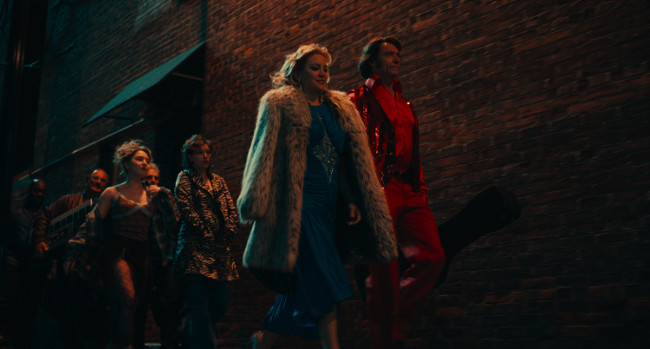
The film’s second half is more grounded. The rags-to-riches arc peters out. There are physical challenges (she’s involved in a crippling accident, he has a heart condition) and they must cope with the public’s fickle fascination with tribute acts. And, with most of Diamond’s best-known songs having been showcased during the first hour, the soundtrack becomes less pop-heavy - at least until the rousing finale. Ultimately, this structure allows Brewer to deliver a full serving of Diamond nostalgia without strip-mining the singer’s life story. It’s a far better approach and makes Song Sung Blue more accessible than either A Complete Unknown or Deliver Me from Nowhere, two recent examples of biographical overreach.

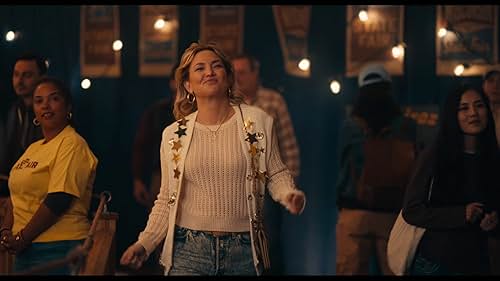
Jackman's interpretation of Lightning is solid. He’s got the singing chops and does a convincing faux-Diamond, though he has more vocal freedom since he’s not impersonating the singer directly but rather performing a second-generation version. But Jackman, for all his star power, can’t quite match Kate Hudson when it comes to lumens. This is the most magical she has been since Almost Famous, another movie about the power of music. There’s a kinship between Penny Lane and Claire - they’re soul mates of a sort - one still young and unformed, the other older and more weathered. The thing that surprised me most about Hudson’s performance was how good her voice is.
Brewer’s source material for the screenplay is a little-known 2008 documentary by Philadelphia-based filmmaker Greg Kohs, who followed the duo on and off for about eight years, assembling footage. Kohs’ Song Sung Blue did well on the film-festival circuit (it debuted at Slamdance) but never gained much traction beyond that, in part because, despite their renown in the Milwaukee area, Lightning & Thunder’s appeal never extended much beyond regional interest. Still, when Brewer watched it, he recognized the potential. 

As with most fictionalized versions of real events, Song Sung Blue doesn’t shy away from making changes to the historical record in the service of better drama and/or showmanship. The big moments in the movie are mostly reflective of real-life events, except the ending, which invents plenty of details, but the time frame is drastically condensed. Mike and Claire were connected for 17 years, but the movie shortens that to something like three or four years. (Their kids hardly seem to age.) Such quibbles, however, only matter to those who forget the mantra for movies like this: Never let the facts get in the way of a good story. And Song Sung Blue is a good story - heartwarming, uplifting, tear-jerking, and chock full of a beautiful noise. (Berardinelli's rating: 3 stars out of 4)

Labels: biography, documentary, drama, history, musical, tragedy,
IMDb 72/100
MetaCritic (critics=61, viewers=68)
RottenTomatoes (critics=77, viewers=97)
Netflix
Blu-ray
Jame Berardinelli's review (3 stars out of 4)


Saturday, May 28, 2022

David Foster: Off the Record (2019) [TV-MA] ****

A film review by Allison Rose for flickdirect.com on July 2, 2020.

David Foster is one of the greatest producers of all time without question. High praise especially when it is coming out of the mouth of former Columbia Records President Clive Davis. Of course, Foster's 47 Grammy nominations and 16 wins also speak for themselves. The numbers certainly don't lie, neither does the long list of hit songs and world-famous artists he has produced. That kind of fame could make a person egotistical and one dimensional – and Foster readily admits on camera that he is egotistical.  However, he certainly isn't one dimensional as evidenced in what both he and others say about him in the new documentary,  David Foster: Off the Record.

Certainly, unless you follow music and the upper echelon of players in that world, you may have never heard of David Foster. However, I have no doubts that you have heard at least one of the hit songs he produced.  He has worked with Earth, Wind, and Fire, Chicago, Whitney Houston, Andrea Bocelli, etc. and discovered and molded new talent including Celine Dion, Michael Bublé and Josh Groban. He produced numerous songs for films including the St. Elmo's Fire soundtrack and The Bodyguard: Original Soundtrack Album. He has been a part of the music industry for almost fifty years and has created a legacy of songs that will remain timeless.

Born in Victoria, British Columbia, to a maintenance yard superintendent father, and a homemaker mother, David was the only boy with five sisters.  At a very young age, David's mother discovered that he had perfect pitch and encouraged him to learn to play the piano.  At age thirteen, he enrolled in the University of Washington's music program and became a session musician in 1971. However, by the end of the 1970's he found his niche in producing records and since then has had a string of hits spanning over four decades.

His personal life, unfortunately, hasn't been quite as successful, as Foster himself will admit he's a runner. He is currently married to his fifth wife, Katherine McPhee, who also happens to be 34 years his junior and is even younger than a few of his five daughters from previous marriages / relationships. He does say he is happy with McPhee partially because she calls him out on his past behavior and makes him listen as she talks about her feelings until he understands that he hurt / upset her. Being from a younger, more open generation may be the trick that will keep Foster from a fifth divorce.

It's obvious from how Foster and others speak about him that he is his harshest critic and doesn't necessarily think of himself as all that successful.  He will also be the first person to tell you that he can be a real asshole and even the artists who he has had great success with have probably hated him at some point during the recording process. And while Foster will admit to the ego and the bad behavior, even having cursed out Clive Davis once, he is unwilling to explore his feelings deeper than on the shallowest level. So even though his family and friends offer a portrait of a complex man, they will be the first to tell you that they don't fully know him.

Always striving for the next obstacle to conquer, Foster has now set his sights on Broadway and is in development on three different musicals. He also is obsessed with surviving and, as his daughters tell it, he will want to be frozen and come back. He is also a kind and generous man who will most probably say yes to every charity event he can and has his own foundation that offers to cover all costs to individuals who need organ transplants.

Again, a complex man who no one truly knows, I would love to see a follow up to this documentary where he actually explores his feelings and the motivation that still drives him so hard to be successful even at 70 years old.  Writer/director Barry Avrich does the best he can to piece together a full picture of Foster utilizing some of the most famous people in music and Foster himself. However, the musical genius will let the outside world in only so far. [Allison Rose’s rating: A-]

Labels: documentary, music
IMDb 70/100

MetaCritic (critics=tbd, viewers=tbd)
RottenTomatoes (critics=78, viewers=64)


Blu-ray Hit Man: David Foster and Friends (2008)

Blu-ray Hit Man Returns: David Foster and Friends (2010)
A rather negative review from Nick Allen at rogerebert.com

Wednesday, June 17, 2020

The Social Dilemma (2020) [PG-13] ****

Link to a film review by Neil Minow for rogerebert.com on Sept. 8, 2020.

Labels: documentary, drama, Netflix
IMDb77/100 
MetaScore (critics=78, viewers=77) 
RottenTomatoes Averages (critics=74, viewers=80) 

Five tips from experts to avoid social media manipulation

Apollo 11 (2019) [G] *****

A film review by Peter Bradshaw for TheGuardian.com, 28 June 2019.

A stunning return to an incredible journey featuring previously unseen footage, this electrifying documentary marks 50 years since the first moon landing.

Sometimes gush is the only appropriate response and the amazingness never gets any less amazing. The 50-year anniversary of the Apollo 11 moon launch has now been marked by this fascinating documentary, which presents newly discovered colour footage of the build-up with the buzzcut wholesomeness of the astronauts’ good-naturedly trustful faces in close-ups, the electrifying launch, the touchdown and the return to Earth.

Somehow, it doesn’t look like something that happened 50 years ago – but rather an extraordinarily detailed futurist fantasy of what might happen in the years to come, if we could only evolve to some higher degree of verve and hope. And, to my amateur eye, the design of the Apollo rockets is incomparably superior to the NASA spacecraft that came afterwards or to anything in any sci-fi movie or TV show ever.

Then there are the gripping shots of what appears to be the spectators’ outdoor gallery in Florida, people in fantastic 60s clothes and sunglasses, many with some high-powered binoculars and cameras – some professional media, some apparently hobbyist civilians. There don’t seem to be many people there. Did they win a lottery to be at that exclusive venue?

I thrilled all over again to the images of the men on the moon, from Neil Armstrong’s stirring statement on taking his historic step and to Buzz Aldrin’s heart-stopping joke about what would happen if he absent-mindedly pulled the capsule door shut behind him on his way down the ladder. And what is maybe just as remarkable is not the journey to the moon but the journey back to Earth, and the views of the planet from space, the historically new perspective. It never gets old. Are we ever going to go back? [Bradshaw’s rating: 5 out of 5 stars]

Labels: biography, documentary, history, Sixties


Tuesday, June 16, 2020

The Biggest Little Farm (2018) [PG] ****/*****

A film review by Peter Debruge for Variety.com on Sept. 1, 2018.

With all due respect to former Vice President Al Gore, here is an inconvenient truth about most environmental documentaries: No matter how important the message, it’s kind of a drag to sit through so many alarmist lectures about how the world is going to end and what humans are doing to speed along its destruction. That’s what makes The Biggest Little Farm feel like fresh air for the soul - figuratively, of course, although audiences will almost surely breathe a little easier after tuning in to this inspirational story of one couple who made an impact by entirely rethinking their ecological footprint.

The inspirational story of how a Los Angeles couple quit the city, moved an hour north [to Moorpark, CA] of one of the most polluted metropolitan centers on Earth, and pursued their dream of growing every ingredient she could possibly want to cook with, this lead-by-example, change-the-world documentary is perhaps the closest cinema has come to the eco-philosophical musings of The Omnivore’s Dilemma author Michael Pollan, who freely challenges long-held social paradigms in his work - something this enlightening documentary does too. Both deeply personal and remarkably objective, The Biggest Little Farm offers a firsthand account of the ups and downs of married duo John Chester and Molly Chester’s trial-and-error attempt to start a biodiverse agricultural operation on land that had long since been stripped of nutrients.

As a couple, John and Molly don’t know much about farming, but their ignorance proves to be an asset to the film, which delivers a humble back-to-nature fantasy for city-living adults, while doubling as a rich classroom learning tool for younger audiences. By enticing kids with all kinds of adorable animal footage, the movie finds an intuitive way to make them care about the fate of the farm (where chickens and ducks are regularly attacked by coyotes, and gophers, snails and other pests eat away at the trees), teaching lessons the Chesters themselves observed about how the complex ecosystem could be made to regulate itself. It’s a simple way of farming. It’s just not easy, director and narrator John confesses at one point via typically eloquent voiceover.

He and Molly may seem like dilettantes at first, granola-minded city folk with no idea how to begin cultivating the land they’ve purchased, but they have wisdom and humility to engage an expert, a man named Alan York, who helps map out a plan to turn their newly acquired Apricot Lane Farms into a kind of modern-day Eden. York, in his vaguely loony-sounding way, spells out a plan that sounds far too utopian to be practical, and yet, the Chesters go along with it, taking land that could barely support even lemon and avocado trees and transforming it into a habitat for all kinds of plants and animals. The key, York believes, is reviving the soil through cover crops, coupled with a diversity of flora and fauna - to the extent that they wind up with 76 distinct varieties of stone fruits (arranged in such a way that it looks more like a botanical garden than an orchard from the air).

Directly benefiting from John Chester’s cinematography background, the otherwise casual, scrapbook-style documentary - in which old home videos and hand-drawn animation fit nicely with Jeff Beal’s folksy string score - boasts intervals of stunning, unexpectedly gorgeous wildlife footage: Drone-mounted cameras convey York’s incredible design, night vision exposes the sneaky critters who disrupt things after dark, high-frame-rate macrophotography captures each flap of a hummingbird’s wings while turning raindrops into a kind of Luftwaffe air raid for shell-shocked bugs, and so on.

The movie covers an awful lot - roughly eight years of obstacles overcome - in its judiciously short running time, introducing a handful of lovable animal characters in the process. There’s Todd, the rescue dog whose incessant barking got the Chesters evicted from their Santa Monica apartment. And there’s Emma, the very pregnant and somewhat ornery sow who blesses them with more piglets than they know how to handle (17 in her first litter alone!), later becoming a kind of mascot for the farm after her breeding days are over. Audiences are invited to connect with the material as they might a good James Herriot story, forging a kind of familiarity that includes them in problem-solving each challenge, with the result that viewers share in the triumph of each tiny success.

Though it opens with a raging California wildfire (and later frets about the worst drought the state has seen in 1,200 years), The Biggest Little Farm never mentions global warming or pollution. Instead, it’s unflappably solutions-oriented - like the Chesters themselves - focusing on what a small group of dedicated people can do to improve their immediate environment. The answer: more than anyone could have thought. And compared with the sky-is-falling tone of most eco-documentaries, that upbeat, motivational approach makes the biggest little difference. [Debruge’s rating: 4 out of 5 stars = 80%]

Labels: documentary

Jane Fonda in Five Acts (2018) [TV-14] *****

A film review by Alonso Duralde for TheWrap.com on Sept. 19, 2018

Jane Fonda in Five Acts could easily have been a 10-hour miniseries; it would take at least two hours merely to go through each of her 50 or so film performances. As a second-generation star, an outspoken activist, an entrepreneur and feminist icon, Fonda almost seems like a living metaphor for the uneasy and constantly changing post-WWII era.

If she didn’t actually exist, Jane Wagner and Lily Tomlin would have had to make her up as a character in The Search for Signs of Intelligent Life in the Universe. But she does exist, and she’s still here, and documentarian Susan Lacy (Spielberg) digs deep into Fonda’s life to create a film (for HBO) that’s an audio-visual supplement to the actress’ fascinating 2005 memoir (My Life So Far), a frank examination of Fonda’s personal evolution, and a celebration of her role in popular culture.

It’s a story of highs and lows, successes and regrets; yes, Megyn Kelly, Fonda wishes she hadn’t had plastic surgery, noting that she loves lived-in faces, like the one on her dear friend Vanessa Redgrave, after whom she named her oldest daughter. Her relationship with her daughter also counts as a regret, but it’s taken Fonda a lifetime to understand her own mother, and she hopes that it’s not too late to make up for her own mistakes.

The first four acts of the title refer to the men who guided Fonda through most of her life: her father, Henry Fonda, an iconic screen presence in his own right; her first husband, French filmmaker Roger Vadim, who guided her through her Euro-sex kitten period (and it’s a delight to hear her trill part of the Barbarella theme song); her second husband, activist Tom Hayden, whom she met during her own agitation against the Vietnam War and for the rights of indigenous peoples; her third husband, billionaire Ted Turner. The final act belongs to Fonda herself, who left her final marriage when she realized she was finally ready to guide her own destiny.

It’s a whirlwind trip through the Actors Studio, Paris, Hanoi, Beverly Hills, Three Mile Island, aerobics studios and Montana, among other stops, and we see the progression from a little girl who felt distanced from her parents (dad cheated, mom was diagnosed with what we now know as bipolar disorder), to a young ingénue who had chops but not confidence, to a vocal spokesperson for causes that had meaning for her.

Fonda admits that during the early years of her activism, she was starving and speedy, eating very little and taking Dexedrine to suppress her appetite. And even as a vocal feminist, she still spent much of her life craving validation from men.

While Jane Fonda in Five Acts in no way acts as a substitution for the book, it does allow for other voices; we hear from Hayden and Turner, friend and producer Paula Weinstein, and Fonda’s son with Tom Hayden, Troy Garity, who supplies some of the film’s most hilarious and poignant observations on its subject.

It was surprising to see, at Sundance no less, interviews with Robert Redford about his decades-long friendship and collaboration with Fonda, particularly since Weinstein calls him out at one point; according to her, it was Redford not fighting for Fonda to get the role in Legal Eagles over the younger, newer Debra Winger that made Fonda realize that her years as a big-screen leading lady were behind her.

But Lacy and Fonda aren’t afraid to go to the uncomfortable places: We see footage of angry Americans who demanded exile (or execution) for Fonda after her visit to Hanoi during the Vietnam War, and Fonda herself admits that allowing herself to be photographed with an anti-aircraft gun was a huge mistake and her one regret of the trip.

She’s also got a lot to be proud of: Besides her work as an actress and activist, she produced Coming Home and The China Syndrome and 9 to 5 to tell stories she felt were important, and it would be hard to find someone working in movies now who is similarly committed to marrying issues and entertainment. And at the age of 80, she’s still getting laughs (opposite Tomlin) on Netflix’s Grace and Frankie and showing up at Standing Rock and other hot spots to loan her spotlight to causes that need them.

The movie opens with makeup artists attaching Fonda’s false eyelashes before her appearance at a recent Golden Globes, and that scene lets us know that the film’s subject is going to let us in on pretty much everything. Hers is a lot of life to try to capture in one movie, but Jane Fonda in Five Acts certainly covers her emotional arc with thoroughness and compassion. [Duralde’s rating: 90 out of 100]

Blogger's comment: Jane Fonda's impact over the past sixty years, the lives she's touched, the headlines she's made, the movements she's been a part of, make her a little like a real-life female Forrest Gump.

Labels: biography, documentary, filmmaking, history, Robert Redford


An Inconvenient Sequel: Truth to Power (2017) [PG] ****

A film review by Scott Tafoya for RogerEbert.com, July 28, 2017.

There is no guaranteeing that you walk into a press screening with a clear head anymore. If you check your phone before walking into a movie, you're liable to read that a career senator took advantage of his office's health care plan, had a cancerous growth removed, then hobbled onto the floor of the Senate to cast a vote saying no other American deserves that treatment. How are you meant to feel anything but disgust when you then sit down to watch a movie about a lifelong environmentalist meeting staunch opposition from the planet he's trying to save? How is this movie not going to seem both more relevant and like a complete waste of everyone's time? An Inconvenient Sequel: Truth To Power (even the title screams for your attention over the horrifying din) chronicles a continuing and exhausting fight to get the world to stop destroying itself on purpose but it's also implicitly about the fight for your attention. Directors Bonni Cohen and Jon Shenk do their utmost to make Al Gore's climate studies seem like the life or death struggle they are, but they're racing a news cycle and the real-time destruction of our civil liberties, and frankly they don't want to play dirty enough to win.

We join Al Gore in 2015, looking a good deal older and tired. With his slow, awkward gait, gray hair and dad jokes, he's out of step with American politics. He's still giving his PowerPoint presentation on the effects of capitalism on the environment, with updated information. He wants to come off folksy, another Jimmy Carter selflessly giving whatever he's got to give to the country that rejected him, but his anger occasionally gets the better of him. Frankly, if he was angry more often this film might not be necessary. He's outmatched and outnumbered, and the best that can be said about him is that he hasn't given up. Of course, he's got time and money with which to continue his crusade to curb greenhouse gases. What about the rest of us?

This is a film set largely in board rooms and hotel rooms while the most powerful people in the globe talk to Gore about considering cap and trade measures to stop their populations from rampantly polluting the planet. Shenk and Cohen make a handful of calculated risks showing us who's in these rooms. A few years ago, choosing to show Cory Booker listening intently to Gore at a Senate committee meeting might have seemed like a good sign. Now that his ties to pharmaceutical companies have been exposed, his attention is just another empty promise from a bought politician. Watching Booker pretending to listen to Gore in one of many silent reaction shots the editors throw around Gore to make sure we know people are moved by his words; I just kept seeing the Jersey democrat embracing McCain on the floor after he voted to kill Obamacare. With friends like these...

Gore lopes through flooded streets and cemeteries like John Wayne in The Shootist. He's got tokens of past failures all around him, and every victory is qualified. He knows how flimsy his future is, even if he heroically refuses to stop. Watching him take in the faces of Floridian public servants smiling nervously as they admit that conditions have never been this bad and then sit and change his wet socks like a man returning from a bad day of fishing show Gore at his most human. Seeing him on a Golden cell phone dropping Elon Musk's name in the hopes of shaking people into taking him seriously show him at his most out of touch and desperate (Musk, it should be said, immediately went to work for Donald Trump when the call came, even if he retired in June). The film basically breaks even in its portraiture of Gore and his reaction to setbacks. The Paris terrorist attacks postpone a call to action broadcast. A small Texas town committing to using 100% renewable energy is undercut slightly by listening to the mayor say, leave the world in better shape than you found it and realizing he doesn't mean human rights. Hell, I was offered a 30-page press kit as I walked into this movie about the importance of recycling. How are we supposed to think this planet has a chance? The final minutes of the movie show Gore, ashen-faced, as he tries to rally his courage and strength after the 45th President is elected. His grief is eminently relatable, even if his composure is not.

The film begins and ends with arresting footage of glaciers melting. The problem is that those images have never been enough, final and incontrovertible though they may be. It's been ten years since An Inconvenient Truth first told everyone in black-and-white how doomed we are if we don't shape up. A lot of people listened, but just as many mocked him and encouraged us not to care. An Inconvenient Sequel shows the twilight of one of our most coherent champions. The glaciers have not stopped melting, every day brings worse news, but Gore has never given into despair. Despair can be paralyzing, he says at one point, accidentally but appropriately sounding like Kyle MacLachlan in Dune (a story of a man trying to save an arid planet from corpulent fascists). Despair is all we've got some days, and try though it might, this film can't curb it. The best An Inconvenient Sequel can offer is the formidable image of Gore, nearly 70, refusing to stand down. It's inspiring, but even the filmmakers have to know it's not enough. I was moved by the movie, and then I stepped outside and looked at my phone. [Tafoya’s rating: 2.5 out of 4 stars = 63%]

Labels: climate-change, disaster, documentary, environment, prophetic


Whitney: Can I Be Me (2017) [NR] ****

A film review by Richard Roeper for chicagosuntimes.com, August 9, 2017.

For all the beautiful and lovely music Whitney Houston gave us, for all those soaring notes she hit, the documentary Whitney: Can I Be Me is a nearly joyless and melancholy piece of work. Because we know how it ends. Because we know about Houston’s lifetime of troubles, from the tumultuous relationships to the family fractures to the years spent battling addictions.

Directed by Nick Broomfield, architect of sometimes salacious but admittedly very watchable documentaries about Kurt Cobain and Courtney Love; Biggie and Tupac; Hollywood madam Heidi Fleiss, and serial killer Aileen Wuornos, among others, Whitney: Can I Be Me begins at the end: a 911 call from the Beverly Hilton in February, 2012, after Houston was found dead in a bathtub at the age of 48. The news of Whitney’s death was stunning, but not shocking. Tragic, but not completely unexpected. By then, everybody knew about Houston’s demons.

Broomfield circles back to Houston’s childhood in New Jersey, giving us archival footage of an adolescent Whitney singing in church and telling the story of how she was guided to early stardom by her domineering mother, singer Cissy Houston, and then Clive Davis, the controlling mastermind of Arista Records.

It was Davis who steered Houston away from R&B and soul and toward a more mainstream sound, designed to appeal the broadest possible audience. For perhaps the first time but certainly not the last time in her career, Whitney asked, [But] can I be me?

Some of the most compelling scenes include previously unseen concert and backstage footage from Houston’s 1999 European tour, which would become her last major worldwide venture of such scope. Shot by the German director Rudi Dolezal for a concert documentary that was never finished, the footage shows a sweat-drenched Houston hitting the highest, nearly unreachable notes on I Will Always Love You, bonding with her band and backup singers backstage - and navigating her complicated relationships with her husband Bobby Brown and her longtime assistant and best friend Robyn Crawford.

It has long been maintained Crawford and Houston were lovers. Can I Be Me addresses the rumors but does not answer them definitively. What we know for sure is Brown and Crawford loathed one another, and Whitney was often caught in the middle. (Neither Brown nor Crawford agreed to be interviewed for the documentary.)

One associate of Houston’s says she died of a broken heart. Others say she was given a gift from God and didn’t properly treasure it. Some point to the toxic relationship with Brown, in which the two enabled one another. (Houston brought drug abuse to the table. Brown introduced alcohol into the relationship. Each indulged in the other’s addiction, making for a volatile and destructive mix.)

Perhaps the most heartbreaking scene in the film shows Houston with her then 6-year-old daughter Bobbi Kristina Brown onstage. Bobbi Kristina looks like she doesn’t want to be there. Whitney looks like she never wants to leave the stage, because by then the stage was the only place she could hide from all the madness dominating her personal life. [Roeper’s rating: 3 out of 4 stars]

Labels: biography, documentary, music, tragedy