Pages

Showing posts with label comedy. Show all posts

Sunday, June 28, 2026

Wild Mountain Thyme (2020) [PG-13] ***

A film review by Max Geo for observer.com on Dec 11, 2020.


In a year that has left the world in desperate need of a flight from reality, Wild Mountain Thyme - the long-awaited romantic comedy from Oscar, Tony and Pulitzer Prize-winning writer and director John Patrick Shanley - is a welcome, albeit unconventional, love story that will likely delight more nostalgic theatergoers than hard-bitten critics.
 
Set in the beauty of the lush Irish countryside, the film, which is based on Shanley’s hit Broadway play Outside Mullingar, stars Emily Blunt and Jamie Dornan as two star-crossed lovers whose neighboring families are caught up in a bizarre feud over a strip of land that separates their two farms. Blunt plays Rosemary Muldoon, a passionate and headstrong farmer who has an unshakeable yearning for her off-kilter neighbor, Anthony Reilly (Dornan). Unfortunately for Rosemary, it’s an enduring love that has gone unrequited - or at least unrealized - by Anthony for nearly three decades.

Dornan’s Anthony is a far cry from his days as billionaire Christian Grey in the Fifty Shades franchise. An eccentric introvert, Anthony’s isolated upbringing in the heart of Ireland leaves him with a sense of self that is both unworldly and unmistakably human. After years of playing dark, brooding men in leading roles, Dornan is able to tap into a different, and perhaps more authentic, side of himself to shine as an endearingly awkward farmer in his mid-30s whose greatest fears - including a belief that he is inherently unlovable after a failed childhood romance - will ultimately transform his melancholic life.

After a series of flashbacks that reveal the origins of Rosemary’s independence and steadfast love for Anthony, the film begins on a rainy night after the funeral of Rosemary’s stubborn, crow-shooting father, Chris Muldoon (Don Wycherley). It is in a candid conversation about death and inheritance with his widowed father, Tony (played by the legendary Christopher Walken), and Rosemary’s newly-widowed mother, Aoife (a role reprised by original Broadway cast member Dearbhla Molloy), that Anthony discovers that he does not stand to take over the Reilly family farm. Despite his years of maintaining and modernizing the property, a blindsided Anthony later learns that his hypercritical father is planning to sell the farm out from under him to his wealthy American cousin, Adam (played by Mad Men’s Jon Hamm), who wants to find a bride and settle down in Ireland.

There is just one complication: Nearly three decades ago, Tony sold a certain strip of land to the departed Muldoon, a patch that runs right through the access route to the Reilly farm, that would make a sale - even to his naïve nephew - more difficult. It’s a plot of land that is inherited not by Chris’s widow, Aoife, but rather by his daughter, Rosemary, who has been smoking in the pouring rain while the trio chats away in the kitchen.

Despite holding a petty grudge against Anthony for pushing her down as a child, Rosemary is visibly disconcerted by the very thought of Tony handing his farm down to Anthony’s cousin. In an explosive exchange with Tony at the contested parcel, which leaves her quick-witted mother smirking with pride, the audience is given their first major clue that lying underneath Rosemary’s iron-clad exterior is a deep-rooted longing for the boy next door - and a Herculean amount of patience.

While she might not have the perfect Irish accent, a fact made abundantly clear by the Irish side of social media, Blunt’s fiery portrayal of Rosemary makes her a force of nature. In the same breath, she is able to masterfully portray the emotional agony that sends Rosemary into a deep state of exasperated desperation. While Rosemary might be a fiercely independent farmer who knows exactly what she wants, Blunt’s nuanced approach illustrates that she is still a hopeless romantic who longs for the basic human connection that has eluded the better part of the world this year.

Anyone who has ever seen a romantic comedy can predict the resolution of Wild Mountain Thyme, but it’s the anticipation - and the eventual execution - of the final showdown that makes the denouement so satisfying. From the time that we first see them standing together in the rain, Blunt and Dornan have a beautiful, natural chemistry that seems to build as tensions rise between their characters. But given that Rosemary and Anthony are both stubborn to the core, it still takes another year before they can break their ridiculous stalemate, with the help of a dark secret from Anthony that is so ludicrous that it will stop any movie know-it-all dead in their tracks.


Nevertheless, it’s a year that is well-spent for Anthony, who is given the chance to reconcile with his aging father in a moving scene from cinematographer Stephen Goldblatt that highlights the complicated relationships between fathers and sons and makes the film worth watching alone. Elevated by the stunning soundtrack of composer Amelia Warner, Shanley’s screenplay seems to take on a fairy-tale charm with its colorful and lyrical dialogue, both in playful and somber scenes, but it must be said that this unique piece, much like his Oscar-winning Moonstruck, will not be everyone’s cup of tea.

While Wild Mountain Thyme might be far from a perfect depiction of the intricacies of central Ireland, it is, at its core, the fabled and beautifully shot love story of two witty and eccentric childhood sweethearts that will have the ability to warm the coldest of hearts this holiday season. [Geo's rating: 3 out of 4 stars]

Labels: comedy, drama, Emily Blunt, romance
IMDb 58/100
MetaCritic (critics=42, viewers=55)
RottenTomatoes Averages (critics=46, viewers=62)
DVD
Max Geo's 3 out of 4 star review
Netflix


Friday, May 8, 2026

Barefoot in the Park (1967) [G] ****

 An uncredited review published in Time magazine, June 9, 1967

Barefoot in the Park is one of the few plays to be reincarnated on-screen while playing on the Broadway stage. Happily, it loses little in transition.

Essentially, author Neil Simon has taken a plot as bland as a potato, sliced it into thin bits—and made it as hard to resist as potato chips. Two spoiled young honeymooners (Robert Redford and Jane Fonda) settle into a six-flight walk-up apartment in Greenwich Village. In Ogden Nash's phrase, a little incompatibility is the spice of life, particularly if he has income and she is pattable. And so it proves in Barefoot. The puny pad she has chosen has no heat, no bathtub, and a hole in the skylight.

When Redford remonstrates, Fonda starts sniping - only to agree to a cease-fire when her middle-class mother (Mildred Natwick) arrives. Before long, they are joined by a randy reprobate of a neighbor (Charles Boyer) known as the Bluebeard of Tenth Street. Bluebeard leads the way to an Albanian hash house that serves such delicacies as black salad and ouzo. The foursome eventually wend their way home, whereupon Fonda and Redford drunkenly declare all-out war.

She is a nut, he declares, whose idea of fun is walking barefoot in the park in 17-degree weather. Your laundry arrived, she simpers. They stuffed your shirts beautifully. But if the couple's happiness seems as short as their tempers, their misery is just as temporary. By the final reel they are neck and neck in a race for the bed, and even Natwick and Boyer have found something in common - stomach trouble.

The film is not an original-cast production. Sly substitutions have been made, notably Fonda for Broadway's Elizabeth Ashley. Jane's performance is the best of her career: a clever caricature of a sex kitten who can purr or scratch with equal intensity. Among the tastiest leftovers from the stage are Redford as the harassed husband and Mildred Natwick, skittering on the edge of hysteria as she articulates the film's philosophy to her daughter: Make him feel important. If you do that, you'll have a happy and wonderful marriage, like two out of every ten couples.

Labels: comedy, Robert Redford, romance
IMDb 70/100
MetaCritic (critics=55, viewers=68)
RottenTomatoes (critics=81, viewers=79)
Blu-ray

Blogger's comments: Barefoot in the Park is notable for another reason. When Redford asks something like: We're going to be doing this for the next fifty years? and Fonda replies: We're only going to be married for fifty years? it reminded me that exactly half a century later they would star together in Our Souls at Night (2017) and she would say in an interview that she had fallen in love with him so deeply that she would look into his eyes and forget her lines. And I can see that passion in the intensity of her performance. 

And there's something else that most viewers will not see. The opening scene of the film is at the Plaza Hotel in New York City, where they get out of their horse-drawn carriage and enter the hotel to begin their week-long honeymoon. The same Plaza Hotel setting is used six years later in the final scene of the Redford - Streisand film The Way We Were (1973).

Arriving at the Plaza Hotel, Barefoot in the Park


Final Scene from The Way We Were


Friday, January 23, 2026

Alfie (2004) [R] ***

A film review by James Berardinelli for ReelViews.net


For me, there's a litmus test for remakes: are they sufficiently different and/or interesting in their own right that their existence is easily defended? Admittedly, it's a lot easier to argue the case for a new version of Alfie (to today's audiences, the 1966 original could be considered obscure) than Psycho, but somehow the film doesn't work as well as it should. The problem is one of context. Although director/screenwriter Charles Shyer changes the setting from '60s London to '00s New York, he otherwise stays relatively faithful to the approach (if not the specific text) of Lewis Gilbert's version. The first Alfie occurred during the birth pains of the sexual revolution, when one-night stands were the expected norm for virile young men. Applying that mindset to the AIDS era, when one-night stands can become games of Russian roulette, doesn't work. Cosmetic updates to the title character can't change the fact that Alfie is a relic lifted from one era and dropped into another one.

Scooting aroundHaving said that, however, it is necessary to point out that Jude Law does a solid job, although he's essaying a person who generates limited audience sympathy. Law does not attempt to ape Michael Caine, but makes the character his own. (Along with The Ipcress File, Alfie is the film that cemented Caine's reputation. It's odd that he doesn't have a cameo in this remake - maybe he learned a lesson from Get Carter.) Like Caine, Law seems comfortable breaking the fourth wall and addressing the audience directly. When Gilbert used the device some 40 years ago, it was fresh, but, by 2004, it is clichéd. Not to mention that it emphasizes Alfie's smugness and narcissism, making him less likable.

Shyer has never found a remake he didn't like. His recent resume is dotted with re-dos. He was involved in new versions of Father of the Bride, Father's Little Dividend (called Father of the Bride Part II so as to not confuse audiences), Once Upon a Crime..., and The Parent Trap. None of these films showed remarkable qualities, so anyone with a degree of familiarity with Shyer's career should have known about what to expect from Alfie. The original Alfie came out at precisely the right time. The remake is 40 years too late.

The storyline is one of simple karma. Throughout the first half of the film, Alfie plays the perfect womanizer, a fashion whore who goes after every pretty FBB (face, boobs, bum) he sees, without concern for the consequences. These include Dorie (Jane Krakowski), a lonely wife whose husband hasn't touched her in five months; Lonette (Nia Long), his best friend's girl; Julie (Marisa Tomei), his quasi-girlfriend who has a son Alfie adores; Nikki (Sienna Miller), who makes a convenient companion on the second loneliest night of the year (Christmas Eve); and Liz (Susan Sarandon), a confident older woman who knows what she likes. Shortly after the midpoint, the tables are turned, and Alfie discovers some hard truths about how he has been treating the opposite sex. By the end of the movie, he hasn't found happiness, but he has discovered humility. During the closing scenes, one can imagine that Charles Chaplin's Smile was written for this character (Smile, though your heart is breaking…).

What's it all about? Cleavage.Aside from Law, there aren't any standout performances. None of the women have large roles, and even the best of them (Sarandon, Miller) struggle to escape the stereotype confines in which the script pigeonholes them. As Marlon, Alfie's best/only friend, Omar Epps doesn't fare any better. Epps has one memorable moment, and it's more his facial expression than his words that make it work. Tomei is surprisingly subdued, and wears a hairdo that one could argue is paying homage to the era in which the original Alfie debuted.

Having expressed some negative thoughts about the film, however, I have to admit that Alfie grew on me. Once we get past all the smart-aleck asides offered up by the title character, and begin to get to know the real Alfie, the movie becomes more engaging. Certain individual scenes are surprisingly effective, such as Alfie's bathroom chat with an older gentlemen (who advises: Find someone to love and live every day as if it was your last), his farewell to Nikki, and the result when he finally brings flowers to a woman. Alfie shouldn't have a happy ending, and it doesn't. Thankfully, Shyer doesn't force something into the film that wouldn't fit.

Alfie has the requisite moments of pathos and humor that allow the movie to be enjoyed on some level, even if the main character occasionally feels like a walking, talking anachronism. Those who demand a sympathetic character to appreciate a film may not have a favorable feeling. I'm more open to ambiguous protagonists and anti-heroes, so this aspect didn't bother me. Still, this is a mixed bag - passable entertainment made palatable largely by Law, but the question of Why? more than What's it all about? still lingers where this remake is concerned. [Berardinelli's rating: 2.5 out of 4 stars = 62%]

Blogger's observation: Alfie's self-assessment in the final scene goes like this:

I used to think I had the best end of the deal. What have I got? Really? Some money in my pocket. Some nice threads. Fancy car at my disposal. And I'm single. Yeah. Unattached. Free as a bird. I don't depend on nobody. Nobody depends on me. My life's my own. But I don't have peace of mind. And if you don't have that, you've got nothing.

Labels: comedy, drama, romance
IMDb 62/100
MetaCritic (critics=49, viewers=59)
RottenTomatoes (critics=48, viewers=51)
DVD


Love Again (2023) [PG-13] ***

 A film review by Brian Orndorf for Blu-ray.com on May 5, 2023.


Writer/director Jim Strouse made a positive impression with his last two features, guiding 2015’s People Places Things and 2017’s The Incredible Jessica James to big hearts and sizable laughs, positioning him as a helmer to watch, especially with smaller, more human tales of love and confusion. However, indie film work has its professional limitations, with Strouse trying on a studio project for size with Love Again, which is a remake of a 2016 German picture, detailing the experiences of two strangers who find each other through text-based confessions, leading to a romance that’s built on a big issue of trust. Love Again isn’t an event movie, but it does have some scale thanks to a supporting turn from Celine Dion, and the material plays to Strouse’s strengths with its presentation of wounded souls. Typical romantic comedy shallowness isn’t completely avoided, but the material makes a serviceable attempt to highlight human concerns, and chemistry with leads Priyanka Chopra Jonas and Sam Heughan is pleasant enough to lift the endeavor up when it needs it.

Mira (Priyanka Chopra Jonas) is a children’s book author struggling to come up with an idea for her latest project, still lost in the grieving process two years after the death of her boyfriend, John (Arinze Kene). She lives with her sister, Suzy (Sofia Barclay), still reminded of the man she loved, trying to work through her thoughts by texting his number, sharing her feelings with the void. Rob (Sam Heughan) is a newspaper music critic struggling to get over being dumped by his longtime girlfriend, fighting to focus on an assignment to interview Celine Dion. He receives a new phone from his boss, with the number transferred from John’s old account, allowing Rob to receive Mira’s intimate messages of sadness. Rob eventually meets Mira at the opera, sparking an immediate attraction to the woman, and their dates turn into a relationship, though the writer can’t bear to tell his love about the messages, complicating their union.


While Rob’s heartbreak isn’t immediately detailed, Mira’s sudden loss serves as the introductory scene of Love Again, with John looking to win his girlfriend over with a personal visit before work, gifting her a bag of Skittles as a token of his affection (there’s a sizable amount of product placement in the feature). They soon separate, with John killed by a drunk driver right in front of Mira, which understandably sends her into a downward spiral of grief. The story picks up two years later, with the woman unable to break free of her sadness, still clinging to John’s belongings as a way to stay in contact with his smell, finally coaxed out of the shadows by Suzy. Love Again examines Mira’s return to life, forced to perform as a writer by her publisher, while a possible return to the dating scene is considered, though she doesn’t want anything to do with dating apps, striking out with a handsy suitor (Nick Jonas).


Mira purges her feelings into texts for John’s number, confessing her fears and sadness, unaware that these messages are being received by Rob, who’s also managing heartbreak, but more pressing professional matters are found with his mission to chat with Dion, who appears in the film as a Yoda-type figure wise in the ways of love and loss. Love Again settles into sitcom-y territory with the mix-up, but Strouse fights plasticized plotting as much as possible, giving the feature over to the leads, who manage to create semi-real people in the face of ridiculousness. There’s some degree of warmth in Love Again, but it’s challenged by formula, with Rob assigned two pals at work to act as his guide into technology and human contact, giving the picture a few stabs at humor it doesn’t really need.


Rob can’t believe what’s happening with Mira, with the pair growing closer, sharing protected parts of their lives and bits of basketball-themed philosophy. He’s in possession of knowledge that will surely destroy his new relationship, and Love Again lines up with the usual in nonsense communication issues, but Strouse handles it all to the best of his ability. He has to make something accessible and familiar for fans of the subgenre, which isn’t welcome, but Love Again carries initial care for profound situations of pain, finding ways to address the reality of the mourning process without completely losing itself to cliché. [Orndorf's rating: 3 stars out of 5]

Labels: comedy, drama, romance
IMDb 5.9/10
MetaCritic (critics=32, viewers=53)
RottenTomatoes (critics=30, viewers=91)
Blu-ray
Brian Orndorf's original review
Blu-ray review by Kenneth Brown (3/5 stars)


Saturday, December 13, 2025

Jay Kelly (2025) [R] ****

A film review by Brian Tallerico for RogerEbert.com on Dec. 4, 2025.


Noah Baumbach’s Jay Kelly is a study of a man in the middle of a personality crisis who worries that he doesn’t have one, only the personalities which fictional characters and the glory of celebrity have granted him. It’s a deeply meta film, a movie that uses as its foundation what we know of its star, George Clooney, one of the few leading men who can coexist in the same frame with images of legends like Paul Newman and Marcello Mastroianni and we don’t immediately reject the idea. Clooney knows a thing or two about not being able to walk through public spaces without being mobbed and, one presumes, about how much the life of an actor pulls people away from other things in their lives, like friends and family.

For a story of a guy who’s willing to get messy for the first time in years, it’s an overly clean piece of screenwriting, one that too often lets its A-list star play ideas instead of a character. But there’s enough to like here to forgive a film whose ambition exceeds its reach, both in some of those ideas and a flawless supporting cast, especially another fantastic turn from Adam Sandler.

Jay Kelly opens with its titular character (Clooney) finishing his latest production, as Baumbach and his co-writer Emily Mortimer (who also has a small role) wonderfully sketch their two male leads through their work. Kelly seems to be tapping into something true as he films the emotional death scene of his character. Still, there’s a common actorly insecurity underneath, especially as he asks his director for reassurance about whether they should try again. Meanwhile, Jay’s manager Ron (Sandler) uses the same tone to comfort Jay that we just heard him using with his daughter on the phone. For Ron, Jay is almost like another child, someone whose needs are prioritized over his own, and whose insecurities need to be assuaged. He might even be Ron’s favorite child. He’s the one who pays the bills.

A series of events rocks Jay Kelly’s pattern of movie shoots and red carpets (and, by extension, Ron’s). First, Jay discovers that his daughter, Daisy (Grace Edwards), is leaving for the summer, the one he thought they would spend together. She’s off to Northern Italy, where, coincidentally, an arts festival is being held at which Jay was supposed to receive a tribute. Jay will be on his own, and we discover later that he has a borderline-estranged relationship with his older daughter, Jessica (Riley Keough, so phenomenal in just a few scenes). He’s going to be alone, although, in a funny repeated bit in which Jay is handed drinks by silent assistants after insisting he’s always alone, the celebrity alone is different than yours or mine.

A bigger shift in Jay’s personality starts to quake when he learns that the director who gave him his break, Peter Schneider (Jim Broadbent), has died. Jay remembers a Schneider at his home not long ago, practically begging to put his favorite actor’s name on his project to get funding. Jay declined. He never gave the man he owes much of his life his last shot.

Finally, Jay runs into an old friend at Peter’s funeral named Timothy (Billy Crudup, excellent as always in just one extended scene). The two go out for a drink, and what starts as playful memories of their twenties and what might have been gets dark when Timothy admits that he hates Jay. After all, Jay took his life. If Timothy hadn’t brought Jay to an audition in front of Peter Schneider, he might have gotten the job. The night ends in a flurry of bad, half-drunk choices that really send Jay spiraling. He’s not doing the next movie, he’s going to Italy to find his daughter and accept the tribute, and Ron and his publicist Liz (Laura Dern) are just going to have to keep up with him. If they can.

The first act of Jay Kelly, in which these emotional figures from Jay’s past descend on him like Scrooge’s ghosts, hints at a darker movie than the midsection, one in which Kelly travels across Italy by train to reunite with his daughter and the common people. Clooney captures the joy of an actor fascinated by those who celebrity has cordoned off from him. But the writing here dips into some odd valleys regarding his fellow travelers, including an aside about a purse theft that exists solely as a plot crutch later in the film. It’s a bit of a problem when a movie about a celebrity trying to meet real people and discover the true core inside him starts to feel calculated and manufactured. And that tone starts to infiltrate other aspects of the screenwriting, including characters played by Stacy Keach (Jay’s dad) and Patrick Wilson (Ron’s #2 client), who seem to exist solely as signposts for Jay’s journey of the soul.

The sense that too few of the supporting characters have been fleshed out is part of what makes Jay Kelly often feel a little too neat. It’s a film that works in part because it’s an actor we know looking at the traps of celebrity and the difficulty of playing yourself instead of a scripted character, but it also feels remarkably calculated. Part of that is intentional to make the undeniably powerful final lines hit with more force, but a lot of Jay Kelly feels as rehearsed as a celebrity’s sound bites at a junket. Even Nicholas Brittell’s lovely score and Linus Sandgren’s fluid cinematography add to the film’s often sterile tone when it should be a movie that’s rougher around the edges.

Thank the Celebrity God, then, for Adam Sandler, who steals the movie by feeling the most truthful. I would never purport to know Sandler’s complex emotional relationship with fame or with people in his life, but he understands, either through observation or experience, what it means to devote your life to someone in a power imbalance. Are Ron and Jay friends? They’ve been through it all together. But Jay pays Ron, and he’s not afraid to remind him of that. Doesn’t that automatically throw it off? Sandler perfectly embodies a guy who’s been hit by Jay’s emotional shrapnel over and over again. Every time Jay missed a school concert for a project, Ron probably did too. Rons don’t get tributes. It’s just another example of how good Sandler can be in the right material, his best performance since Uncut Gems (and a reminder of how good he was in Baumbach’s The Meyerowitz Stories).

There are several lines about the transparency of fame that pepper Jay Kelly. Peter’s son says at his funeral, My dad was never there. It’s something Jay’s daughters would say too, especially his older one. In one of the film’s most powerful emotional chapters, Jessica speaks of the pain of seeing her dad playing a loving parent on screen despite never feeling that at home. So does Jay find himself? Luckily, Baumbach, Mortimer, and Clooney refuse to give Jay Kelly too much of a redemption arc, ending on a note that feels more emotionally true than manipulative. It lands with a powerful sentiment that so many of us will feel when the end is near. If we’re as lucky as Jay Kelly. (Tallerico's rating: 3 out of 4 stars)

Labels: comedy, drama, filmmaking
IMDb 66/100
MetaCritic (critics=67, viewers=55)
RottenTomatoes (critics=76, viewers=87)
Netflix
Tallerico's original review

If you enjoy the film Jay Kelly I invite you to watch the 51-minute Netflix documentary The Making of Jay Kelly. Writer / director Noah Baumbach, George Clooney, Adam Sandler, Laura Dern, co-writer Emily Mortimer and others share behind-the-scenes insights from the first shot through the final line.
As you watch it, you will appreciate that there were no special effects used in the film; everything was physical, constructed on movie sets: Jay Kelly's home, the private jet, the railroad car, all of it was physical. And the music was recorded on analog tape. None of it is digital.
But the most remarkable thing is to appreciate that while this is Jay Kelly's reality, it is also George Clooney's reality, and the viewer gains a new appreciation for what it means to be a movie star - the rewards and also the sacrifices.


Tuesday, December 2, 2025

Champagne Problems (2025) [TV-14] ***/****

A film review by Brian Orndorf for blu-ray.com on Nov. 19, 2025.


Once the director of Daredevil and Ghost Rider, Mark Steven Johnson is on a different career path these days. He’s in the business of making romantic comedies for streaming services, trying his luck with Hallmark Channel-style offerings of mild drama and feels that provide viewers with a sense of escapism as beautiful performers work with a screenplay of no particular emotional emphasis. It’s vanilla stuff, but Johnson locates a degree of charm in Champagne Problems, hitting all the highlights of fantasy as the main character faces a crisis of the heart and business ties during a holiday work trip to France. Johnson (who is also the writer) has no love for originality, but he finds some help from the actors, who maintain mild warmth and a sense of humor while the feature strives to conjure as much coziness as possible.

Sydney (Minka Kelly) is an employee at The Roth Group, working on acquisitions for the corporation, often competing with colleague Ryan (Xavier Samuel). Impressing her boss with her diligence, Sydney is sent to Paris to help negotiate a deal with Chateau Cassell, a champagne house looking to sell to a prepared buyer. Only in the country for a few days, Sydney is encouraged by her sister (Maeve Courtier-Lilley) to experience a little French magic, inspiring her to visit a bookstore, where she meets Henri (Tom Wozniczka), who’s happy to show the American a different side of Paris. Flirtations turn into a night of passion, but Sydney has a job to do, meeting Chateau Cassell owner Hugo (Thibault De Montalembert), and facing competition from business rivals Roberto (Sean Amsing), Otto (Flula Borg), and Brigitte (Astrid Whettnall). Prepared to make her best impression, endeavoring to win over Hugo and his demands for his business, Sydney is hit with a dose of reality when she learns Henri is actually Hugo’s son, and he has no patience for corporate predators.

Sydney isn’t an office terminator. She’s attempting to impress her boss and carefully handle acquisitions for the company, keeping her an approachable character. She’s also a supportive sister and continues to mourn the loss of her mother, who had her share of unrealized dreams. Kelly is particularly good at projecting warmth, and offers steady, reasonably sensitive work in Champagne Problems, which soon sends Sydney to France to prove her negotiation abilities, though she’s entering a country where she doesn’t even speak the language. The central meet cute in Champagne Problems occurs in a quaint bookstore, finding Sydney and Henri sparking immediate attraction, which turns into a night on the town, fueled by cups of hot wine and bonding over deceased mothers. Talk evolves into sex, but Johnson is sticking with his rom-com playbook, quickly disrupting post-coital bliss with business reality, sending Sydney to the glorious Chateau Cassell, where she’s forced to figure out what’s coming for her in terms of competition.

Comedic support is provided by other business reps, finding Roberto a fun-loving, flamboyant man who loves to drink and connect with others. Brigitte is serious about the mission, locating a bond with Hugo she tries to turn into a deal. And Otto is a nervous German sharing tales from his dark childhood, which gives Borg, a gifted comedian, chances to shine, especially when the character shares the legend of Krampus with the group. Champagne Problems sets up conflict between Sydney and Henri, who can’t trust the American once he learns who she is, and a challenge is supplied in presentations, putting the buyers in pitch positions that bring great stress to them. High jinks are minimal, extending to Brigitte pushing a cheese dinner on Sydney, who’s lactose intolerant. Winery challenges are more enjoyable, watching the gang compete in games of vine pruning and riddling, and there’s a debate about Die Hard to really sell the holiday spirit of the picture.

There’s a romance to sell in Champagne Problems, and Kelly and Wozniczka have decent chemistry, generating tenderness that’s challenged by outside interests. Johnson also works in father and son issues between Henri and Hugo, which helps to expand gentleness and concern. There’s seasonal immersion as well, following the characters as they visit Christmas markets and devour treats. Champagne Problems is easy on the senses and nicely acted, but Johnson can’t resist formulaic happenings, dragging the feature to a close with the same old moves seen in hundreds, if not thousands of these pictures. He goes for plasticized fantasy instead of trusting the moderate intimacy and light humor that’s worked for the first two acts of the movie. [Orndorf's rating: 6 stars out of 10]

Blogger's comment: A "champagne problem" describes a minor, trivial issue arising from affluence, privilege, or good fortune, like choosing between luxury cars or too many vacation options, contrasting with significant "real world problems". It's a problem where all choices are positive or desirable, often an annoyance of abundance rather than a genuine hardship, though sometimes these problems can feel more significant to the person experiencing them, as highlighted in Taylor Swift's song 'Champagne Problems'.

Labels: Christmas, comedy, Paris, romance
IMDb 60/100
MetaCritic (critics=50, viewers=tbd) 
RottenTomatoes (critics=72, viewers=65)
Orndorf's original review with pictures


A Walk in the Woods (2015) [R] ***

A film review by James Berardinelli for ReelViews.net on Sept. 4, 2015.


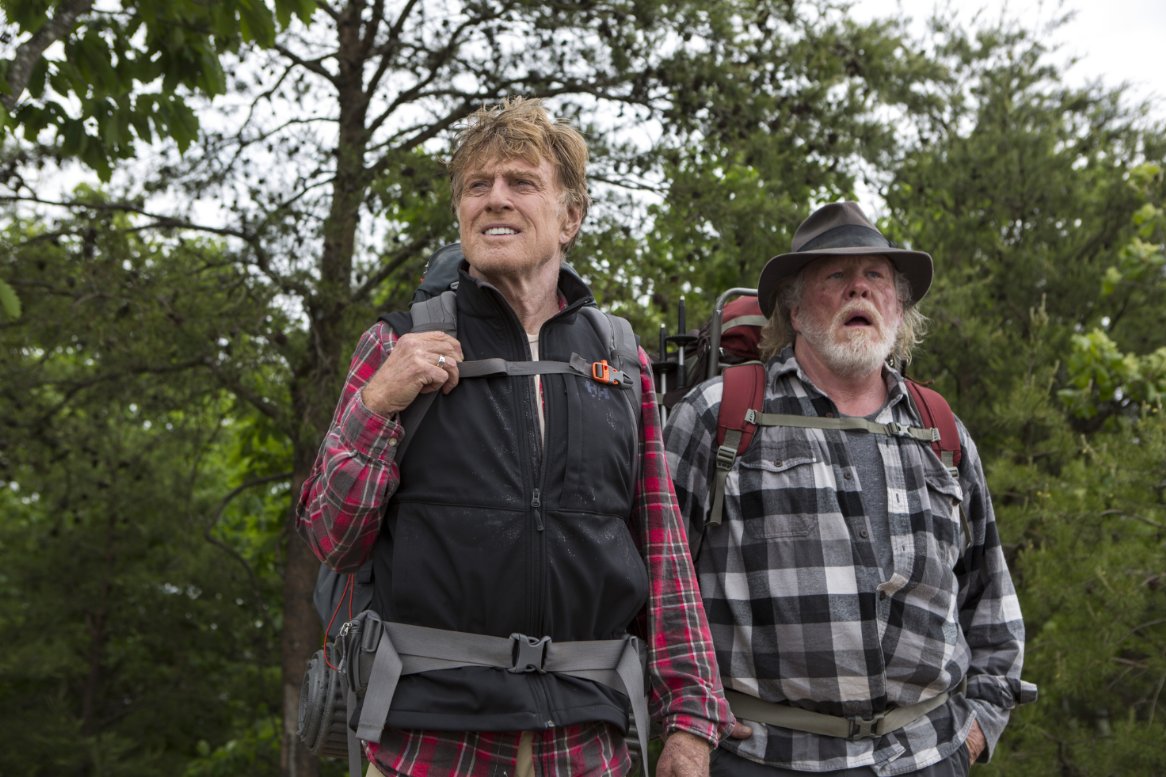
A couple of old guys taking a walk on the Appalachian Trail - it doesn't sound like a winning motion picture formula and, as it turns out, it isn't. Like all road trip movies, the success (or lack thereof) of A Walk in the Woods relies heavily on the chemistry between the two leads, in this case Robert Redford and Nick Nolte. And, although both men do a reasonable job inhabiting their characters, as an odd couple, they don't click. There's something missing. Maybe if this had been made 20 years ago by Walter Matthau and Jack Lemmon. Or even 10 years ago, as originally planned, with Redford and Paul Newman…

A Walk in the Woods is surprisingly funny at times but, like many comedies, it runs out of steam about halfway through. Some of the humor is unexpectedly lowbrow, at least insofar as anything with Redford could be considered lowbrow. The iconic actor generally takes the high road, leaving the crass comments and physical slapstick to Nolte. There are some clever, witty one-liners. I found myself laughing more than once or twice but the jokes, like the movie as a whole, lack staying power. The first half is significantly more enjoyable than the second.


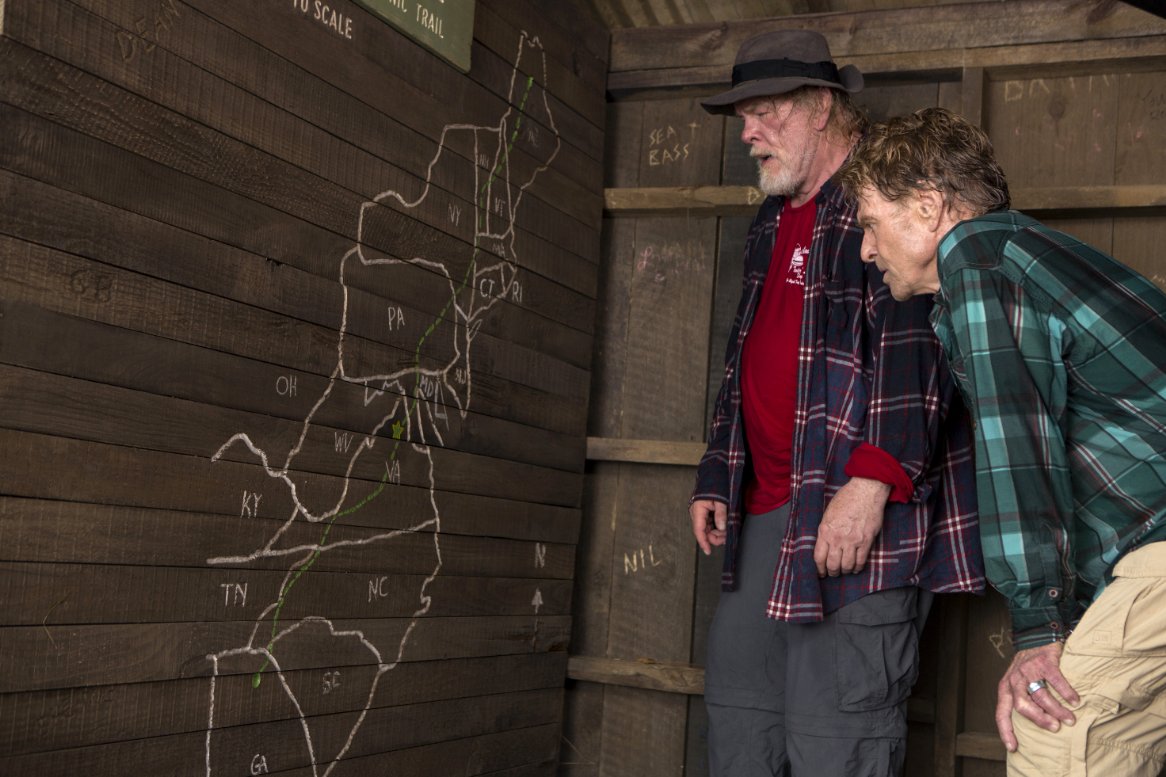
The narrative is more concerned with the predictable mismatched buddies interaction between Redford's Bill Bryson and Nolte's Stephen Katz than it is with the terrain they're crossing. Last year's Wild, with Reese Witherspoon, did a better job illustrating the perils of traveling the more than 2100-mile wilderness path from Georgia to Maine. Here, things like bears, slips and falls, and bad weather serve as punchlines. Following the road movie formula, A Walk in the Woods is divided into clearly delineated episodes: being trapped in the company of the most annoying hiker to walk the earth, flirting with an attractive motel owner, etc. The film also has a message Yoda would disagree with: trying is what really matters.

Bryson, a renowned travelogue author, decides to walk the Appalachian Trail on a whim - perhaps it's a delayed mid-life crisis or maybe he's thinking of a bucket list. His wife, Catharine (Emma Thompson), won't let him make the hike alone. After sending out feelers to most of his old friends and striking out, he is forced to invite the only one with interest - a man he hasn't seen in decades and with whom he didn't part on the best of terms. By his own admission, Katz hasn't done much with his life, and is so out-of-shape, it looks like he might have trouble hiking for a mile, let alone 2100+ of them. Together, the codgers hop on a plane to Georgia and the odyssey begins.


The screenplay was loosely adapted from Bill Bryson's nonfiction book and is directed by Ken Kwapis, who has an extensive TV resume to go along with a few big screen titles (for example, The Sisterhood of the Traveling Pants). There are times when one gets the sense Kwapis wants to capture the majesty of the trail but, even though there are some spectacular mountain shots, the postcard moments don't last long enough to inspire awe. Added to that, there's an instance in which shoddy production design undermines a scene. With ceramic rocks and an awful matte painting in the background, this key sequence is so obviously studio-bound that it becomes a distraction.

Decades removed from being considered a heartthrob, Redford is still able to command the camera's attention with his innate charisma and likability. He's a good foil for Nolte's oafishness; it's surprising the two don't mesh better in an oil-and-water fashion. The lighthearted tone keeps A Walk in the Woods from becoming too dour and, in contrast with other wilderness adventure movies (like the aforementioned Wild and the similarly-titled Into the Wild), there's never a sense that Nature is more than a cantankerous prankster. The message about mortality is underplayed - older people may be spry of mind but their bodies often don't cooperate. Any bittersweet element this might have injected into the proceedings is quickly washed away by a jokey turn. The film adamantly rejects being serious for more than a passing moment. A Walk in the Woods is pleasant but inconsequential, a passing diversion rather than a worthy cinematic destination. (Berardinelli's rating: 2.5 stars out of 4)

Labels: adventure, biography, comedy, drama, Robert Redford
IMDb: 64/100
MetaCritic (critics=51, viewers=57) 
RottenTomatoes (critics=46, viewers=48) 
Blu-ray
Berardinelli's original review


Friday, November 28, 2025

Last Summer in the Hamptons (1995) [R] ***/****

A film review by James Berardinelli for ReelViews.net.


With a style that's a cross between Vanya on 42nd St. and a home movie, Henry Jaglom's Last Summer in the Hamptons pulls the viewer in. This intimate look at a dysfunctional family uses a perspective so seemingly-real that it would be easy to mistake parts of this film for a documentary rather than a work of fiction. Hanania Baer's straightforward cinematography contributes to the illusion, as does a script with frank dialogue that often concentrates on minutiae.

The story, which is really just an excuse for monologues on assorted profundities, dialogue about almost anything, and quirky character interaction, is set in East Hampton, Long Island. There, three generations of a theater family are spending the final weekend of their last summer at a home that has served as their vacation retreat and acting school for decades. Because of their declining economic fortunes, they can no longer afford the place, so the family matriarch, Helena Mora (Viveca Lindfors), has been forced to put it up for sale.

Gathered for this weekend are an odd assortment of people, including pupils of the acting school, friends, and relatives. The honored visitor is actress Oona Hart (Victoria Foyt), a Hollywood star who has just hit it big with a blockbuster movie. However, she's less interested in headlining the inevitable sequel than in exploring meaningful work, such as taking the lead role in a play written by Helena's grandson, Jake (Jon Robin Baitz).

Screen life mirrors real life in Last Summer in the Hamptons. Helena's career reflects that of Lindfors, the actress who plays her (this was Lindfors' final performance before her death in October, 1995). Both have spent long, rewarding careers on screen and on stage, and have little cause to regret their choices. Real-life playwright Baitz plays the author of a production that everyone wants to be a part of. Renowned director Andre Gregory plays a director, and numerous members of New York's acting community take up roles they should be at home in.

At the crux of Last Summer in the Hamptons lies the age-old question of commercial viability versus artistic honesty. Can something that makes money also be artistically pure? Oona is wondering this when she comes to the Hamptons, since her career aspirations are divided between making money and doing real acting. This issue is mulled over during a number of the film's seemingly-endless conversations, with all sorts of interesting viewpoints coming to light. There is, of course, no resolution.

The melodrama illustrating the emotional fractures within the family is less successful. In Jake's words, his relatives are like a barrel of theatrical eels electrocuting and poisoning one another over and over. According to him, none of them can do anything without turning it into a performance. He apparently includes himself in that sweeping generalization, since one of the most unpleasant revelations concerns his relationship with his sister. Jaglom occasionally goes overboard trying to get us to care about the characters. The well-honed dialogue and intimate camerawork would have been enough without the soap-opera-like interludes.

As might be expected, the best performance is turned in by Viveca Lindfors, who, like Jean Moreau, could boast screen presence even at an advanced age. She heads a cast that doesn't have many weak participants. When the screenplay grows thin, the wealth of acting ability pushes Last Summer in the Hamptons through the rough spots. Whether tightly-scripted or not, many scenes have an improvised feel.

Last Summer in the Hamptons is tailor-made for those who enjoy talky, somewhat pretentious, dialogue-rich motion pictures. While the character interaction isn't as sharp as in an Eric Rohmer picture, it is deft enough to involve an interested audience. Last Summer in the Hamptons isn't a landmark film, and it doesn't broach any new issues, but the unconventional style makes it worthwhile for those who appreciate offbeat fare. (James Berardinelli's rating: 3 stars out of 4)

Blogger's comment: Some of the cast I recognized include: Holland Taylor, Roddy McDowall, Martha Plimpton, and Ron Rifkin.

Labels: comedy, drama
IMDb 58/100 
RottenTomatoes (critics=64, viewers=39)
DVD
Berardinelli's original review 


Sunday, August 31, 2025

My Oxford Year (2025) [PG-13] ***

 An edited film review by Courtney Howard for Variety on Aug. 1, 2025.


My Oxford Year review: Sofia Carson learns lessons of the heart in Netflix's disheartening weepie

While studying at Oxford, an ambitious American has her pursuits upended after meeting a charming British cad in a mediocre offering that often defies logic in favor of contrived poignancy.

Seconds after the opening credits of My Oxford Year have discreetly scrolled across the screen, our happy heroine strolls the streets surrounding the titular British institution and is haphazardly doused by a massive puddle thanks to a classic 1960s-era Jaguar E-Type driven by her soon-to-be paramour. This klutzy comedic moment endemic to the rom-com genre unfortunately doubles as a fitting metaphor for the viewing audience, as the ensuing shenanigans make us feel pelted by that same gutter water time and time again. What should be a tender, feminist-minded story centered on a young woman rediscovering her dormant childhood dreamer turns into a middling melodrama about being with a cute guy in desperate need of her rescue.

Anna de la Vega (Sofia Carson) has been fantasizing about attending Oxford University since she was 10 years old, cracking open a dusty old book of poetry for the first time. Even before her face appears on camera and the narration reiterates what’s already been shown, it’s clear that this Type A personality has built her entire world around this milestone adventure (reinforced by meticulously curated context clues, which include dog-eared copies of Austen, Fitzgerald and Brontë’s works, as well as a diploma from Cornell and other framed honors). Anna’s plan is to defer her post-graduate financial analyst gig at Goldman Sachs for a year to study Victorian poetry under the tutelage of her personal hero Professor Styan (Barunka O’Shaughnessy) and then return to the States to make her mom (Romina Cocca) and dad (Yadier Fernández) proud by getting a job in finance.

However, Anna’s plans are quickly dashed upon meeting hunky, wealthy local playboy Jamie Davenport (Corey Mylchreest). Their chance, embarrassingly adorable meet-cute in a fish-and-chips shop leads to fate pushing them together again in the classroom when Jamie takes over teaching duties on the first day. Flirtatious hi-jinks ensue, such as singing pub karaoke, eating at a kebab food truck and playing unhealthy jealousy games involving leggy redhead Cecelia Knowles (Poppy Gilbert) and oblivious dweeb Ridley (Hugh Coles). They inevitably give in to their lustful feelings. But when the pair begin to realize their casual love affair is far more meaningful than a fling, complications and hard, hidden truths bubble to the surface that affect both of their futures.

The execution by director Iain Morris (The Inbetweeners) and writers Allison Burnett and Melissa Osborne (adapting Julia Whelan’s novel) is subpar, both in their character construction and narrative twists and turns. Unless it’s blatantly stated, we rarely get the sense Anna values practicality and financial success over indulging her romantic whimsy. All we see is her swooning over sentimentality. It’s not far-fetched to wonder how she compartmentalizes pragmatism and passion, allowing her ambitious drive to take a back seat to love. The filmmakers had ample opportunity to establish and better integrate Anna’s inner push-pull as a first-generation American daughter of immigrants, searching for a balance between her heart’s desires and her parents’ wishes for success, yet they falter. Instead, they hand-wave that aspect.

Rather than exploring Anna’s complex conundrums after she acclimates to her new digs (with lame fish-out-of-water gags galore) and starts sleeping with Jamie, they allow his conflicts to take over the film, eclipsing her struggles and dwarfing her significance in her quest. His familial strife dealing with his disapproving father William (Dougray Scott) and denial-riddled mother Antonia (Catherine McCormack) is given priority around the midpoint and doesn’t let up until the finale. There’s a predictable outcome as well, made worse by contrivances where circumstances are problems until they’re magically not, lacking satisfying emotional resolution. Anna puts herself in a subordinate role as a tool used to mend Jamie’s family’s fissures, allowing him to experience a greater arc than her own.

While its story holds much to be desired, the film’s technical craftsmanship earns higher marks. Pacing picks up in tangible energy and vibrancy within editors Victoria Boydell and Kristina Hetherington’s montages. The upbeat effervescence of Anna and Jamie’s trysts are endearingly bubbly in their hands. With its punch of Isabella Summers’ swelling, swirling score and a flurry of sharp cuts, toggling between fantasy and reality, their final montage’s end note is surprisingly effective, radiating beyond the end credits. Cinematographer Remi Adefarasin’s diffuse lighting during enchanting sequences brings a soft warmth, though the film’s overall flat, shallow focus is made a glaring issue at the start when clips from Oxford Blues play, emphasizing how cinematic films looked in the 1980s compared to the current digital era.

A love story only works if audiences care about the couple, and despite the aforementioned shortcomings, Carson and Mylchreest elevate the material. They have great chemistry together, conducting heat and sparks for necessary rootable interest. Both deliver genuinely open-hearted performances. As seen mere months ago in her previous Netflix romantic-dramedy The Life List, Carson is adept at making sarcasm and sorrow resonate, finding nuance and strength in vulnerability. When it comes to the supporting players, Harry Trevaldwyn is a true highlight as Anna’s gay neighbor/ classmate Charlie Butler. His attention-grabbing performance recalls Rhys Ifans in Notting Hill, stealing the show as the comedic relief best exemplified in a scene where he goes on a riff about his elaborate vision of his death.

Everything that Me Before You (2016, Emilia Clarke, Sam Claflin) does right, My Oxford Year manages to do wrong, from its heroine’s journey toward enlightenment to basic fundamentals dealing with character motivations. Our hopes for a thoughtful rumination on the messy bits of life making up the best parts of us deflates into a mess as the filmmakers continually forget their female protagonist should remain at the center of its universe. [Howard's rating: 2 stars out of 5 = 40%]

Labels: college, comedy, drama, romance, tragedy
IMDb 59/100 
MetaCritic (critics=39, viewers=51) 
RottenTomatoes (critics=29, viewers=39) 
Courtney Howard's review


Saturday, July 5, 2025

The Thursday Murder Club (2025) [PG-13] ****

A film review by Jocelyn Noveck for AP on August 27, 2025.


First of all, is this really what retirement looks like?

If so, perhaps we should all sign up, no matter our age. In The Thursday Murder Club, an amiable, cozy, pleasantly entertaining adaptation of Richard Osman’s mystery novel, the lucky club members live in a retirement home that resembles Downton Abbey.

The food at this dreamy manor house nestled in the English countryside is scrumptious, with a choice of wines at lunch. The apartments are huge, the antiques tasteful, the archery and life-drawing classes top-notch. And the emotional support animals are llamas. Yes, llamas.

This is the setting, quaintly called Coopers Chase, in which four retirees, led by Helen Mirren in her no-nonsense plaid blazers, depart from yoga and Sudoku each week to consider cold cases. Old folks solving cases — and outthinking police — is nothing new in our popular culture. Let’s recall Murder, She Wrote, in which Angela Lansbury’s Jessica Fletcher solved cases in tiny Cabot Cove, Maine — where close to 300 murders somehow occurred during the show’s 12-year run.

The crime-busting seniors in The Thursday Murder Club, directed by Chris Columbus, are nowhere near that fortunate in terms of body count. But they approach their weekly meetings with gusto. Mirren’s Elizabeth has skills from a career in international affairs (smells like espionage). Pierce Brosnan’s Ron is former trade unionist, and Ben Kingsley’s Ibrahim a former psychiatrist. As we begin, the trio is considering a case from the ’70s in which a woman fell out a window under mysterious circumstances.

But they need medical expertise, and thus they recruit new resident Joyce (Celia Imrie), an expert baker and former trauma nurse. We meet her as she’s showing off the grounds to her haughty daughter, who manages a hedge fund and can’t eat Mom’s cakes because she’s perimenopausal. Everybody’s doing llamas these days, Mum, she says, unimpressed with the surroundings.

But Joyce is thrilled to join the club, and even more thrilled when, one morning, news comes that an actual murder has occurred — a co-owner of Coopers Chase, actually. Now we’ve got a real case to solve! she gushes, with Disco Inferno suddenly playing on the soundtrack (that’s a little much), as she pulls Ron from aqua aerobics for a meeting. Isn’t it wonderful!

But no, it isn’t all wonderful — the deceased had promised to protect the retirees from the plans of another co-owner to demolish the home and make an event space. The shady Ian Ventham (David Tennant) also intends to uproot the cemetery. Ron organizes a noisy protest. And then, yet another murder happens.

Naomi Ackie is appealing as a police officer who aches for exciting work, and Daniel Mays is very funny as her clueless boss. As for the plot – well, the rather dry storyline is not what brings pleasure here.

No, that pleasure is derived from seeing these veterans strut their stuff, foremost among them Mirren. (Kingsley, alas, gets almost no good lines). Her most delicious moment is a direct nod to her Oscar-winning role as a different Elizabeth. Heading out on an incognito mission with Joyce, she dons a silk headscarf, a comfy cardigan, a tartan skirt and a walking stick. You look like the Queen! notes her husband. Do I? she asks, cheekily.

But moments later, on the bus with Joyce, Elizabeth has a scene that rings false. Reading a text message, she asks her friend: What does WTF mean? Joyce explains, loudly, what it means, saying she learned it from her daughter. A young mother with a child nearby is shocked at the profanity. It’s all too cute by half. We’re supposed to believe razor-sharp Elizabeth doesn’t know what WTF means?

It’s a few moments like this that cause some discomfort, raising the question of whether these characters are being, well, caricatured. Columbus seems to acknowledge the issue with an exchange where Joyce tells Elizabeth that she feels like she’s in one of those Sunday night dramas about two bright-eyed, feisty, old lady detectives outsmarting the police at every turn. Annoyed, Elizabeth tells her never to utter the words again.

In any case, there’s a sadder undertone that provides some grounding here. Elizabeth’s husband — poignantly played by Jonathan Pryce — is in the early stages of dementia, a fact Elizabeth is keeping from him. He has his good days and his bad ones, she explains to a friend. Sometimes he’s his old self, and sometimes he’s just gone.

It’s a message that even if our main protagonists seem healthy and active, they’re at a stage in life where every day is a bit more precarious. Cherish the good moments, the friend tells Elizabeth.

It’s a good message, overall, for the movie. The script could certainly be sharper, the comedy more clever. But for two hours on Netflix, Coopers Chase is rather a comfy place to be, with some moments to cherish.

The Thursday Murder Club, a Netflix release, has been rated PG-13 by the Motion Picture Association for violent content/bloody images, strong language and some sexual references. Running time: 118 minutes. 2.5 stars out of 4 stars.

Labels: comedy, crime, mystery, thriller
IMDb 68/100
MetaCritic (critics=59, viewers=69)
RottenTomatoes (critics=77, viewers=54)
Noveck's review


Saturday, May 17, 2025

Charlie Wilson's War (2007) [R] ****

A film review by James Berardinelli for ReelViews.net


It's a curious thing. Whenever this much talent is assembled for a motion picture, the result inevitably seems to be a letdown. And to say that Charlie Wilson's War is topheavy with talent is to understate the matter. The cast features three Oscar winners and two nominees. The director has been nominated five times and won once. The writer is a multiple Emmy winner. The cinematographer has a couple of Oscar nominations and the composer has six. Almost against the odds, however, Charlie Wilson's War does not collapse under the weight of expectations. In fact, it meets them squarely without flinching. With its rapid pace, smart screenplay, and top-notch acting, this is one of the 2007 Oscar season's most appealing and compelling adult motion pictures.

The screenplay, penned by veteran writer Aaron Sorkin, is based on George Crile's biography of Congressman Charlie Wilson, who is credited as being one of the architects of the United States' covert war against the USSR in Afghanistan. While the film takes liberties with some of the details, the broad strokes are accurate. It's fascinating to look back at the pre-Taliban era and see some of the factors that led to the country's becoming destabilized. While the Taliban is never mentioned (it did not come into power until some six years after the conclusion of the events in this movie), it casts a long shadow over events that unfold during Charlie Wilson's War. It is impossible to watch this movie without considering the natural progression of events after the Soviet retreat.

When the film begins, Charlie Wilson (Tom Hanks) is the Democratic Congressman from Texas' Second District. Known more for his love of parties and beautiful women, Good Time Charlie becomes aware of the situation in Afghanistan shortly after being named to the Defense Appropriations subcommittee in 1980. The budget for covertly opposing the USSR in Afghanistan at the time is $5 million. Charlie places a phone call and orders it doubled. But, as he learns from his friend, socialite and right wing mover-and-shaker Joanne Herring (Julia Roberts), that's not going to be enough. Charlie ends up on a whirlwind tour of Pakistan, where he meets the President (Om Puri) and walks through the refugee camps. He returns to Washington with renewed determination to open up the coffers and get the freedom fighters (Afghan Mujahideen) weapons that will enable them to bring down Soviet helicopters. With the aid of CIA operative Gust Avrakotos (Philip Seymour Hoffman), Charlie begins a campaign that eventually leads to the U.S. diverting more than $500 million of aid to Afghanistan.

Politically based stories of this sort run the risk of coming across as dry; that's not the case here. Director Mike Nichols keeps this fast-paced film moving and Sorkin peppers the screenplay with one-liners that vary from amusing to laugh-aloud funny. Charlie Wilson's War is justly classified as a drama, but someone could be excused for thinking it's a comedy. The film is more insightful, incisive, and intelligent than any of the many other current Middle East-themed motion pictures. Equally as important, it doesn't play politics with a loaded deck. This is not a repudiation of the totality of America's Afghanistan policy, although it makes it plain where the biggest error lay. Ironically, one could argue that the film's point validates aspects of the current Iraq strategy.

As the acting foundation of Charlie Wilson's War, Tom Hanks gives another fine performance, although it's not the kind of meaty role one normally associates with nominations. He shows fundamental changes to Charlie's nature as the man changes from a good ole boy (reminiscent of J.R. Ewing) to someone with a conscience. Hanks is perfect for the role. No matter how questionable a character's ethics, we always want to side with him if he's played by Hanks. That's currency in the emotional bank, and it works perfectly with Charlie: a disreputable individual who develops into something more. Philip Seymour Hoffman is the standout, shamelessly pilfering nearly every scene he's in, whether he's breaking glass, shouting at the top of his lungs, or uttering heartfelt profanities. If Hoffman gets nominated for his performance it's going to be deserved. Amy Adams, delightful as always, is Charlie's ever-faithful assistant. Ned Beatty plays Doc Long, the chairman of the Appropriations subcommittee. Emily Blunt shows up briefly and memorably. If there's a negative, it's Julia Roberts. Either she's miscast or her heart isn't into acting, but this is an example of plastic and ineffective acting. There's little here of the fire and passion that earned the actress a statuette for Erin Brockovich. It's a shame, but it doesn't hurt the movie too much - Roberts is only in a handful of scenes.

There's some interesting musical stuff going on as well. Composer James Newton-Howard has borrowed the He Shall Purify chorus from Handel's Messiah and put it to good use. This is perhaps the first time any song from the oratorio has been used as a battle anthem. One could argue that it simply fits the mood but, considering the words (He shall purify the sons of Levi, that they may offer unto the Lord an offering in righteousness) and the context in which the song is employed, there is a strong element of irony here. It's a pretty subtle thing so many viewers won't get it.

With so many movies working on auto-pilot, it's easy to forget the pleasure of a well-written screenplay, and even easier to forget how good things can be when a director of Mike Nichols' pedigree brings the script to life. The film has it all: suspense, drama, and humor. There's a brilliant scene in which Charlie is conferring with Gust and his aides keep interrupting with news about his involvement in a cocaine scandal. The deftness of timing necessary in this scene is the kind of thing that would have Charlie Chaplin smiling (as is the punch line, which involves a bottle of whiskey). Sorkin's screenplay is clean and crisp and not muddled by an overt political agenda (surprising, since Sorkin is openly political). From start to finish, Charlie Wilson's War is an unrelieved delight, and it works even better for those who understand the bridges that took us from the withdrawal of the Soviet Union from Afghanistan to 9/11 and beyond. [Berardinelli's rating: 3.5 stars out of 4]

Labels: biography, comedy, drama, Emily Blunt, history, Tom Hanks, war
IMDb 70/100 

MetaCritic (critics=67, viewers=67)
RottenTomatoes (critics=82, viewers=73)
Blu-ray 
Berardinelli's review 


Monday, March 10, 2025

As Time Goes By (TV, 1992-2005) [TV-PG] *****


Late in 1952, Lionel Hardcastle (Geoffrey Palmer) a young
second lieutenant in training with the Middlesex Regiment meets nineteen-year-old nurse Jean Pargetter (Judi Dench). They spend three months together during which they fall in love, and then Lionel is posted to Korea. He writes to Jean immediately:

1st Battalion
The Middlesex Regiment
BFPO3
February 10th ‘53

My Darling Jean
England seems so far away
and I miss you terribly. This is
the first chance I have had to
send you my address here in
Korea.
Do write back straight away
my darling…

However, Lionel doesn’t receive a reply and he incorrectly assumes Jean wants to forget him. She never receives his letter and incorrectly assumes he wants to forget her. And so he never writes another letter to her and she never tries to find his address in Korea.

Thirty-eight years pass. Jean marries, has a daughter Judith (Moira Brooker), her husband passes away, and she opens a secretarial service Type For You. Lionel meanwhile has gone to Kenya and started a coffee plantation, married and divorced, sold the plantation and moved back to London.

He has written an autobiography about his years in Kenya, titled My Life in Kenya, however his publisher Alistair Deacon (Philip Bretherton) wants him to make some edits, so he contacts Jean’s secretarial service, and Judith, who works for her mother, becomes his secretary. He invites her out for dinner, goes to Jean’s Holland Park row house, where Judith lives with her mother, and meets Jean. They don’t recognize each other immediately but each one suspects who the other one is, and later, when they meet again in the lobby of Lionel’s hotel, it becomes clear, and they realize how young and proud and stupid they were, so long ago, when they each let the other one go.

Their story is a poignant, slightly bittersweet romantic comedy-drama about two former lovers who reunite after thirty-eight years, and try to determine if they can recapture their youthful passion and exuberance, or if it is too late. They understand that they have been given a second chance, but it is a new relationship they must create, based on their nearly forty years of life experience apart, and their bittersweet regrets of the years they missed. Their story echoes the wish many of us have later in life, that we could go back and experience again the passion and possessiveness of those first weeks and months of a love affair.

The cast is uniformly excellent, and the writing has the perfect blend of the comedy that finds itself in a variety of domestic and work-related situations, and the drama that accompanies the search for love, not only for Jean and Lionel, but for her daughter Judith, for his publisher Alistair, and for Sandy (Jenny Funnell) who begins as a young employee at the secretarial service and becomes a live-in member of the Pargetter-Hardcastle family, and, really, a second daughter to Jean and Lionel.

Labels: comedy, drama, romance, rom-com-faves
IMDb 83/100 
RottenTomatoes (critics=tbd, viewers=tbd) 
DVD 
britbox