Pages

Showing posts with label history. Show all posts

Thursday, May 28, 2026

Song Sung Blue (2025) [PG13] ****

A film review by James Berardinelli for ReelViews.net on Dec 18, 2025.


If you enjoy the music of Neil Diamond, then Song Sung Blue will take you to places that not even Brother Love’s Traveling Salvation Show can. But if the thought of hearing Sweet Caroline one more time sounds like an act of torture, there’s nothing I can say about this based-on-a-true-story drama that will soften the blow. It’s not about Neil Diamond, but his music imbues the film with its energy and his songs are omnipresent. He never makes an appearance, but his spirit hovers over the entire production. Song Sung Blue is the (mostly) true story of Diamond’s most devoted impersonation band, Lightning & Thunder, and when magic happens on screen, it’s the result of the chemistry between Hugh Jackman, Kate Hudson, and Diamond’s iconic music.

The first half of Song Sung Blue is frothy and lighthearted, charting the romance between the two musicians - Mike Sardina, a.k.a. Lightning (Jackman), and Claire Sardina, a.k.a. Thunder (Hudson) - which began when they first met in 1989. As their act evolves, he morphs into Neil Diamond while she does Patsy Cline. Director Craig Brewer gives us full renditions of a wide variety of Diamond’s greatest hits (with the actual singer’s voice making a cameo - albeit for a Christmas song, not one of his own melodies) as a backdrop to Mike and Claire’s deepening relationship. They eventually marry and edge toward the cusp of stardom - opening for Pearl Jam and singing along with Eddie Vedder on Forever in Blue Jeans - when tragedy strikes. 

The film’s second half is more grounded. The rags-to-riches arc peters out. There are physical challenges (she’s involved in a crippling accident, he has a heart condition) and they must cope with the public’s fickle fascination with tribute acts. And, with most of Diamond’s best-known songs having been showcased during the first hour, the soundtrack becomes less pop-heavy - at least until the rousing finale. Ultimately, this structure allows Brewer to deliver a full serving of Diamond nostalgia without strip-mining the singer’s life story. It’s a far better approach and makes Song Sung Blue more accessible than either A Complete Unknown or Deliver Me from Nowhere, two recent examples of biographical overreach.
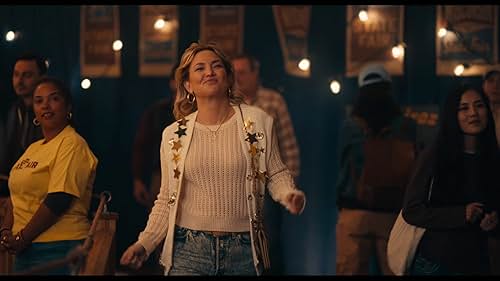
Jackman's interpretation of Lightning is solid. He’s got the singing chops and does a convincing faux-Diamond, though he has more vocal freedom since he’s not impersonating the singer directly but rather performing a second-generation version. But Jackman, for all his star power, can’t quite match Kate Hudson when it comes to lumens. This is the most magical she has been since Almost Famous, another movie about the power of music. There’s a kinship between Penny Lane and Claire - they’re soul mates of a sort - one still young and unformed, the other older and more weathered. The thing that surprised me most about Hudson’s performance was how good her voice is.

Brewer’s source material for the screenplay is a little-known 2008 documentary by Philadelphia-based filmmaker Greg Kohs, who followed the duo on and off for about eight years, assembling footage. Kohs’ Song Sung Blue did well on the film-festival circuit (it debuted at Slamdance) but never gained much traction beyond that, in part because, despite their renown in the Milwaukee area, Lightning & Thunder’s appeal never extended much beyond regional interest. Still, when Brewer watched it, he recognized the potential. 

As with most fictionalized versions of real events, Song Sung Blue doesn’t shy away from making changes to the historical record in the service of better drama and/or showmanship. The big moments in the movie are mostly reflective of real-life events, except the ending, which invents plenty of details, but the time frame is drastically condensed. Mike and Claire were connected for 17 years, but the movie shortens that to something like three or four years. (Their kids hardly seem to age.) Such quibbles, however, only matter to those who forget the mantra for movies like this: Never let the facts get in the way of a good story. And Song Sung Blue is a good story - heartwarming, uplifting, tear-jerking, and chock full of a beautiful noise. (Berardinelli's rating: 3 stars out of 4)

Labels: biography, documentary, drama, history, musical, tragedy,
IMDb 72/100
MetaCritic (critics=61, viewers=68)
RottenTomatoes (critics=77, viewers=97)
Netflix
Blu-ray
Jame Berardinelli's review (3 stars out of 4)


Friday, May 8, 2026

Ferrari (2023) [R] ****

A film review by James Berardinelli for ReelViews.net on Dec. 23, 2023.


With Ferrari, Michael Mann falls afoul of one of the pitfalls of the bio-pic: by focusing too tightly on one brief period in the main character’s life, he creates an is that all there is? feeling. Although the real Enzo Ferrari was a larger-than-life individual, the movie, which focuses on events from 1957, provides only the briefest of glimpses into the life of one the 20th century’s icons, relying on dialogue to fill in some of the blanks. Although this approach is arguably preferable to an alternative – attempting to cram 50+ years into two hours – it results in viewers never really understanding Ferrari as a man. Despite a riveting portrayal by Adam Driver, he remains an inscrutable figure even after spending 130 minutes with him.

Ferrari drops us into Enzo’s life in early 1957, follows him through several months until just after the final Mille Miglia race (May 11-12), then exits with many plot threads left unresolved. It is therefore more of a snapshot than a full-fledged biography. The movie explores the business difficulties experienced by Ferrari (the company), which is drowning in red ink. Enzo, still emotionally rent by the death of his son, Dino (who died in June 1956), is involved in an increasingly difficult marriage with his wife of 34 years, Laura (Penelope Cruz), and is facing demands from his long-time mistress, Lina Lardi (Shailene Woodley), regarding his illegitimate son, Piero. While attempting to balance family issues, Enzo hires a new, hot shot driver, Alfonso De Portago (Gabriel Leone), and enters five cars into the 1000-mile cross-Italy Mille Miglia where a win would increase the company’s prestige sufficiently to allow Enzo to enter into a favorable partnership with a larger car manufacturer, such as Fiat or Ford.

Mann’s typical high-energy approach imbues Ferrari with intensity. The racing sequences generate tension and excitement (especially the Mille Miglia). The film is less certain when focused on more intimate interactions, such as Enzo’s dialogues with his wife and mistress. Mann’s zenith as a filmmaker was in the 1990s (when he made, in succession, The Last of the Mohicans, Heat, and The Insider). Since then, his films have been largely hit-and-miss affairs and he hasn’t made anything for eight years (2015’s Blackhat). Ferrari seems an odd choice for his return to the spotlight but, despite occasional moments of cinematic flair, one would never associate this with the man who spearheaded Miami Vice.

Ferrari is anchored by the strength of Driver’s performance. Partially obscured underneath effective aging makeup, he could easily be mistaken for Michael Imperioli. Driver’s portrayal presents Ferrari as a tragic figure trapped between a loveless marriage with a mentally unstable wife and an affair with the woman and child he wishes he could acknowledge. He is hyper-focused on business but not so consumed that he ignores the gravesite of his recently-deceased adult son, Dino. To the extent that we come to understand Ferrari, it’s more due to Driver’s performance than anything in the screenplay. He is ably supported by a vibrant Penelope Cruz, who enlivens the production whenever she’s on screen. The scene in which her character confronts Enzo with the truth behind her betrayal is riveting.

Ferrari may prove a difficult sale for distributors NEON and STX Entertainment. Despite Mann’s involvement, it doesn’t have the cache to be a prestige film and movies of this nature are typically finding greater interest on streaming sites than in theaters. Although Driver’s performance may earn some deserved Oscar buzz, that likely won’t be enough to push the needle and there probably aren’t enough sports car enthusiasts to juice the box office. As a well-acted standard-order bio-pic, Ferrari delivers but as something more, it falls short. (Berardinelli's rating: 3 stars out of 4)

Labels: action, auto-racing, biography, drama, Ferrari, history, romance, sport, tragedy
IMDb 64/100
MetaCritic (critics=73, viewers=65)
RottenTomatoes (critics=73, viewers=73)
Blu-ray
Netflix
Berardinelli's original review (3 out of 4 stars) 

Blogger's comment: While I appreciate Berardinelli's perspective, I believe this period in time was a defining moment in Ferrari's life and I appreciate the historical accuracy. The 1957 Mille Miglia was marred by the tragic death of Ferrari driver Alfonso de Portago, his navigator and nine roadside spectators, including five children, in the village of Guidizzolo when his car hit an object on the road, blew a tire, spun out and became airborne. As a result, the Italian government forever banned all racing on public roads, permanently ending the thousand mile road race.

If you are a fan of auto-racing, and you appreciate films like Grand Prix (1966), RUSH (2013), Ford v Ferrari (2019) and F1: The Movie (2025), I predict you will enjoy Ferrari.


Saturday, May 17, 2025

Charlie Wilson's War (2007) [R] ****

A film review by James Berardinelli for ReelViews.net


It's a curious thing. Whenever this much talent is assembled for a motion picture, the result inevitably seems to be a letdown. And to say that Charlie Wilson's War is topheavy with talent is to understate the matter. The cast features three Oscar winners and two nominees. The director has been nominated five times and won once. The writer is a multiple Emmy winner. The cinematographer has a couple of Oscar nominations and the composer has six. Almost against the odds, however, Charlie Wilson's War does not collapse under the weight of expectations. In fact, it meets them squarely without flinching. With its rapid pace, smart screenplay, and top-notch acting, this is one of the 2007 Oscar season's most appealing and compelling adult motion pictures.

The screenplay, penned by veteran writer Aaron Sorkin, is based on George Crile's biography of Congressman Charlie Wilson, who is credited as being one of the architects of the United States' covert war against the USSR in Afghanistan. While the film takes liberties with some of the details, the broad strokes are accurate. It's fascinating to look back at the pre-Taliban era and see some of the factors that led to the country's becoming destabilized. While the Taliban is never mentioned (it did not come into power until some six years after the conclusion of the events in this movie), it casts a long shadow over events that unfold during Charlie Wilson's War. It is impossible to watch this movie without considering the natural progression of events after the Soviet retreat.

When the film begins, Charlie Wilson (Tom Hanks) is the Democratic Congressman from Texas' Second District. Known more for his love of parties and beautiful women, Good Time Charlie becomes aware of the situation in Afghanistan shortly after being named to the Defense Appropriations subcommittee in 1980. The budget for covertly opposing the USSR in Afghanistan at the time is $5 million. Charlie places a phone call and orders it doubled. But, as he learns from his friend, socialite and right wing mover-and-shaker Joanne Herring (Julia Roberts), that's not going to be enough. Charlie ends up on a whirlwind tour of Pakistan, where he meets the President (Om Puri) and walks through the refugee camps. He returns to Washington with renewed determination to open up the coffers and get the freedom fighters (Afghan Mujahideen) weapons that will enable them to bring down Soviet helicopters. With the aid of CIA operative Gust Avrakotos (Philip Seymour Hoffman), Charlie begins a campaign that eventually leads to the U.S. diverting more than $500 million of aid to Afghanistan.

Politically based stories of this sort run the risk of coming across as dry; that's not the case here. Director Mike Nichols keeps this fast-paced film moving and Sorkin peppers the screenplay with one-liners that vary from amusing to laugh-aloud funny. Charlie Wilson's War is justly classified as a drama, but someone could be excused for thinking it's a comedy. The film is more insightful, incisive, and intelligent than any of the many other current Middle East-themed motion pictures. Equally as important, it doesn't play politics with a loaded deck. This is not a repudiation of the totality of America's Afghanistan policy, although it makes it plain where the biggest error lay. Ironically, one could argue that the film's point validates aspects of the current Iraq strategy.

As the acting foundation of Charlie Wilson's War, Tom Hanks gives another fine performance, although it's not the kind of meaty role one normally associates with nominations. He shows fundamental changes to Charlie's nature as the man changes from a good ole boy (reminiscent of J.R. Ewing) to someone with a conscience. Hanks is perfect for the role. No matter how questionable a character's ethics, we always want to side with him if he's played by Hanks. That's currency in the emotional bank, and it works perfectly with Charlie: a disreputable individual who develops into something more. Philip Seymour Hoffman is the standout, shamelessly pilfering nearly every scene he's in, whether he's breaking glass, shouting at the top of his lungs, or uttering heartfelt profanities. If Hoffman gets nominated for his performance it's going to be deserved. Amy Adams, delightful as always, is Charlie's ever-faithful assistant. Ned Beatty plays Doc Long, the chairman of the Appropriations subcommittee. Emily Blunt shows up briefly and memorably. If there's a negative, it's Julia Roberts. Either she's miscast or her heart isn't into acting, but this is an example of plastic and ineffective acting. There's little here of the fire and passion that earned the actress a statuette for Erin Brockovich. It's a shame, but it doesn't hurt the movie too much - Roberts is only in a handful of scenes.

There's some interesting musical stuff going on as well. Composer James Newton-Howard has borrowed the He Shall Purify chorus from Handel's Messiah and put it to good use. This is perhaps the first time any song from the oratorio has been used as a battle anthem. One could argue that it simply fits the mood but, considering the words (He shall purify the sons of Levi, that they may offer unto the Lord an offering in righteousness) and the context in which the song is employed, there is a strong element of irony here. It's a pretty subtle thing so many viewers won't get it.

With so many movies working on auto-pilot, it's easy to forget the pleasure of a well-written screenplay, and even easier to forget how good things can be when a director of Mike Nichols' pedigree brings the script to life. The film has it all: suspense, drama, and humor. There's a brilliant scene in which Charlie is conferring with Gust and his aides keep interrupting with news about his involvement in a cocaine scandal. The deftness of timing necessary in this scene is the kind of thing that would have Charlie Chaplin smiling (as is the punch line, which involves a bottle of whiskey). Sorkin's screenplay is clean and crisp and not muddled by an overt political agenda (surprising, since Sorkin is openly political). From start to finish, Charlie Wilson's War is an unrelieved delight, and it works even better for those who understand the bridges that took us from the withdrawal of the Soviet Union from Afghanistan to 9/11 and beyond. [Berardinelli's rating: 3.5 stars out of 4]

Labels: biography, comedy, drama, Emily Blunt, history, Tom Hanks, war
IMDb 70/100 

MetaCritic (critics=67, viewers=67)
RottenTomatoes (critics=82, viewers=73)
Blu-ray 
Berardinelli's review 


Saturday, July 27, 2024

The Boys in the Boat (2023) [PG13] ****

A film review by James Berardinelli for ReelViews.net on December 26, 2023.


The Boys in the Boat is an old-fashioned, uplifting story about the triumph of underdogs. The film radiates the same level of classiness often associated with its director, George Clooney. Sentimental without being saccharine, this based-on-history account of the victory of the U.S. rowing team at the 1936 Berlin Olympics offers likeable characters in a well-structured narrative that never becomes bogged down by extraneous elements.

Mark L. Smith
’s screenplay relies heavily on the source material, Daniel James Brown’s 2013 account of how an unsung University of Washington J.V. rowing team ascended to the upper echelon of the sport, winning a gold medal with Adolf Hitler in attendance. Because those Olympics are remembered primarily for the images crafted by Leni Riefenstahl in Olympia and the triumphs of Jesse Owens, the victory of the rowing team was for many years regarded as a footnote. That changed with the success of Brown’s book, which ascended to #1 on the New York Times Bestseller list. Although the movie rights were quickly optioned (with Kenneth Branagh attached as director), it took a decade for a film to reach movie theaters.

The book
The Boys in the Boat offers a two-pronged approach to the climactic Olympic contest that took place from August 12-14, 1936. To streamline the film’s narrative, the backstory related to the Nazi preparation for the games has been elided, resulting in a focus on the University of Washington’s team as seen primarily through the eyes of one of the rowers, Joe Rantz (Callum Turner). Although several of the other eight boys in the boat are given moments to help differentiate them from one another, Rantz is the lone rower with a fully developed character. The only other three-dimensional individual is Coach Al Ulbrickson (Joel Edgerton). Aside from Joyce Simdars (Hadley Robinson) and Hazel Ulbrickson (Courtney Henggeler) – token roles as Joe’s girlfriend and Al’s wife, respectively – there are no women to speak of.

The curtain rises on 1935 Seattle, with the world mired in the depths of the Great Depression. Joe Rantz, a student at the University of Washington, is facing expulsion from college due to an unpaid tuition bill. Unable to find a job and with day work at a premium, he decides to try out for the school’s rowing team after learning that participants are given paid part-time positions. Of the hundreds of would-be rowers, only eight are selected following a grueling series of try-outs. Joe is one of them. With his economic issues at least temporarily resolved, he settles into bonding with the eight other young men in the Junior Varsity boat as they develop into what would become, in the coach’s words, the best team he has ever seen.

The movie’s sports elements are impeccably recreated; even those who know the ending (as a matter of the historical record) will find an element of suspense in the way Clooney frames them. He does this not by fast-cutting or overly relying on editing but by clean, clear shots both at the boat level and from above. Winning becomes important because we are invested in Joe, who at one point states that being on the team is all he has.

Although
The Boys in the Boat doesn’t have a political agenda, it makes a point of acknowledging Jesse Owens’ importance to the Olympics. Owens doesn’t have a large role in the film – to give him one would unbalance the narrative and take the focus away from the main characters – but he notes that he’s in Berlin not so much to thumb his nose at the Germans but to prove something to everyone back home who doubted him.

Tonally,
The Boys in the Boat is a relatively low-key affair, lacking the overt melodrama that characterizes many sports movies. Nevertheless, in part because of a strong lead performance by Callum Turner, solid supporting work from Joel Edgerton and Peter Guinness (as George Pocock, the boat-builder), and a well-honed screenplay, the film engages viewers on its intended level. The period detail is evocative but not overbearing and there are no forced allegories. Offering inspiration in both the truth of its basis and the way in which it is presented, The Boys in the Boat is an antidote to the pervasive cynicism of the modern era. [Beradinelli’s rating: 3 stars out of 4 = 75%]

Labels: biography, drama, history, sport
IMDb 70/100 
MetaCritic (critics=54, viewers=66) 
RottenTomatoes (critics=57, viewers=96) 
Blu-ray 
Berardinelli’s review 


Tuesday, May 31, 2022

Operation Mincemeat (2021) [PG-13] ****

A film review by Christy Lemire for rogerebert.com on May 11, 2022.

Operation Mincemeat looks like a proper British spy drama and for the most part, well, it is. It’s based on the true story of wartime daring and heroism, features a classy cast including Colin Firth and Matthew Macfadyen and has a director in John Madden (Shakespeare in Love, the Best Exotic Marigold Hotel movies) who’s made his name with exactly this kind of sturdy, old-fashioned fare.

But the story itself is so absurd and is told with enough surprises and dry humor that it’s constantly engaging. Imagine Weekend at Bernie’s set during World War II, with a dash of romance sprinkled in amid the spy craft and physical gags, and you’ll have some idea of the tricky tonal balance this film improbably achieves. Operation Mincemeat takes its title from the real-life mission that tricked Hitler into believing the Allies were going to invade Greece, rather than Sicily, in 1943. Ben Macintyre’s non-fiction book of the same name also provides the basis for television veteran Michelle Ashford’s sprawling script. But while the film as a whole may seem dense and restrained, the performances and attention to detail consistently bring it to life
.

Operation Mincemeat
also serves as a bit of a James Bond origin story. One of the British intelligence officers behind this unlikely plan was Ian Fleming, who would go on to create the iconic 007 character based on his own experiences working in espionage. So if you ever wondered about the inspiration behind such legendary figures as M and Q, you’re in for some amusing enlightenment. The charismatic actor and singer Johnny Flynn plays Fleming and provides the film’s dramatic narration, accompanied by the clickety-clack of his typewriter while the other members of his interagency intelligence squad get actual work done in their hidden headquarters. But who could blame the aspiring novelist for wanting to take notes? This stuff’s just too juicy.

Firth’s Ewen Montagu and Macfadyen’s Charles Cholmondeley lead the scheme to secure a body, dress it in a military uniform and dump it off the coast of Spain in the hope that it will wash ashore with a briefcase full of fake documents intact. A million pieces large and small must fall into place to ensure that this disinformation falls into precisely the right hands in order to deceive Hitler and break his army’s hold on Europe. And as is the case in any great heist movie, much of the fun comes from watching the players work through their plan. Here, that means creating a fictional identity and backstory for their deceased drifter that’s so complete and air-tight that it won’t raise suspicion. These brainstorming sessions between the officers Montagu and Cholmondeley, clerk Jean Leslie (Kelly Macdonald) and secretary Hester Leggett (a lovely Penelope Wilton) have a snappy, lighthearted pace, but they also allow us to get to know these characters as it becomes clear that they’re not just playing a high-stakes game of make-believe. They’re investing their own very-real personalities, dreams and regrets into the made-up Capt. William Martin.


They’re also making themselves vulnerable in a profession that’s all about keeping up your defenses. That extends to the romantic bond that steadily builds between the widowed Jean and Ewen, who sent his wife and kids to America to protect them because they’re Jewish; early scenes suggest that the couple’s marriage was in jeopardy anyway. Macdonald and Firth have a sweet and easy chemistry tinged with the slightest sadness and world-weariness. They’re both great. But this burgeoning relationship grows complicated as it becomes obvious that Charles has feelings for Jean, as well; Macfadyen is mostly stoic, but he gets to deliver plenty of wry zingers. And mistrust begins to bubble up among everyone on the team as deceptions within the deception emerge.


Operation Mincemeat
grows legitimately tense on both the personal and professional levels as the team executes the mission and waits anxiously to learn whether it was successful. Tiny zigs and zags along the way could mean disaster at any moment, and characters who may have seemed minor at first become majorly important as they’re forced to improvise. At times, you may wish Madden had taken the same kind of chances as the masterminds behind Operation Mincemeat, but his film is still sufficiently rousing. [Lemire’s rating: 3 stars out of 4]

Labels: drama, history, war, WWII
IMDb 66/100

MetaScore (critics=65, viewers=61)

RottenTomatoes Averages (critics=83, viewers=65)


Lemire’s original review


Wednesday, May 4, 2022

Seven Years in Tibet (1997) [PG-13] ****

An (edited) film review by James Berardinelli for ReelViews.net.

Hollywood has a habit of producing multiple films about the same topic in a short span of time. The tale of the Dalai Lama is the latest example of this, so Seven Years in Tibet, Jean-Jacques Annaud's adaptation of Heinrich Harrer's 1953 autobiographical work, isn't the only 1997 film to cash in on the new wave of Buddhism. Martin Scorsese's Kundun, a look at the life of the Dalai Lama before he went into exile, is due out on Christmas day. Both films have significant historical and thematic overlaps.

The focus of Seven Years in Tibet isn't the spiritual leader of Tibet, but the Austrian who would become his tutor and friend. In 1939, Heinrich Harrer (Brad Pitt) is an Austrian golden boy. An Olympic skiing medalist and mountain climbing champion, Harrer is invited to be a part of a German expedition to the top of Nanga Parbat, one of the tallest mountains in the Himalayas. The summit is never attained, however, because the group's leader, Peter Aufschnaiter (David Thewlis) calls a halt after a close call with an avalanche. When the climbers return to their camp at the mountain's base, they discover that WWII has begun and they are arrested by British soldiers and interred in a prisoner of war camp.

After numerous unsuccessful escape attempts, Harrer finally gets out, and, along with Aufschnaiter, makes his way through the mountains of India into Tibet, the roof of the world. Eventually, after a difficult trek, the two men enter Lhasa disguised as pilgrims, the Tibetan holy city, where they are accepted as foreigners who achieved a great feat by completing such a journey. There, they vie for the affection of a comely tailor (Lhakpa Tsamchoe) and Harrer attracts the attention of the 11-year old Dalai Lama (Jamyang Wangchuk). Soon, Harrer has not only met Tibet's young spiritual leader, but is spending hours every day with him, teaching him geography, English, and Western culture.

Those expecting a heavy dose of Tibetan Buddhist religion may be disappointed by Seven Years in Tibet, which keeps its religious elements low-key. This is essentially the story of Harrer's redemption, and, until the film's final quarter, Annaud keeps the proceedings centered on him. In fact, it's during Seven Years in Tibet's last act, which depicts China's ruthless submission of Tibet during the 1950s, that the film's focus wavers. This attempt to broaden the movie's scope detracts from its primary story. The extra scenes serve only to divert our attention from Harrer the Dalai Lama and prolong a movie that would have been more enjoyable with some additional pruning.


Seven Years in Tibet also tries too hard to underscore Harrer's personal transformation by overemphasizing his negative traits at the beginning. When Seven Years in Tibet opens, he's a egotist who abandons his pregnant wife to go on the Nanga Parbat expedition. During the climb, he endangers the others by concealing an injury, and, all the while, he shows the arrogance of someone who believes himself to be infallible and who practices blaming others rather than examining his own culpability. However, by the closing scene, he's a virtual saint. Of course, the end points of a spiritual journey matter less than the actual trek, so, although Harrer starts out the movie as a cliché, his character is permitted enough growth to allow him to become progressively more human as the story advances.

Seven Years in Tibet is at its strongest during those sequences when Harrer is crossing the Himalayas, adapting to Tibetan society, and forging a friendship with his surrogate son, the Dalai Lama. The latter scenes are especially effective, due in large part to a remarkable performance by Jamyang Wangchuk, whose fine acting makes it possible to believe that this boy, with all the natural curiosity of someone his age, has access to the wisdom of ages. Next to Wangchuk, Pitt comes across as rather pedestrian - his portrayal isn't exactly uninspired, but it's nothing special, and his inconsistent Austrian accent is a source of irritation. Of the other actors, only Lhakpa Tsamchoe manages to forge an impression. David Thewlis, who has been on a downhill slide since Naked, is even more unremarkable than Pitt.

Nevertheless, although he may not have the strongest leads, Annaud compensates for the deficiency with stunning photography. Cinematographer Robert Fraisse has used the glorious mountain landscapes to their best effect, almost always affording the viewer the opportunity to see something spectacular, such as a scene where two climbers are ascending a mountainside while silhouetted against a glorious sunset. It's a little ironic that, because of Asian politics, Annaud couldn't do any filming in the Himalayas, and was forced to use the South American Andes as a stand-in.

Ultimately, however, Annaud's desire to create an epic tale actually harms the production, since it results in unnecessary scenes that pad the running length to more than two hours. The best moments in Seven Years in Tibet are the quiet, intimate ones, and while there's some enjoyment to be gained from the more adventurous sequences, they pale in comparison to the interaction between Harrer and the Dalai Lama. Those are the times when Seven Years in Tibet is at its best; I just wish there had been a few more of them. [Berardinelli’s rating: 2.5 stars out of 4 = 62.5%]

Labels: adventure, biography, Brad Pitt, drama, history
IMDb 71/100

MetaCritic (critics=55, viewers=72)
RottenTomatoes (critics=57, viewers=73)

Blu-ray

Wikipedia Heinrich Harrer 

Wikipedia 14th Dalai Lama

Sunday, April 17, 2022

Genius: Picasso (2018) [TV-14] ***


Interweaving scenes between Pablo as the young man determined to express his own point of view with his art, and Picasso as the older, mature, technical master and visionary creator, Genius: Picasso takes us into the artist’s life.

Picasso lived for 91 years and spent roughly 80 of that creating nearly 50,000 works of art including paintings, drawings prints, sculptures and ceramics, that made him famous throughout the world and also one of the most creative artists in history. Genius: Picasso tells the story of Pablo Picasso’s life, taking us through his ups and downs, successes and failures to help us understand what drove him to create, and why his art was more important to him than anyone or anything in his life.

Filmed throughout Western Europe, including Paris, Málaga, Barcelona, Budapest and Malta, the series features a number of well-known personalities who crossed paths with Picasso, including Gertrude Stein, Henri Matisse, Georges Braque and Jean Cocteau.


Genius: Picasso was originally broadcast as a National Geographic special in 2018. The ten chapters are available as a 3-DVD set through your local library or on streaming channels such as Hulu or Prime Video. Here is an extensive synopsis of the ten chapters:

CHAPTER 1 opens on October 25, 1881
with the birth of Pablo in the Spanish coastal town of Málaga. Next, we see Pablo (Timothy Lyons), nine years of age, at a bullfight with his father, José Ruiz y Blasco (David Wilmot). Pablo learns to draw under the tutelage of his father, who is an art instructor at a provincial school. In 1894 we see Pablo at thirteen (Alessio Scalzotto), drawing his young sister Conchita who later succumbs to diphtheria. In 1895 Pablo begins studying at La Llotja, School of Fine Arts in Barcelona, and two years later, in 1897 Pablo (Alex Rich) begins studying at the Real Academia de Belles Artes in Madrid thanks to the generosity of his wealthy uncle, Dr. Salvador Ruiz (Jordi Mollà). After several years of study in Madrid, and being told he has talent but no discipline, Pablo decides he's had enough studying. He wants to paint something original, unique. Then, in 1899 the Spanish-American War begins and Pablo, along with his friend Manuel Pallarès (Charlie Carrick) leave Madrid for the mountains to avoid the draft. But the rains come early and ruin his paintings, so Pablo returns to Barcelona and meets anarchist Carles Casagemas (Robert Sheehan) in a local brothel where he is painting Dolores (Elena Martinéz). It is then that Pablo decides he must go to Paris to see the work of artists of Post-Impressionism such as Paul Cezanne. In 1900 he has a painting accepted at the Spanish Pavilion of the Universal Exhibition in Paris, so, in October, 1900, Pablo and Casagemas go to Paris.

In 1937 we see Picasso at 56 (Antonio Banderas) in his Paris studio with two-year-old Maya, his daughter with mistress
Marie-Thérèse Walter (Poppy Delevingne). Though Marie-Thérèse’s unassuming and yielding personality provides a haven for Picasso during his tempestuous marriage to ballerina Olga Khokhlova, her lack of intellectual curiosity and spirit bore him and he begins an affair with beautiful painter and photographer Dora Maar (Samantha Colley), his equal in drive, intellect and passion. Dora challenges him to accept a commission to paint a large mural for the Spanish Pavilion at the 1937 World's Fair in Paris. After Fascist Franco's German allies bomb the ancient Basque town of Guernica during the Spanish Civil War (1936-39), Picasso decides he must paint a mural of the destruction, and Dora photographs his creation of Guernica, a powerful visual statement of the bombing.

Françoise Gilot (Clemence Poesy) and her school friend and fellow artist Geneviève Aliquot (Stephane Caillard) see the mural. It disturbs Françoise but Geneviève reminds her that Picasso said art is not meant to decorate apartments; it is meant to be a weapon.

In 1938 Antibes, South of France, Picasso and Dora Maar enjoy the beach. Dora is clearly his muse; she is creative, fiercely independent and challenges him as no other woman. A year later, in 1939, the Germans invade Poland and begin WWII. Paul Rosenberg (Will Keen), Picasso's Jewish art dealer, closes his gallery and emigrates to London, but Picasso refuses to leave his art behind and stays in Paris.


CHAPTER 2 opens in Rennes in May, 1940.
Françoise Gilot and her parents are unable to leave France for England because the Germans have closed the harbor. In Tremblay-Sur-Mauldre, Germans occupy Picasso's home, so he drives 300 miles north from Hotel du Tigre in Royan on the Mediterranean to liberate his artwork while the Germans are away on patrol.

In 1943, in German-occupied France, Picasso divides his time between
Marie-Thérèse Walter and her young daughter Maya (Flora Chedlivili), Dora Maar, and his wife Olga and son Paulo. Realizing that he needs new inspiration from a new muse, Picasso tells Dora that Marie-Thérèse is the only woman he loves, signalling the approaching end of their eight-year (1935-43) affair.

While out to dinner with the soon-to-be-replaced Dora, Picasso flirts with Françoise Gilot, who has accompanied friend and fellow artist Geneviève Aliquot and famous film actor Alain Cuny (Johnny Flynn) to the Catalan Restaurant. Picasso invites Françoise to come to his studio.

In 1910 in Paris, Pablo and Carles are living with Isidre Nonell (Max Befort) when Manuel Pallarès arrives from Barcelona. He meets Nonell's three lovely nude models: Louise Odette Lenoir (Alexia Giordano), Pablo's favorite, Antoinette Fornerod (Lola Dubus) and Germaine Pichot (Emma Appleton) with whom Carles falls desperately in love although, unfortunately, he is unable to satisfy her in bed. Berthe Weill (Bronagh Gallagher) buys three of Pablo's paintings from Manach (Alex Hassell), his dealer.

Pablo works furiously, painting dance hall scenes at
Le Moulin de la Galette. Arthur Huc (Attila Bardoczy), a well-known collector, observes that his work is alive, that he can almost smell the smoke and perfume, that it could be a Degas or a Lautrec. Pablo becomes successful painting dance hall scenes and portraits in the style of popular Impressionist painters such as Pierre-Auguste Renoir and Edgar Degas, but he doesn't want to be known as a copyist and struggles to find his own original style.

Thinking that they both need rest Pablo returns to Málaga with Carles for New Years 1901. But Carles cannot forget Germaine. He returns to Paris, convinces her to join him and their friends for dinner, takes out a pistol with which to shoot Germaine, but misses her and then commits suicide. Returning to Paris, a despondent Pablo begins painting in blues, a time called his Blue Period.

CHAPTER 3 opens in 1902 in Fontenay-Sous-Bois, France with a young wife
Fernande Olivier (Aisling Franciosi) escaping by train to Paris after being beaten by her husband. Shivering outside a cafe, Fernande meets Laurent Debienne (Edward Akrout), a sculptor, and begins living with him and modeling for him. Max Jacob (T.R. Knight), French poet, critic and fortune-teller, sees a painting of Pablo's in a gallery owned by Ambroise Vollard (James Garnon) and finds Pablo in his studio. He tells Pablo he will have a large fortune by the time he is 30, and that love will play a great role in his art. Needing a place to live, Pablo accepts Max's offer to share his studio, but when Pablo realizes that Max is gay, he moves out.

In 1903, Pablo says goodbye to Germaine, returns to Barcelona, rents a studio and paints Carles and Germaine as lovers in La Vie, 1903, in hues of blue, having found a way for Carles to have in art what he couldn't have in real life. After finishing the painting Pablo returns to Paris in 1904 and rents a studio in the same Bateau-Lavoir, Montmartre building where Fernande Olivier lives with sculptor Laurent Debienne.

In 1943
Françoise Gilot and Geneviève Aliquot visit Picasso and then he goes to the art gallery where they are exhibiting their paintings. Later Françoise goes to see Picasso again and he tells her she has talent, but her father Emile Gilot (Sebastian Roche) tells her Picasso is a lecher and forbids her to see him. When she refuses, he disowns her and when Geneviève suggests she can't remain a virgin forever, Françoise goes to Picasso and offers herself to him.

CHAPTER 4 opens in 1905 in a bank in Paris.
Poet Guillaume Apollinaire (Seth Gabel) is working as a bank clerk but hates it, preferring to read his poetry and get drunk with his friends. His motto, which Pablo adopts, is that as artistes we must demand nothing less than the perpetual immoral subversion of the existing order. Pablo sees the Henri Matisse painting Luxe, Calme et Volupte, using the technique of Pointillism and realizes he has to smash the rules and do something completely new and different.

Apollinaire shows Pablo some harlequins, itinerant circus performers, calling them clowns with evil behind their eyes, devils escaped from Hell, and Pablo sees a new opportunity for self-expression.
He casts off the dark hues of his Blue Period, embraces his new subject matter and portrays harlequins in warm hues. His painting Saltimbanques (1905), portraying a family of harlequins in a desolate landscape, is considered a masterpiece of his Rose Period, sometimes called his circus period.

Pablo becomes obsessed with Fernande. He cleans his studio, introduces her to the opium pipe and shows her a little shrine he has created to her, because he worships her. The two fall deeply in love and when Debienne is abusive to Fernande, Pablo offers her shelter, treating her with love and respect. She becomes the first great love of his life and they are together for seven years (1905-1912).

Pablo finishes Saltimbanques and his friend and poet Guillaume Apollinaire composes a poem to accompany it. They take the painting to the Autumn Salon but when Pablo sees Matisse's Woman with a Hat (1905) he withdraws his painting.

In 1943
Françoise Gilot becomes Picasso's lover and artistic muse, although she is 21 and he is 62. Their relationship, both professional and romantic, will last a decade and produce two children, Claude and Paloma. Dora Maar, desperately afraid of losing Picasso, becomes increasingly paranoid, imagining people stealing her bicycle and her dog, and following her in the street.

In 1944 Max Jacob is praying in the Saint-Benoit-Sur-Loire monastery. He has converted to Catholicism but in the eyes of the Germans he is still a Jew as well as a homosexual and they arrest him. Jean Cocteau (Simon Buret) appeals to Picasso to sign a petition to release Max but Picasso refuses. Cocteau finally gets his release approved, but too late. Jacob dies in the Drancy Deportation Camp hospital in March, 1944, just five months before Paris is liberated in August, 1944.

At Picasso's invitation Françoise goes to the art gallery where Dora Maar is exhibiting her paintings, but does not want to meet her, so Picasso invites them both to dinner. Françoise arrives with Andre Beaudin (Timothy Renouf) to make Picasso jealous, and he calls her a little devil. Later that night, unable to make an impression on Picasso, Dora smashes her forehead against a mirror. The police find her wandering along the river and take her to Picasso's where she claims, hysterically, to have been attacked and had her dog and bicycle stolen. Picasso cares for Dora while Françoise decides she cannot live with him.

CHAPTER 5 opens in Brittany, France in 1931 with
Françoise's father pushing the young Françoise (Beau Gadsdon) off a cliff into the ocean in a misguided attempt to make her strong in a mans' world. Fifteen years later in 1946 Paris, Picasso visits her in the hospital while she recovers from a broken arm caused by a fall. He tells her he only wants her and invites her to convalesce in a house he has in Golfe-Juan on the Mediterranean. Françoise takes her friend Geneviève Aliquot with her and writes to Picasso not to come. So, of course he does, and attempts to seduce Geneviève, ostensibly so she will leave and Picasso can be alone with Françoise. She does, and Picasso takes Françoise for a drive to visit Henri Matisse (Andrew Buchan). Later in 1946 she finally moves in with Picasso.

In 1905, while young Pablo is challenged by the radical genius of Henri Matisse, his style attracts the attention of new collectors and patrons, including some wealthy Americans living in Paris: Gertrude Stein (Tracee Chimo Pallero) and her brother Leo Stein (Iddo Goldberg). Pablo and Fernande attend one of the Stein's Saturday salons where Fernande flirts with Leo Stein, making Pablo's jealous. Pablo and Fernande
both become victims of their own passions and jealousies, which ultimately destroys their relationship.

After five months of trying unsuccessfully to paint Gertrude Stein's portrait, early in 1906 Pablo takes Fernande on a vacation to Gosol, Spain. In a small chapel he sees a stature of the Madonna and Child and knows how to finish his Portrait of Gertrude Stein (1906). When Pablo shows it to her, Gertrude says it looks nothing like her. Pablo replies Not now, but it will.

In 1907 Henri Matisse again shocks the art world with Blue Nude, classified as Fauvist and shown at a Stein Saturday salon. Fernando flirts with a salon guest for whom she used to model. Insane with jealousy Pablo locks her in their studio and she nearly dies when there is a kitchen fire in another studio. Pablo apologizes and since Fernande cannot have children, they adopt 13-year-old Raymonde (Sophia Aparecido-Innes) from a Catholic orphanage. But when Fernande sees that Pablo has sketched the girl partially nude she realizes that even if Pablo's intentions were good, their studio is no place for a child, so they return her to the orphanage.

In September, 1907 Georges Braque (
Kerr Logan) visits Pablo and asks to see his new painting, but Pablo refuses him. Braque notices two sculptures but does not realize they were stolen from the Louvre by Gery Pieret (Jack Brett Anderson). Then Pablo visits the Ethnographic Museum in the Trocadero Palace, sees the African masks and realizes they are weapons, just like his brush and paints. And finally he has the theme for the new painting he is working on. Using Fernande as a model along with African masks, he creates Les Demoiselles d'Avignon and shocks the world. Fernande reminds Pablo that he said he wanted to offend, to be abhorrent, and he has done it. The painting becomes the foundation of Cubism, a movement jointly created by Pablo and Georges Braque, in which all the rules of art - light, color, form, perspective - are challenged.

CHAPTER 6 opens in Paris 1946 in a Left Bank restaurant.
Françoise is talking with Luc Simon (Tom Cullen). He is jealous of her relationship with Picasso but says he will be teaching at a small art school in Tunis and invites her to visit him. Picasso takes Françoise to the Midi for a vacation but it is 80 km (50 miles) inland from the Mediterranean and he neglects to tell her that it is Dora Maar's home. It is during this trip that Picasso suggests they should make a baby together.

In 1908 Pablo shows his new painting to Georges Braque and Daniel-Henry Kahnweiler (Lucas Englander), German art collector and notable French art dealer, who wants to exhibit it in his gallery. In an antique shop Pablo discovers Portrait of a Woman (1895) by Henri Rousseau (Tcheky Karyo) an old retiree who had worked as a customs clerk and has never been appreciated as an artist. So Pablo and Apollinaire hold a party to introduce their friends to Rousseau. Young artist Karl-Heinz Wiegels (Gerran Howell) disparages Rousseau and when Pablo defends him and calls Wiegels a fraud, the young man hangs himself in his studio.

On August 21, 1911 the Mona Lisa is stolen from the Louvre. Gery Pieret is a suspect and he implicates both Apollinaire and Picasso. Apollinaire is charged and later released for lack of evidence. Picasso denies knowing Apollinaire and is not charged. Two years later they are exonerated when the Mona Lisa is recovered in Florence, Italy. The thief, Vincenzo Peruggia, a handyman employed by the Louvre, serves a brief prison sentence for the crime.

CHAPTER 7 opens in Paris in October, 1944 with a reporter asking Picasso to describe why he joined the Communist Party.

In Vallauris, France in 1948 Picasso and
Françoise share a home and work. Claude is a toddler and Françoise is pregnant with Paloma. The World Conference of Intellectuals in Defense of Peace is scheduled to be held in Warsaw in August, and Paul Éluard (Ed Stoppard) convinces Picasso that, as a Communist, he has a duty to attend. Picasso spends three weeks in Poland and visits the Auschwitz concentration camp, which deeply affects him.

In Paris in 1912 Pablo and Georges Braque discuss the use of wallpaper in creating a collage. When Pablo discovers that Fernande is having an affair with Ubaldo Oppi, a 22-year-old painter from Bologna, Italy, Pablo begins an affair with one of her friends, Eva Gouel (Eileen O'Higgins). Pablo intends to marry Eva, but she dies of lung cancer before they can marry.

CHAPTER 8 opens in 1917. Pablo designs costumes and sets for the ballet Parade featuring Sergei Diaghilev's (Michael Gor) Ballet Russes, choreographed by Leonide Massine, with a scenario by Jean Cocteau and music by Erik Satie, and meets his first wife, ballet dancer Olga Khokhlova (Sofia Doniants). In 1918 Pablo marries Olga, meets Coco Chanel (Rebecca Calder) and accepts a 50,000 franc commission to paint Margo Rosenberg's (Lisa Dwyer Hogg) picture. Apollinaire succumbs to the Spanish Flu.

In 1949 Picasso tries to mediate between Olga and their son Paulo (Zachary Fall),
Marie-Thérèse and their daughter Maya (Violet Young), and Françoise and their two children Claude and Paloma. In Paris in 1951, Picasso begins an affair with model Geneviève Laporte (Margaux Chatelier), and fires his driver of 25 years, Marcel (Bruno Paviot), after he wrecks Picasso's beloved 1930 Hispano-Suiza Type H6B during an outing with his own family.

CHAPTER 9 opens in 1927. Picasso realizes that Olga is more interested in Persian carpets and chandeliers than his art and so he finds a new muse and lover in
Marie-Thérèse Walter. In Paris in 1935 Olga finds out about Marie-Thérèse, who tells Picasso she is pregnant and demands that he marry her. Picasso asks Olga for a divorce but when he discovers she will own half of all of his artworks he refuses to divorce her. In the same year, he discovers that Marie-Thérèse no longer inspires him and Paul Eluard, poet and one of the founders of the Surrealism movement , introduces him to photographer and artist Dora Maar.

In 1952, Picasso enlists his son Paulo to find a house in Saint-Tropez where he can spend time with his new model
Geneviève Laporte. Françoise finds out about Geneviève and accepts a job in Paris to design costumes for a new ballet. Marie-Thérèse's teenage daughter Maya (Athena Strates) baby-sits for Claude and Paloma with Picasso in the South of France. Kostas Alexos (Dimitri Leonidas) who has been trying to seduce Françoise for years, finally succeeds after the grand opening of her ballet and, in 1953, she leaves Picasso after a decade and two children. Madame Suzanne Ramie (Anna Savva) who owns the ceramic studio in Vallauris where Picasso has his ceramics fired, introduces him to her cousin Jacqueline Roque (Valentina Bellè)

CHAPTER 10 opens a year later, in 1954. Picasso convinces Jacqueline to quit her job and move into his mansion, but when
Françoise brings Claude and Paloma for a visit and tells Picasso about Luc Simon, art teacher and her lover, Picasso confesses he made a mistake and wants her back. The following year Picasso buys Villa La Californie, near Cannes, and Françoise and Luc marry. But after Picasso demands the return of all of his paintings, Françoise realizes that if something were to happen to her, Claude and Paloma would not be cared for. Picasso's lawyer suggest that if she were to divorce Luc, he would marry her, but then, in March 1961 in the Vallauris town hall, Picasso marries Jacqueline Roque. The same year they move to Mougins, near Cannes for the final 12 years of his life, and when Picasso no longer wants to paint Jacqueline he begins to paint himself. In 1962 Françoise divorces Luc, moves to New York, and in 1970 marries Dr. Jonas Salk

The last six minutes of the final episode, as Picasso lies on his death bed, are devoted to a poignant fantasy reunion of all the members of his extended family: his second and current wife Jacqueline, first wife Olga, former lovers Fernande, Eva,
Marie-Thérèse and Dora, his children and grandchildren, and even Carles Casagemas, the friend of his youth who had ended his life so many years earlier. It is a beautiful way to end the story of the life of the great artist.

Labels: biography, drama, history

IMDb 82/100
RottenTomatoes (critics=57, viewers=30)

Movie Recipe Review 

Fernande Olivier Encyclopedia.com