To find films, actors, directors, etc., use 'Search This Blog' omitting accents (à ç é ô ü). Ratings average IMDb, MetaCritic and RottenTomatoes: ***** Excellent (81+); **** Very Good (61-80); *** Average (40-60); ** Fair (20-39); * Poor (19-). FEEDBACK: MauiPeterB at Hotmail dot com
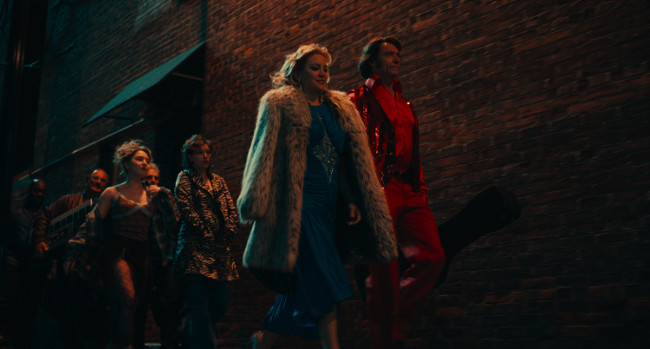
Ferrari drops us into Enzo’s life in early 1957, follows him through several months until just after the final Mille Miglia race (May 11-12), then exits with many plot threads left unresolved. It is therefore more of a snapshot than a full-fledged biography. The movie explores the business difficulties experienced by Ferrari (the company), which is drowning in red ink. Enzo, still emotionally rent by the death of his son, Dino (who died in June 1956), is involved in an increasingly difficult marriage with his wife of 34 years, Laura (Penelope Cruz), and is facing demands from his long-time mistress, Lina Lardi (Shailene Woodley), regarding his illegitimate son, Piero. While attempting to balance family issues, Enzo hires a new, hot shot driver, Alfonso De Portago (Gabriel Leone), and enters five cars into the 1000-mile cross-Italy Mille Miglia where a win would increase the company’s prestige sufficiently to allow Enzo to enter into a favorable partnership with a larger car manufacturer, such as Fiat or Ford.
Mann’s typical high-energy approach imbues Ferrari
with intensity. The racing sequences generate tension and excitement
(especially the Mille Miglia). The film is less certain when focused on more
intimate interactions, such as Enzo’s dialogues with his wife and mistress. Mann’s
zenith as a filmmaker was in the 1990s (when he made, in succession, The Last of the Mohicans, Heat, and The Insider). Since then, his films
have been largely hit-and-miss affairs and he hasn’t made anything for eight
years (2015’s Blackhat). Ferrari seems an odd choice for his
return to the spotlight but, despite occasional moments of cinematic flair, one
would never associate this with the man who spearheaded Miami Vice.
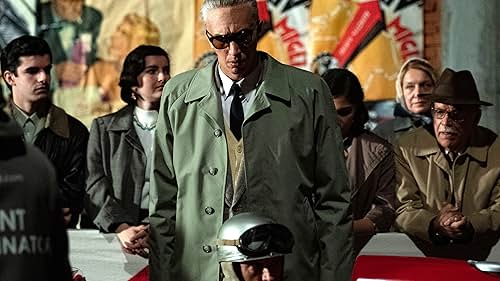
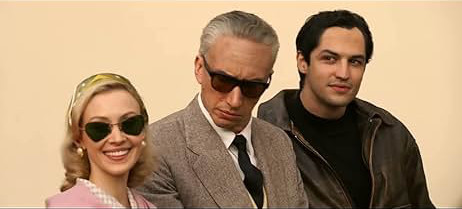
Ferrari is anchored by the strength of Driver’s performance. Partially obscured underneath effective aging makeup, he could easily be mistaken for Michael Imperioli. Driver’s portrayal presents Ferrari as a tragic figure trapped between a loveless marriage with a mentally unstable wife and an affair with the woman and child he wishes he could acknowledge. He is hyper-focused on business but not so consumed that he ignores the gravesite of his recently-deceased adult son, Dino. To the extent that we come to understand Ferrari, it’s more due to Driver’s performance than anything in the screenplay. He is ably supported by a vibrant Penelope Cruz, who enlivens the production whenever she’s on screen. The scene in which her character confronts Enzo with the truth behind her betrayal is riveting.

Ferrari may prove a difficult sale for distributors
NEON and STX Entertainment. Despite Mann’s involvement, it doesn’t have the
cache to be a prestige film and movies of this nature are typically finding
greater interest on streaming sites than in theaters. Although Driver’s
performance may earn some deserved Oscar buzz, that likely won’t be enough to
push the needle and there probably aren’t enough sports car enthusiasts to
juice the box office. As a well-acted standard-order bio-pic, Ferrari
delivers but as something more, it falls short. (Berardinelli's rating: 3 stars out of 4)
Labels: action, auto-racing, biography, drama, Ferrari, history, romance, sport, tragedy
IMDb 64/100
MetaCritic (critics=73, viewers=65)
RottenTomatoes (critics=73, viewers=73)
Blu-ray
Netflix
Berardinelli's original review (3 out of 4 stars)
Blogger's comment: While I appreciate Berardinelli's perspective, I believe this period in time was a defining moment in Ferrari's life and I appreciate the historical accuracy. The 1957 Mille Miglia was marred by the tragic death of Ferrari driver Alfonso de Portago, his navigator and nine roadside spectators, including five children, in the village of Guidizzolo when his car hit an object on the road, blew a tire, spun out and became airborne. As a result, the Italian government forever banned all racing on public roads, permanently ending the thousand mile road race.
If you are a fan of auto-racing, and you appreciate films like Grand Prix (1966), RUSH (2013), Ford v Ferrari (2019) and F1: The Movie (2025), I predict you will enjoy Ferrari.
An uncredited review published in Time magazine, June 9, 1967
Barefoot in the Park is one of the few plays to be reincarnated on-screen while playing on the Broadway stage. Happily, it loses little in transition.
Essentially, author Neil Simon has taken a plot as bland as a potato, sliced it into thin bits—and made it as hard to resist as potato chips. Two spoiled young honeymooners (Robert Redford and Jane Fonda) settle into a six-flight walk-up apartment in Greenwich Village. In Ogden Nash's phrase, a little incompatibility is the spice of life, particularly if he has income and she is pattable. And so it proves in Barefoot. The puny pad she has chosen has no heat, no bathtub, and a hole in the skylight.
When Redford remonstrates, Fonda starts sniping - only to agree to a cease-fire when her middle-class mother (Mildred Natwick) arrives. Before long, they are joined by a randy reprobate of a neighbor (Charles Boyer) known as the Bluebeard of Tenth Street. Bluebeard leads the way to an Albanian hash house that serves such delicacies as black salad and ouzo. The foursome eventually wend their way home, whereupon Fonda and Redford drunkenly declare all-out war.
She is a nut, he declares, whose idea of fun is walking barefoot in the park in 17-degree weather. Your laundry arrived, she simpers. They stuffed your shirts beautifully. But if the couple's happiness seems as short as their tempers, their misery is just as temporary. By the final reel they are neck and neck in a race for the bed, and even Natwick and Boyer have found something in common - stomach trouble.
The film is not an original-cast production. Sly substitutions have been
made, notably Fonda for Broadway's Elizabeth Ashley. Jane's performance
is the best of her career: a clever caricature of a sex kitten who can
purr or scratch with equal intensity. Among the tastiest leftovers from
the stage are Redford as the harassed husband and Mildred Natwick,
skittering on the edge of hysteria as she articulates the film's
philosophy to her daughter: Make him feel important. If you do that,
you'll have a happy and wonderful marriage, like two out of every ten
couples.
Labels: comedy, Robert Redford, romance
IMDb 70/100
MetaCritic (critics=55, viewers=68)
RottenTomatoes (critics=81, viewers=79)
Blu-ray
Blogger's comments: Barefoot in the Park is notable for another reason. When Redford asks something like: We're going to be doing this for the next fifty years? and Fonda replies: We're only going to be married for fifty years? it reminded me that exactly half a century later they would star together in Our Souls at Night (2017)
and she would say in an interview that she had fallen in love with him
so deeply that she would look into his eyes and forget her lines. And I
can see that passion in the intensity of her performance.
And
there's something else that most viewers will not see. The opening
scene of the film is at the Plaza Hotel in New York City, where they get
out of their horse-drawn carriage and enter the hotel to begin their
week-long honeymoon. The same Plaza Hotel setting is used six years
later in the final scene of the Redford - Streisand film The Way We Were (1973).
Arriving at the Plaza Hotel, Barefoot in the Park
A film review by Kate Erbland for IndieWire on May 7, 2026.
There is much to admire about Olivia Newman’s Where the Crawdads Sing follow-up Remarkably Bright Creatures, another film adaptation of a beloved (and bestselling) novel. There’s Sally Field, in a role that has already earned her awards accolades,
and a massive octopus voiced by Alfred Molina. There’s a crowd of
chatty best pals that include Joan Chen, Kathy Baker, and Beth Grant.
There are actual locations (a sea that is a sea! what an idea!). There’s Lewis Pullman, continuing to work his own dad’s (Bill Pullman's) charming everyman appeal.
And there’s something increasingly rare (yes, even more rare than Alfred
Molina voicing a huge sea creature): a book-to-film adaptation that
actually adapts the material, and does not just crib blindly
from the original. Fans of Van Pelt’s novel might balk at what Newman
and co-writer John Whittington have snipped from her story (huge
apologies to Pullman’s character’s early backstory and his beloved aunt,
similar regrets to Field’s character’s brother), but the trims that run
throughout the film are smart and useful. They serve the story, yes,
but also its new shape as a film.
And, as a film, this tear-jerking story about giant sea creatures, broken
people, and huge secrets works well enough. Much like Van Pelt’s novel,
it’s a cozy little drama with twists and turns that feel both
inevitable and delightful. It’s all bolstered by Field and Pullman’s
performances, which crackle with chemistry and good choices,
nothing big or showy here. If you’re looking for a pick for the entire
family, this is a solid one, and that’s no small feat in the crammed
streaming world, where it can too often feel as if there’s plenty of content but nothing that feels actually made for people.
Or octopuses! At the center of the story is Molina’s tentacled avatar, Marcellus, a giant Pacific octopus who has lived most of his life at the cozy and clean Sowell Bay Aquarium, located near Puget Sound. Many of the details of Marcellus’ life — like how he came to be rescued — will be revealed later, but his primary characteristic is on full display from the start. Marcellus is really, really smart, which Molina imparts via a wry and world-weary voice-over. In Van Pelt’s book, Marcellus gets his own chapters to share his story and observations, and transferring these bits into a consistent voice-over narration is yet another example of this smart scripting.
Marcellus is, in fact, smart enough that he’s figured out how to get out of his tank, explore (read: eat some of his fellow aquarium residents), and get back in without anyone noticing. But Marcellus is growing older, so his assignations are getting slower, and the consequences of his ramblings are getting worse. Thankfully, he has at least one other creature he can trust: Field’s Tova, the aquarium’s dedicated overnight cleaner, who shares a dream of the sea that even Marcellus can deduce.
Or, as he tell us: they both dream of the bottom of the sea and what we lost there. For Marcellus, it was his freedom. For Tova, it was her beloved only son, Erik.
That Marcellus knows that, that Tova has told him about it, is the crux of the story. If you can not only buy that, but delight in it, Remarkably Bright Creatures is very much for you. (It was very much for me.)
Tova’s existence is about to be upended by the arrival of another
flighty young man. Cameron Cassmore (Pullman) lands in Sowell Bay,
convinced his unknown father not only lives there, but is wildly rich
and perhaps interested in meeting the kid he never knew he had. Finding
him, however, is proving tricky, and the perpetually down-on-his-luck
Cameron sure needs a job in the interim. Thank God that most people in
Sowell Bay, like local grocery story owner Ethan (Colm Meaney) are so
happy to welcome outsiders. Thank God also that Tova just sustained a
minor injury (she slipped while helping Marcellus, but no one can know
that) and her gig at the aquarium needs a temp fill-in. Thank God he’s
about to meet Marcellus.

Oh, and he’s still about to meet Tova.
Despite this rambling semi-introduction, Newman’s film makes quick work
of all of this, recognizing that getting to the Tova-and-Cameron show
(with, of course, many guest appearances by Marcellus) is the entire
point of the picture. As Cameron adjusts to life in Sowell Bay (more
bonding with Ethan, who is a little hung up on Tova, plus his own
potential romance with Avery, played by a peppy Sofia Black-D’Elia),
Tova starts to inch her way out of it.
The pains and pleasures of family life are top of mind for her.
Widowed, heartbroken, and left rattling around the house her own father
built (the film has a real sense of place, both out in the town and
inside the aquarium and Tova’s home), Tova is preparing to decamp for a retirement home across the bay. Everyone — including smitten Ethan
and her rowdy pack of pals — think this is a bad idea. What, however,
will become most important is what Cameron thinks, and what part he
comes to play in Tova’s life.
The film does occasionally lean on flashbacks of Tova and her long-gone son Erik to fill in some blanks — and lay out some real winking table-setting — but Remarkably Bright Creatures fares better when Tova or Cameron are telling their woes to Marcellus or even each other. Zippy, smart editing moves us through the story, drawing connections where necessary, bolstered by that old octopus voice-over, and gently guiding us to some major plot points.
Never fear, book lovers, the film sticks firmly to its late act
upheavals and revelations, and even manages to make them feel richer and
more earned here. Maybe it’s something about seeing Sally
Field bond with an octopus, or watching a true inter-generational
friendship blossom on screen, or maybe it’s just something more obvious:
taking the best parts of a sweet story, and paring it down to its best
bits. Or, well, best arms? Tentacles? Whatever can reach out and touch
you, just as this film will. (Erbland's rating: B)
Labels: drama
IMDb 79/100
MetaCritic (critics=56, viewers=45)
RottenTomatoes (critics=79, viewers=91)
Netflix