Pages

Showing posts with label Sixties. Show all posts

Wednesday, March 11, 2026

A Complete Unknown (2024) [R] ****

A film review by James Berardinelli for ReelViews.net on Dec. 23rd, 2024.

If one was going to cite a movie title for truth in advertising, it might be James Mangold’s Bob Dylan bio-pic, A Complete Unknown because, at the end of the proceedings, it’s an apt description of the main character. The reason it clear: Mangold doesn’t set out to present a comprehensive look at the singer, nor does it offer a probing psychological portrait. It doesn’t pander or seek to lionize. Instead, it’s a picture of an era and an exploration of Dylan’s impact on those around him. To the extent that it offers insights into the musician, it can be summed up succinctly by quoting Joan Baez (Monica Barbaro): he’s an asshole.

Although Dylan (played in the movie by Timothee Chalamet) was not officially involved in any aspect of the production – his name is absent from the end credits – he apparently was given an opportunity to read the script and responded by providing notes. A Complete Unknown’s take on Dylan is far from complimentary – he’s more of antagonist than protagonist – so the real-life Dylan presumably agrees with this perspective. That’s somewhat reminiscent of Robbie Williams’ self-portrait in Better Man (although Chalamet does not play Dylan as a chimpanzee).
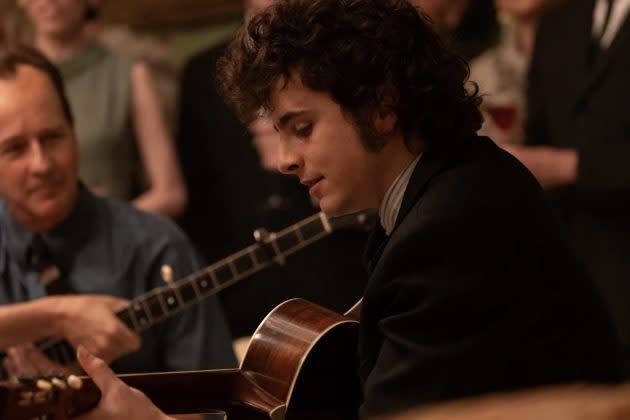
A Complete Unknown follows Dylan through a roughly four-year period, beginning in 1961 with a visit to the Greystone Park Psychiatric Hospital to meet his idol, Woody Guthrie (Scoot McNairy), and ending in 1965 following his controversial performance at the Newport Folk Festival, where his decision to perform using electric instruments is met with boos and jeers. In between, he has off-again/on-again relationships with two women, Sylvie Russon (Elle Fanning, based on real-life paramour Suze Rotolo, whose real name wasn’t used at Dylan’s request) and singer Joan Baez (Monica Barbaro), and approaches fame and fans with an inscrutable façade. He befriends Pete Seeger (Edward Norton), who gives him some of his early breaks, and Johnny Cash (Boyd Holbrook). And he allows his career to be guided by his pushy manager, Albert Grossman (Dan Fogler).

Although the movie features many of Dylan’s best-known songs, all performed by Chalamet with a better-than-passable imitation of the singer’s nasal intonations, it’s not a jukebox film or a traditional musical. Instead, it’s a drama that features music. The singing comes in logical places during studio recordings and live performances. There are no instances when characters spontaneously break into song and no choreographed dance sequences. Mangold approaches Dylan’s music much the same way that he approached that of Johnny Cash in Walk the Line.

At his best, Dylan is impassive and unfeeling. At his worst, he’s dismissive and cruel (although he probably doesn’t see the latter). He repeatedly hurts Sylvie and his relationship with Joan is such that she calls him an asshole on one occasion and a jerk on another. He shows minimal affection to anyone and turns his back on a woman who admits to loving him because he hasn’t known her that long. He is deaf to the desires of fans and afflicted with delusions of grandeur.
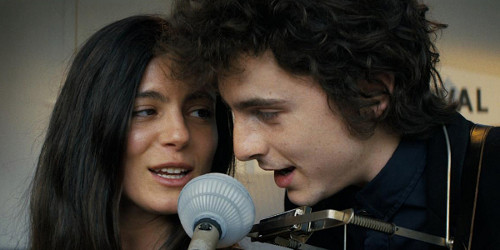


Tasked with portraying this version of Dylan, Chalamet goes full method. For two hours, he is Dylan, recapturing the look, mannerisms, attitude, and vocal inflections of the early ‘60s musician. As always with a performance like this, questions arise regarding how much of this is acting and how much is imitation. Ultimately, it doesn’t matter because A Complete Unknown gets us to believe that we’re watching Dylan wandering around ‘60s New York City. Mangold gets the details right, creating a place that’s both recognizable and alien at the same time.
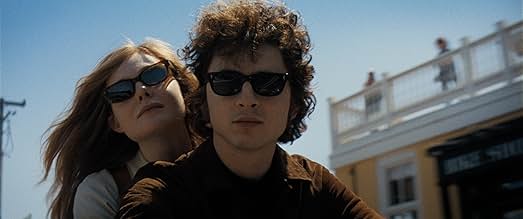


Having an affinity for Dylan isn’t necessary for A Complete Unknown to work. That’s because the movie is more about Dylan within the context of a time period than about Dylan as an individual. One could argue that he’s more of a presence than a character. We don’t know much about his past and Mangold never attempts to get into his mind or explore his motivations. Dylan comments in the film that people make up their own histories and backgrounds all the time. (Shades of The Joker in The Dark Knight.) His birth name is Robert Zimmerman but he changed it because he liked the way Dylan sounded. The screenplay uses TV news announcers as a way to pin scenes to certain critical historical events (like the Cuban Missile Crisis and JFK’s assassination).

An appreciation of Dylan’s catalog – especially his earlier songs – will enhance the movie’s effectiveness. (The title comes from a line in Like a Rolling Stone.) Still, those hoping to gain insight into this peculiar and prickly embodiment of genius will find that desire unsatisfied. A Complete Unknown isn’t shallow but the screenplay makes no attempt to psychoanalyze its subject. If there’s something to be learned, it’s how uncomfortable it could be to enter this man’s orbit. His music is iconic and speaks to many but, from the first scene to the last, he remains A Complete Unknown. [Berardinelli's rating: 3 stars out of 4]

Labels: biography, drama, music, Sixties
IMDb 73/100
MetaCritic (critics=70, viewers=72)
RottenTomatoes (critics=82, viewers=95)
Blu-ray
Berardinelli's original review

Bob Dylan wrote Boots of Spanish Leather, recorded it on August 7th, 1963, and released it on his 1964 album The Times They Are A-Changin'. The folk song is structured as a dialogue between lovers separating, often linked to his relationship with Suze Rotolo. It is noted for its poetic, bittersweet tone.


Saturday, November 15, 2025

A Man and a Woman ( Un homme et une femme) (1966) [NR] ****/*****


On the 2003 DVD release of A Man and a Woman, there is an interview with writer / director Claude Lelouch 37 Years Later with Claude Lelouch, in which he looks back and talks about how the film came to be.

He had just finished making Les Grands Moments and could not show the film because he did not have a distributor. He was broke and his film company was close to bankruptcy. So he did what he often did, which was to get in his car and drive to the beach - from Paris to Deauville on the Normandy coast. He arrived around 2 am, slept in his car and awoke around 6:30 am to see a woman walking on the beach with a child and a dog.

In that moment he had the inspiration for the film A Man and a Woman. Over the next four weeks he wrote the screenplay, having in mind Jean-Louis Trintignant to play Jean-Louis Duroc. When he showed the screenplay to Jean-Louis, he said yes immediately. Then Lelouch said that he had both Romy Schneider and Anouk Aimee (Anouk Aimée) in mind to play Anne Gauthier, and he asked Jean-Louis who his dream woman would be. Jean-Louis said he knew Anouk very well and Claude should just call her up. At first there was a little difficulty because Anouk did not like boats, so she did not want to do the boat scenes, but she finally gave in.

Lelouch shot the film over a period of four weeks, using a rented hand-held camera, and edited it in three weeks. He had intended to shoot it all in black and white because he could not afford color, but an American distributor bought the rights in the U.S. so Lelouch was able to shoot the exteriors in color and the interiors in black and white.

There are some interesting aspects to Lelouch's filmmaking style, particularly A Man and a Woman. He had a screenplay but did not let the actors read the dialogue. He described the scene beforehand, and if there was a particular sentence he wanted said, he would mention that, but, other than that, he let the actors improvise. Also, what he told Jean-Louis was not the same thing he told Anouk. He never rehearsed because he believed that after the first or second take, the spontaneity would be gone. Also, Lelouch did all the filming himself because it eliminated the natural time delay in telling the cinematographer what he wanted.

Sometimes he would play Francis Lai's score for the actors before the scene, especially if he couldn't find the right words to say to direct them. Also, after the scene was finished he would play the dialogue back for the actors so they could all get a feeling for how it was going.

Lelouch said that he was fascinated by people, that the human interraction was the important thing, and that was why he tried to shoot the film in real time, without rehearsals and very few takes. At some point the actors were living the story, which made the film as close to the truth as possible.

Interestingly, the rented camera was not soundproofed, so they would wrap it in a blanket for close-ups, but relied a lot on distance shots using a telephoto lens. This is why the film has the look that it does.

So, what about the story? Anne was a film script girl who met and married her husband Pierre (Pierre Barouh) on a project in which he was working as a stunt man. They had a child, a little girl named 
Françoise, and then Pierre was killed while filming a battlefield scene in a WWII film. To be able to continue working, Anne enrolled her little girl in a boarding school in Deauville.

Jean-Louis was a race car test driver for Ford, testing the new GT40 LeMans car and the Ford Formula 1 car. In a flashback we see him racing at LeMans, being involved in a horrific accident, undergoing a three-hour operation and then having his grief-stricken wife Valerie (Valerie Lagrange) take her own life at the hospital. And so, after that, Jean-Louis put his young son Antoine in the same Deauville boarding school. And Anne and Jean-Louis eventually meet at the boarding school when she misses her train back to Paris and the school headmistress (Simone Paris) introduces them.

It really is a very simple love story, the main complication being that Anne was very much in love with her husband Pierre, and, even though he had died, he was still alive for her. So she could not be present while she and Jean-Louis were making love in their Deauville hotel room, and even at the end of the film, we are not sure if she will be able to move forward.

In an interesting footnote, the film was shot between November, 1965 and January, 1966. Anouk Aimee and Pierre Barouh fell in love during filming, married three months later, on April 20, 1966, and divorced three years later, on March 17, 1969. 

For myself, this is almost a coming-of-age film. I was born in 1942, spent time in Paris in the summer of 1965, just before this was filmed, and appreciate the honesty and integrity with which the film was made.  

Labels: drama, romance, Paris, Sixties
IMDb 75/100
RottenTomatoes (critics=76, viewers=87)
DVD


Friday, October 29, 2021

The Queen’s Gambit (2020) [TV-MA] ***** (updated January 25, 2023)

A film review by Allison Shoemaker for rogerebert.com on Oct. 23, 2020.


When you read the words
Netflix limited drama series about addiction, obsession, trauma, and chess, the first adjective which springs to mind is probably not thrilling. But here we are, and The Queen’s Gambit, Scott Frank’s adaptation of Walter Tevis’ coming-of-age novel of the same name, absolutely demands the use of thrilling. Anchored by a magnetic lead performance and bolstered by world-class acting, marvelous visual language, a teleplay that’s never less than gripping, and an admirable willingness to embrace contradiction and ambiguity, it’s one of the year’s best series. While not without flaws, it is, in short, a triumph. And it is satisfying not just as a compelling period drama, a character study, and a feast for the eyes. It’s also, at its heart, a sports movie wrapped up in the vestments of a prestige TV series. Ask yourself this: When is the last time you fist-pumped the air over chess? Isn’t that something you deserve?

Odds are that Beth Harmon (the remarkable
Anya Taylor-Joy) will earn quite a few fist-pumps as people discover Frank and co-creator Alan Scott’s excellent series. We meet Beth as an eight-year-old (Isla Johnson) when she’s left impossibly unharmed - physically, at least - by the car crash that kills her mother. Her father’s not in the picture, so Beth finds herself at the Methuen Home, a Christian school for orphans in Mt. Sterling, Kentucky. While there, she develops three things: a friendship with Jolene (newcomer Moses Ingram, excellent), a passion for chess, and a physical and emotional dependence on the little green tranquilizers fed to the children until they’re outlawed by the state of Kentucky. When she finally leaves the school, she’s got those last two things packed in her suitcase alongside a bunch of chess books, a sizable ego, some unexplored trauma, and no small amount of self-loathing. But it’s the game that drives her, sending her both to the heights of the competitive chess world and, increasingly, to her hoard of pills and the oblivion offered by alcohol.

In short, Beth has a lot to handle. Luckily, Anya Taylor-Joy is more than up to the task. Playing Beth from 15 onward, Taylor-Joy gives the kind of performance that only becomes more riveting the longer you sit with it. It’s a turn of both intoxicating glamour and precious little vanity, internal without ever being closed-off, heartbreakingly vulnerable and sharply funny, often at once. Much of the story hinges on when and how Beth is alone - and sometimes she’s most alone when surrounded by people - and Taylor-Joy’s performance is particularly remarkable in these moments. Scenes of Beth alone in her home, in a stranger’s apartment, on a plane, in her bed at night - they all hum with the kind of energy that only arises when one is truly unobserved. In this case, however, she’s creating that energy in a room full of cameras and crew members. That kind of honesty and release is the stuff of acting legend, like Eleanora Duse’s blush. It’s yet another high watermark in a young career already full of them, and somehow she’s never better than when Beth is sitting silently behind a chess board.

We’ll come back to those scenes, but it would be a mistake to assume that Taylor-Joy’s only great scene partner is the camera, gazing from across the 64 squares of the board. Frank and casting director
Ellen Lewis assembled an ensemble of heavy-hitters, including the great Bill Camp as Mr. Shaibel, the isolated janitor who introduces Beth to the game, Thomas Brodie-Sangster (as Benny Watts) and Harry Melling (as Harry Beltik) two young men who are first chess rivals, then lovers and eventually allies in the chess world, the wonderful (if underused) Moses Ingram, and actor / writer / director Marielle Heller, who gives a hypnotic performance as the fragile, damaged, compassionate Alma Wheatley, the woman who eventually welcomes Beth into her home. There’s not a dud in the bunch; even the actors who show up for a scene or two at most give performances that feel fully inhabited. It’s a stunner of an ensemble.

And here’s a bonus: they all look incredible.
The Crown is rightly praised for its sumptuous, detailed production design and costuming, and The Queen’s Gambit will likely find itself compared to its Netflix predecessor with some frequency. But for all the strengths of The Crown, it rarely showcases the kind of imagination on display here. Costume designer Gabriele Binder, hair and makeup head Daniel Parker, and production designer Uli Hanisch (the latter of Cloud Atlas, Sense8, and Babylon Berlin) do much more than capture the look and feel of the 1960s in the United States and abroad. They use that aesthetic to illuminate Beth’s mindset. When does Beth embrace the wilder aspects of ‘60s makeup? Why, when she’s balancing precariously on the edge and her thick eyeliner serves to make her look even thinner and more fragile. That’s one example of many. It’s incredibly thoughtful and stylish. Consider it isolated breakdown chic.

The aesthetic of Beth’s inner world is also explored, though to detail what that looks like and what it means is to diminish some of the pleasure (and anxiety) it engenders. Just know that it lends Beth’s struggles a visceral energy that most stories of addiction tend to either take for granted or overplay. And for the most part, that care and thoughtfulness is found in all of the tropes present in
The Queen’s Gambit (and there are plenty of tropes - this is a sports movie in disguise, after all). That said, Frank’s largely excellent teleplays do occasionally stumble, particularly when it comes to race (Jolene deserves better) and gender. The latter is a shortcoming shared with Frank’s Godless - both have their hearts in the right place, but are perhaps not as thoughtful or insightful when it comes to sex, love, and the realities of a patriarchal society than they believe themselves to be.

Frankly, it’s hard to get too worked up about those shortcomings thought, especially when the chess starts. The chess! My god, the chess. Like any good sports movie, this character-driven period drama lives and dies by its editing. Editor
Michelle Tesoro should go ahead and buy a bookshelf for all the hardware she’s about to pick up for The Queen’s Gambit right now; the chess sequences are all electric, and each in its own way. One will make you hold your breath. Two will likely bring you to tears. Some are funny. Some are infuriating. Some are, somehow, very, very sexy. Each is electric, and Tesoro and Taylor-Joy make them so through skill, talent, and precision. (Some credit here is also due to chess consultants Bruce Pandolfini and Garry Kasparov. I know very little about chess, but somehow The Queen’s Gambit convinced me otherwise and dazzled me all at once.)

Every truly great sports story has not one, but two beating hearts. There’s the sport itself, a game or competition in which the viewer becomes undeniably invested. And then there’s the player or players, someone whose life is much bigger than the game, yet is nevertheless somewhat consumed by it.
The Queen’s Gambit has both those hearts, and both are racing. Frank, Taylor-Joy, and company never stop telling both those stories at once, and the result is a fascinating portrait of a young woman fighting to become the person she wants to be, battling for victory and for peace. When her journey brings her to Paris, she remembers the words of a woman who loved her and spends some time wandering museums, feeding her soul with something more than chess. Yet there’s never any doubt that somewhere, in some corner of her mind, she’s got her eyes on the board. What a privilege it is to see that corner and see the world’s beauty, all at once. [Shoemaker’s rating: 3.5 stars out of 4 = 88%]

Blogger's comments and links:
The ending scene takes place in Moscow early in 1968, the morning after Beth defeated Vasily Borgov to win the Moscow Invitational Tournament. She is on the way to the airport to leave Moscow, accompanied by her CIA handler, when she asks the driver to stop because she wants to walk. She walks down the promenade where she knows elderly gentlemen gather to play chess outdoors, and of course they recognize her and clearly they love her. For a girl who never knew her own father, and who had a father figure in the orphanage janitor Willian Shaibel who taught her to play chess, this is fulfillment - to be appreciated, even worshipped in Russia, a country obsessed with the game of chess. The first gentleman to recognize her then invites her to sit down. They set up the chess board, Beth removes her gloves, and the last word of the film is her saying sygrayem, pronounced sy.GRY.em, Russian for Let's Play. LINK

The Queen's Gambit ending explained; the major moments that wrapped up the story. LINK TO CINEMABLEND WEBPAGE

If the ending to the film made you tear up, you are not alone. It made Anya Taylor-Joy cry as well. LINK TO REFINERY29 ARTICLE

Beth Harmon's final word in the film is sygrayem which literally means Let's Play in Russian. LINK TO TRANSLATION WEBSITE

Magnus Carlsen (world chess champion since 2013) breaks down Harmon v Borgov final game from The Queen's Gambit LINK
 
The Queen's Gambit guide to Lexington, Kentucky LINK

Labels: chess, drama, Fifties, high-school, romance, rom-drama-faves, Sixties, teenager
 
 
Blogger's comments on the novel:
The Walter Tevis novel of the same name strongly resembles the TV series, especially in the use of dialogue and narration from the novel. However, there are some notable differences (SPOILERS AHEAD). While Beth visualizes games in her head, she does not visualize them on the ceiling of her room. Townes has a much smaller part in the novel, he is not identified as gay and he does not appear at the 1968 Russian Invitational Tournament in the last episode. Cleo, whom Beth meets in Benny's NYC apartment, is an American girl named Jenny in the novel. She is not at the 1967 Paris Remy-Vallon tournament that Beth loses to Borgov. In the novel, Beth participates in the 1968 Kentucky State Chess Championship and loses. In the miniseries she goes to the tournament, has an argument with Harry Beltik in the parking lot and does not participate in the tournament. Jolene does not contact Beth; Beth gets her phone number from Mrs. Deardorff at Methuen. Jolene is living in Louisville. She was a Phys. Ed. major at Kentucky State University and through her efforts Beth goes to a gym every day for several months, gets in shape physically and gets her drinking and Librium addiction under control.
 
Being a visual person and loving film, especially romantic drama and comedy, I have to say that I much prefer the miniseries. Now, if we were comparing a 243-page paperback novel with a 2-hour film it might not be a fair comparison, but we are comparing it with a 393-minute (6hr 33min) 7-part miniseries. If a person read at 37 pages/hr it would take just about the same time to read the novel or watch the miniseries and the miniseries gives a MUCH richer experience. I don't ever need to read the novel again and I've watched the miniseries at least four times - so far.
 
Having thought about it a little more, let me say the novel provides intellectual understanding; it supports and enriches the experience of the miniseries. The miniseries gives significance to the intellectual understanding provided by the novel. The novel especially helps us understand what is going on inside Beth's mind and body before, during and after tournaments. Also, Beth's relationships with Jolene, Alma Wheatley, Harry Beltik and Benny Watts are developed a little better in the novel. What is absent in the novel? Well, there are very few details about how Alice Harmon, Beth's mother, dies. There's no Cleo at Remy-Vallon in Paris. There's no Townes in Moscow. Also, the novel helped me understand how Beth financed her life, was able to buy out Allston Wheatley's equity for $7,000 and make the mortgage payments, from her tournament winnings. So the novel does have value.
 
There are any number of delightful little cookies in this series. For instance, after Beth is adopted in Episode 2, she accompanies Alma to Ben Snyder's department store in Lexington, to shop for clothes. On the way upstairs to the bargain department she is attracted by two mannequins displaying dresses, before being captivated by the display of chess boards. We learn that Beth likes nice clothes. And after she wins the Kentucky State Chess Championship in October, 1963, she buys the blue dress with her winnings and we see her wearing it when she and Alma go to the Cincinnati Open Tournament. But the other dress, the white and black one? She wears that dress to the U.S. Open in Las Vegas in 1966.
 

Episode 1 "Openings": The film being shown in the orphanage auditorium is The Robe (1953) starring Richard Burton and Jean Simmons.

Episode 3 "Doubled Pawns", 30:39: Beth and Alma are in their hotel room at the 1966 US Open in Las Vegas. Alma is watching a murder mystery on the TV The Strange Love of Martha Ivers (1946). Martha (Barbara Stanwyck) is talking with Sam Masterson (Van Heflin):
Martha: What do you want?
Sam: I think I've got one. I think I've got a gimmick. A gimmick is an angle that works for you. To keep you from working too hard for yourself.

* * * * *

Being a hopeless romantic, I was naturally disappointed with the lack of romance in the series, and so I have envisioned an eighth episode which takes place first in Moscow and later in Lexington, Kentucky. Beth gets out of her State Department handler's cab on the way to the airport not only because she wants to visit the park where the elderly men are playing chess, but also because she and David Townes are falling in love and have agreed to stay in Moscow together after the tournament ends.

So he comes to the park, and after she has finished playing her chess game, which she wins of course, she and David take a cab to the airport, pick up her luggage and find a smaller, less-expensive hotel to stay in. After a few days together seeing the sights in Moscow they board a plane and return to the U.S. Beth invites David to stay with her and eventually they get married.

It turns out that David was not really gay, as he tried earlier to explain to her. He was just confused. Is he bisexual? Who knows?


Wednesday, June 17, 2020

Ford v Ferrari (2019) [PG-13] *****

A film review by James Berardinelli for ReelViews.net on Nov. 14, 2019.

It’s said that the sports movie format works best when telling a true story. Director James Mangold, after having spent some time in the X-Men universe (he helmed both The Wolverine and Logan), has returned to the real world to direct two A-list stars, Matt Damon and Christian Bale, in a story of a different kind of heroism. When it comes to sports movies, race car driving is an underrepresented field, primarily because the act of sitting in a car careening around a track for lap after lap after lap isn’t inherently cinematic. Recognizing this, Mangold limits the racing sequences in Ford v Ferrari to the minimum necessary to ensure audience involvement and divides the focus equally between the sports elements and those faced by the characters when developing and building the cars.

The movie is loosely based on the true story of how Henry Ford II (Tracy Letts) entered into a racing rivalry with Enzo Ferrari (Remo Girone) that culminated in showdowns at the 1965 and 1966 Le Mans. Various factual events have been changed to enhance the drama. Faced with the enormous undertaking of competing against perennial winner Ferrari, Ford tasks executives Lee Iacocca (Jon Bernthal) and Leo Beebe (Josh Lucas) to hire former Le Mans winner Carroll Shelby (Matt Damon) to design a race car. (Note: This is same Lee Iacocca who would revive Chrysler’s fortunes during the 1980s and become a household name by doing so.) When he is given a blank check for the work, Shelby agrees. His team includes Roy Lunn (JJ Field), Phil Remington (Ray McKinnon), and the brilliant but difficult British driver, Ken Miles (Christian Bale). Miles’ irascibility and perceived anti-team attitude earn him Beebe’s ire and he persuades Ford to limit Miles’ involvement to development and test driving. Of course, this being a sports movie, we know that’s not how things are going to end.

Mangold takes Ford v Ferrari out of the simple realm of the genre without entirely losing the vibe. We still have the buildup/training scenes in which the participants prepare for the big contest. We still have a preliminary bout in which the central figure shows his worth. And we still have the showdown. But, although the climax satisfies, it does so in an unconventional fashion. And, in the end, one can make a compelling argument that the true villain isn’t Ferrari or the driver of car #21 but Henry Ford II or his gutless corporate shill, Beebe.

The chemistry between Damon and Bale is solid – an effective meshing of oil and vinegar. Damon is suave, smart, and easy-going. Bale is angry and intense. The best scene featuring the two of them occurs when they engage in a fist-fight outside Miles’ home while his unconcerned wife, Mollie (Caitriona Balfe), pulls up a lawn chair to spectate. It’s one of a number of comedy-tinged scenes. Although Mangold culls the expected tension from the racing scenes, he’s not above going for the funny bone. Witness what happens when Shelby takes Mr. Ford for a little ride. Tracy Letts’ reaction is priceless.

Ford v Ferrari has a pacing issue. While gearheads, racing fans, and some engineers may disagree, the movie goes too deep into the nuts & bolts. There’s too much about the minutia of designing and building the cars. Although the racing scenes are bracing, with just enough first-person, through-the-dashboard shots to give the audience a you are there perspective, there are dead spots in between. This isn’t the first time in 2019 that I’ve felt a movie could have been improved by some judicious cutting. We have reached a point in film evolution where the Extended DVD Director’s Cut has become the theatrical release.

I admire the ways in which Mangold has broadened the sports movie without sacrificing the integrity of its essential elements. There’s a lot more in this production than what one often uncovers in the genre with its elements of corporate greed and the buddy film sideshow. Don’t be put off by the lackluster title. This is solid, middle-of-the-road entertainment. Slow patches aside, it finishes strong and, although it probably won’t win the box office race, it may generate some Oscar interest (because Bale is almost always good enough to warrant that sort of attention). [Berardinelli’s rating: 3 out of 4 stars = 75%]

Blogger’s comment: Ford v Ferrari won Oscars for Best Film Editing and Best Sound Editing.

Labels: action, auto-racing, biography, drama, Ferrari, history, Matt Damon, Sixties, sport


Judy (2019) [PG-13] ****

A film review by James Berardinelli for ReelViews.net on Sept. 29, 2019.

When today’s average movie-goer thinks of Judy Garland, the image that comes to mind is that of Dorothy Gale, the girl-next-door heroine of The Wizard of Oz. Few remember the Garland of the 1960s – a pill-popping alcoholic with a self-destructive streak. Her vocal powers diminished by years of self-abuse, Garland was a shadow of her former self by the time she accepted a five-week engagement for a London stage show. Six months later, she was dead of a barbiturate overdose. For this biopic, director Rupert Goold, working from a screenplay by Tom Edge (which, in turn, used Peter Quilter’s play End of the Rainbow as its source material), focuses on early 1969 and the final hurrah of the singer/actress, played by Renee Zellweger, before the curtain came down on her life at the age of 47.

Judy’s thesis, which is supported by the facts, argues that the broken woman we see struggling through the late 1960s is the direct result of childhood mistreatment. For illustration, Goold provides flashbacks to the set of The Wizard of Oz. Garland (Darci Shaw), 16 at the time, was put on a forced diet by studio head Louis B. Mayer. She was given amphetamines for breakfast for energy and barbiturates at night so she could sleep. The drug habit she developed during those early showbiz years haunted her throughout the remainder of her days. Garland’s life wasn’t a happy one; consequently, Judy isn’t an upbeat motion picture. It cheats a little to provide the occasional Hollywood moment (the most notable of which relates to a rendition of her signature song, Somewhere Over the Rainbow) but its perspective of the title character is mostly clear-eyed and free of overt sentimentality.

Judy opens in 1968, with Garland performing at New York’s Palace Theater along with her two youngest children, Lorna and Joey Luft. She is a devoted mother but an uncertain provider. With her finances in disarray and her debts mounting, she is evicted from the hotel where she has been staying. This forces her to take her kids to the house of her ex-husband, Sid Luft (Rufus Sewell), and accept a lucrative offer to sing in London. While there, she battles her personal demons while becoming a headache for her handler, Rosalyn Wilder (Jessie Buckley), and the owner of the Talk of the Town nightclub, Bernard Delfont (Michael Gambon). She reconnects with Mickey Deans (Finn Wittrock), a smooth-talker she previously met in the United States, who becomes the final Mr. Garland. (Historically, he found her body in their rented London home.)

Judy is the Renee Zellweger show. Although the movie isn’t being accorded an aggressive release (and is coming out before the Oscar Season begins in earnest), she is already on many critics’ short list for awards contention. It’s an all-in performance, with Zellweger doing more than merely mimicking Garland. In addition to radically altering her physical appearance, the actress studied film to be able to impersonate her character’s body language. She worked with a voice coach to capture the timbre of Garland’s vocals. Although there are occasions when we catch a glimpse or two of Zellweger, the person we’re seeing on screen is mostly Garland.

By confining events to a limited span in time, Judy avoids the most common pitfall of screen biographies – too much story for too little time. The movie doesn’t feel rushed or compressed. There are, however, sacrifices necessary to this form of narrative. First, huge chunks of Garland’s life occur off-screen and are either only briefly referenced or ignored. Secondly, The Wizard of Oz flashbacks are so intriguing that some viewers may wish the movie had lingered longer in that era. (The predatory Louis B. Mayer would have made an excellent villain for a Making of Oz film.)

Although Judy doesn’t adhere rigorously to the chronology of the main character’s last months, it provides a compelling portrait of the tragic decline of one of America’s 20th century icons. The predictability of the film’s arc is a reflection of the inevitable rhythms of drug and alcohol addiction and abuse. Zellweger’s performance is the glue that holds everything together. Taken in total, Judy is a workmanlike production where any deficiencies in the narrative are easily covered over by the acumen of the actress who can add this movie to Bridget Jones (Oscar nominee), Chicago (Oscar nominee), and Cold Mountain (Oscar winner) on her shelf of personal triumphs. [Berardinelli’s rating: 3 out of 4 stars = 75%]

Labels: biography, drama, Fifties, history, music, musical, romance, Sixties, tragedy


Apollo 11 (2019) [G] *****

A film review by Peter Bradshaw for TheGuardian.com, 28 June 2019.

A stunning return to an incredible journey featuring previously unseen footage, this electrifying documentary marks 50 years since the first moon landing.

Sometimes gush is the only appropriate response and the amazingness never gets any less amazing. The 50-year anniversary of the Apollo 11 moon launch has now been marked by this fascinating documentary, which presents newly discovered colour footage of the build-up with the buzzcut wholesomeness of the astronauts’ good-naturedly trustful faces in close-ups, the electrifying launch, the touchdown and the return to Earth.

Somehow, it doesn’t look like something that happened 50 years ago – but rather an extraordinarily detailed futurist fantasy of what might happen in the years to come, if we could only evolve to some higher degree of verve and hope. And, to my amateur eye, the design of the Apollo rockets is incomparably superior to the NASA spacecraft that came afterwards or to anything in any sci-fi movie or TV show ever.

Then there are the gripping shots of what appears to be the spectators’ outdoor gallery in Florida, people in fantastic 60s clothes and sunglasses, many with some high-powered binoculars and cameras – some professional media, some apparently hobbyist civilians. There don’t seem to be many people there. Did they win a lottery to be at that exclusive venue?

I thrilled all over again to the images of the men on the moon, from Neil Armstrong’s stirring statement on taking his historic step and to Buzz Aldrin’s heart-stopping joke about what would happen if he absent-mindedly pulled the capsule door shut behind him on his way down the ladder. And what is maybe just as remarkable is not the journey to the moon but the journey back to Earth, and the views of the planet from space, the historically new perspective. It never gets old. Are we ever going to go back? [Bradshaw’s rating: 5 out of 5 stars]

Labels: biography, documentary, history, Sixties


Tuesday, June 16, 2020

First Man (2018) [PG-13] ****/*****

A film review by James Berardinelli for ReelViews.net on Oct. 9, 2018.

First Man, a workmanlike bio-pic of astronaut Neil Armstrong, is at times compelling and at times maddening. Although inferior in its depiction of the early days of the space program to such riveting productions as The Right StuffApollo 13, and From the Earth to the Moon (the 10-part 1998 mini-series that one might consider to be definitive), First Man offers an intimate portrayal of Armstrong, offering a peek behind the taciturn mask he wore as an icon and hero. Unfortunately, along with his determination to burrow into the lead character’s psyche, Oscar-winning Damien Chazelle (whose statuette came for La La Land) fully embraces the shaky-cam handheld approach.

Motion sickness warning! Those who are sensitive to this sort of thing may want to avoid First Man on the big screen. (I have noticed that the shaky-cam technique loses its stomach-churning potency on a TV.) That may seem like bizarre advice for a movie that was in part filmed using IMAX 70mm cameras, but it’s not those scenes that are the problem. And, while it’s defensible to argue the stylistic merits of shaky-cam for the cramped, chaotic environment within the early Gemini and Apollo craft, Chazelle uses the approach for a variety of land-based family and work environment shots. Although the intention of employing the wobbly hand-held shots is to create a deeper sense of immersion, I found the opposite to be true. It is an almost immediate distraction and makes the viewer keenly aware of cinematography and technique. Every time the camera shakes, I was aware that this was a movie. (I am not subject to motion sickness in theaters but I could sympathize with how those who are might react to some of the scenes in First Man. In a post-screening discussion among colleagues, this was the first issue that came up.) It’s not a little thing – it’s a legitimate impediment to appreciating an otherwise involving drama.

First Man follows the development of the space program from 1962 through 1969 as seen through Armstrong’s eyes (for the earlier Mercury phase, see The Right Stuff). Personal tragedy and achievement form parallel forces in Armstrong’s life. He loses his young daughter to cancer and several close friends, including his best pal, Ed White (Jason Clarke), fall prey to work-related accidents. The fatal Apollo 1 pre-launch test fire, which killed White, Gus Grissom (Shea Whigham), and Roger Chaffee (Cory Michael Smith), is a significant plot point. The final quarter of First Man depicts the Apollo 11 mission, including the tense descent to the moon and Armstrong’s delivery of the memorable line: That’s one small step for man; one giant leap for mankind.

controversy has developed about how Chazelle handles a particular aspect of the moon sequences. He does not show Armstrong and co-astronaut Buzz Aldrin (Corey Stoll) setting up the U.S. flag. Taken out of context, this might seem to be an egregious, unpatriotic omission. In context, however, nothing could be further from the truth. The moon scenes aren’t about recreating history; they are about providing a window into Armstrong’s thinking. As such, most of what the astronauts did on the moon isn’t in the film. And the flag itself isn’t removed – only its planting. There are two shots of the lunar lander with the flag very visible next to it. The flag is a visible touchstone throughout the film and a deep sense of patriotism is evident in the subtext. Toward the end, a French woman expresses appreciation for American ingenuity and perseverance. One of the final scenes is a re-affirmation of Kennedy’s determination that America put a man on the moon (and return him home safely) by the end of the (1960s) decade. Those who would level charges against Chazelle should see the movie before jumping to conclusions. Armstrong was an engineer, a pioneer, a father and husband, and an American. The movie depicts all of these things.

As Armstrong, Ryan Gosling (who previously worked with Chazelle on La La Land) provides Armstrong with an expectedly inscrutable façade. His moments of grief, self-doubt, and self-recrimination are all private. Gosling’s performance honors both the man and the icon. (His delivery of Armstrong’s moon-landing statement, although subtly manipulated by computer, is so perfect that many will think Chazelle appropriated the actual recording.) Making the most of a supporting character, Claire Foy’s interpretation of Armstrong’s firebrand wife, Janet, was later nominated for Golden Globes and BAFTA Awards for Best Supporting Actress.

Despite being about spacefaring, this is not a special effects-loaded production. There’s some visual razzle-dazzle, to be sure – shots of the spacecraft, of Earth from space, and of the actual landing – but those instances are limited to what’s necessary to tell the story and, as a result, are effective without seeming overwhelming or gratuitous. Justin Hurwitz’s score is effective in doing justice to the moments of grandeur and the quieter, more personal ones. His style varies between Hans Zimmer for the former and Rachel Portman for the latter.

Timing is undoubtedly one of First Man’s assets with Apollo 50 (the half-century anniversary of the moon landing) coming next year. Interest is high and Chazelle’s presentation of events and the central player in them will heighten it. (The movie will be released on home video only a few short months before the actual anniversary.) For those who can get past the shaky-cam aspect that infects the cinematography, this is an involving look back in time at one of the most significant human endeavors of the last century. It’s not definitive but it is welcome. [Berardinelli’s rating: 3 out of 4 stars = 75/100]

Blogger’s comment: Apollo 11’s moon landing on July 20, 1969 is one of the definitive moments in American history. I happened to be a USAF captain traveling from Texas to Frankfurt, West Germany and remember being in the departure lounge at Torrejón Air Base in Madrid, Spain and watching Neil Armstrong step off the lunar lander and make his now-famous statement. Sadly, I also remember the Apollo launch pad fire in January, 1967 that killed Edward White, Virgil Gus Grissom and Roger Chaffee. At the time I was stationed at Chanute AFB, Rantoul Illinois (now decommissioned), attending Aircraft Maintenance Officer training. Several months later, in May, 1967, I transferred to Webb AFB, Big Spring Texas (also now decommissioned), a pilot training base where James White, younger brother of Edward White, was an instructor pilot. It really is a small world.

Labels: biography, drama, history, Sixties


Monday, June 15, 2020

Hidden Figures (2016) [PG] ****/*****

A film review by James Berardinelli for ReelViews.net on Dec. 23, 2016.

Hidden Figures is an old-fashioned, inspirational tale about the downtrodden overcoming. Based on real people, real times, and real events, the film uses the never-say-die attitudes of three women to provide a window into the racism and sexism that permeated all facets of American culture during the middle of the 20th century. Although softer than many other recent movies about this subject (the PG rating creates stringent limits on how edgy things can get), Hidden Figures is nevertheless able to illustrate the exclusivity of the white male corporate power base and show how three unlikely black women were able to punch through the barrier.

Those who want to use Hidden Figures as a history lesson should beware, however. Although the three women featured in the film, mathematician Katherine Goble Johnson (Taraji P. Henson), coordinator Dorothy Vaughan (Octavia Spencer), and engineer Mary Jackson (Janelle Monáe), aren’t likely to be found in many text books, the screenplay takes liberties with their lives. The time stream is collapsed to streamline the narrative - many of the events presented in the film transpired during the 1950s while Hidden Figures is set in the 1960s (in the lead-up to John Glenn’s historic mission). The production also massages the facts to fit Hollywood’s vision of how the story should be told. It’s mostly accurate from an overarching perspective but there’s artifice in the details. At times, bits and pieces of Hidden Figures seem manufactured. There’s nothing new about this for a based-on-a-real-events movie but it’s something to be aware of.

Katherine, Dorothy, and Mary are three best friends who work as computers in NASA’s pre-electronic era. The racially segregated computers are women who perform the menial computations that allow the male engineers and scientists to plot orbits and determine safety margins for rocket launches. Katherine and Mary are selected for assignments to work directly with the men while Dorothy remains behind to run the colored computer room, despite lacking the title and pay raise that should go along with her job. Working on a team designing heat shielding for capsules, Mary determines that she has an aptitude for engineering and, despite obstacles based on both her sex and race, she pushes forward with a single-minded determination that requires a court challenge of segregation laws. Meanwhile, Katherine’s skills as a mathematician get her noticed by Al Harrison (Kevin Costner), the director of the Space Task Group, who gives her increasingly important tasks as the Friendship 7 (Glenn’s Earth orbit) mission approaches.

By telling three separate stories, writer/director Theodore Melfi (Saint Vincent) has an opportunity to present not one, not two, but three moments of triumph. Since the story slants toward Katherine, hers is the most forceful but Dorothy and Mary get their time in the spotlight as well. The movie works best during the NASA scenes. Many of the home/life segments feel canned - we’ve seen these character-building incidents before. Hidden Figures does a better job of humanizing its protagonists when they’re at work than when they’re at home. The freshness and authenticity of the NASA material is at times undercut by the clichés that are knitted together to form the women’s domestic circumstances.

Hidden Figures does what it can to convey the lack of workplace equality without resorting to the use of racial epithets or physical violence, neither of which would be allowed in a PG-rated movie. The film’s most pointed statement is presented with a flair of absurdist comedy as it shows the long, time-consuming trek Katherine must endure any time she needs to use the bathroom since the only lavatory in the laboratory is a whites only facility. So, rain or shine, she must go all the way to the computers’ building to find a place where she is allowed to go. Harrison’s reaction when he learns of this is a reminder that some in the 1960s were able to see past skin color.

Melfi has assembled a strong cast, led by Oscar and multi-Emmy nominee Taraji P. Henson, Oscar winners Octavia Spencer and Kevin Costner, multi-Emmy winner Jim Parsons (in a straight role), and multi-Golden Globe nominee Kirsten Dunst. Recording artist Janelle Monáe gives a solid performance in one of her first dramatic appearances (she’s also in this year’s Moonlight). Henson’s acting has the heart and power to potentially earn her another nod in the 2017 sweepstakes. Costner continues to show growth in front of the camera, evincing layers we never saw when he was a dominant force at the box office. Age has brought maturity. He won’t get an Oscar nomination for his portrayal of the NASA honcho but it is one of the movie’s pleasant surprises.

Historical fudges aside, Hidden Figures provides an example of determination and talent triumphing over an unfair and repressive system - something that, although grounded by the time period in which the story unfolds, has relevance beyond the decade or the century in which it transpires. [Berardinelli’s rating: 3 out of 4 stars]

Labels: biography, drama, history,  Sixties