
Wednesday, March 11, 2026

F1: The Movie (2025) [PG-13] ****/*****
A film review by James Berardinelli for ReelViews.net, June 26, 2025.

When it comes to the nuts and bolts of car racing movies, there’s a tendency to follow the trends and tropes of the wider sports film genre in which they form a sub-category. The difference is that when Robert Redford steps to the plate or Sylvester Stallone delivers a punch, the stakes tend to be more personal than permanent. Golfers, basketball players, and sluggers generally don’t have to worry about being carted away in a body-bag; the specter of the Grim Reaper is one thing that differentiates F1:The Movie and all its car-racing contemporaries from most sports films. Sometimes in car racing, it’s not so much about crossing the finish line first but living to race another day.
There’s a lot of dramatic potential inherent in this kind of movie but F1 is less interested in developing new tracks than in doing the best it can with existing ones. Ehren Kruger’s by-the-numbers screenplay could have been churned out using AI – the film’s human element aspects are perfunctory and familiar and the narrative rarely veers from the expected trajectory. Those who see F1 shouldn’t expect any surprises or twists and the collaborative involvement of the FIA (the sports’ governing body) takes a lot of possibilities off the table. All that being said, director Joseph Kosinski delivers an experience on par with his earlier mega-hit, Top Gun: Maverick, without the benefit of nostalgia or Tom Cruise. The Grim Reaper’s hovering presence helps with the tension but F1 mostly delivers because of the easygoing charm of Brad Pitt, the energetic camerawork of Claudio Miranda, and the loud, intense score by Hans Zimmer. The movie often pushes the viewer to the point of sensory overload, and that’s where its strength lies. Good luck replicating that at home.
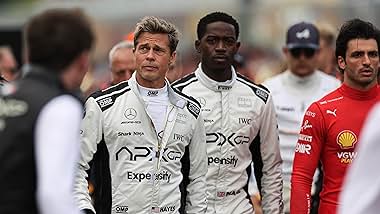
To the extent there’s a non-technical anchor grounding the story, it’s the antagonistic relationship between the two drivers who represent the ne’er-do-well Apex Grand Prix team (APXGP): over-the-hill veteran Sonny Hayes (Pitt) and up-and-coming Joshua Pearce (Damson Idris). Both could use Sinatra’s rendition of My Way as their theme song. Hayes is recruited by his old buddy, Ruben Cervantes (Javier Bardem), the current owner of APXGP, to come out of retirement and give Formula 1 racing one more chance. After initially demurring, Sonny has a change of heart and shows up with his megawatt smile, self-deprecating attitude, and cocky sense of self-assurance – all things that irritate Pearce, the team’s #1 driver. A rivalry develops, fueled by Sonny’s initial track failures. As board member Peter Banning (the always-oily Tobias Menzies) hovers like a vulture, Ruben begins doubting the sanity of his Hail Mary. Sonny might have been a potential star before a near-fatal accident, but that was 30 years ago. Meanwhile, as Sonny tries to build a rapport with the pit crew and other behind-the-scenes members of the team, his flirtations with the chief engineer, Kate McKenna (Kerry Condon), heat up.
It’s a credit to both Pitt and Damson Idris that the fractious relationship between Sonny and Joshua has the force and immediacy it does given the hackneyed nature of the material. Their chemistry transcends the thinness of what’s on the written page. Likewise, there’s an easygoing camaraderie between Sonny and Ruben and genuine sparks between the will-they-or-won’t-they pair of Sonny and Kate. I appreciated that the movie keeps the romantic elements mostly in the background. It adds a dash of flavor without interfering.

Unsurprisingly, F1 shines during the action sequences. As is often the case with racing movies, the events themselves aren’t cinematic (given the length associated with races) but the crashes are. Kosinski’s approach is to home in on big moments, using a variety of camera angles and expert editing techniques to keep the viewer engaged. He also leans heavily on Zimmer’s score, which is suitably overblown for the material, helping to top off the film’s adrenaline-and-testosterone cocktail.
In terms of recent racing movies, I’d put this one a slight notch below James Mangold’s 2019 Ford v. Ferrari, but at least on par with some of the other high-profile efforts like Ron Howard’s 2013 Rush. The effectiveness of the film’s overall aesthetic cannot be understated: what F1 lacks in narrative development it more than compensates for with its thrill-ride aspects. Watching the film, you may not believe you’re in a racing car but you will feel like you’re doing more than passively sitting in a theater seat. [Berardinelli's rating: 3 stars out of 4]
Labels: action, auto-racing, Brad Pitt, drama, sport
IMDb 76/100
MetaCritic (critics=68, viewers=75)
RottenTomatoes (critics=82, viewers=97)

There’s a lot of dramatic potential inherent in this kind of movie but F1 is less interested in developing new tracks than in doing the best it can with existing ones. Ehren Kruger’s by-the-numbers screenplay could have been churned out using AI – the film’s human element aspects are perfunctory and familiar and the narrative rarely veers from the expected trajectory. Those who see F1 shouldn’t expect any surprises or twists and the collaborative involvement of the FIA (the sports’ governing body) takes a lot of possibilities off the table. All that being said, director Joseph Kosinski delivers an experience on par with his earlier mega-hit, Top Gun: Maverick, without the benefit of nostalgia or Tom Cruise. The Grim Reaper’s hovering presence helps with the tension but F1 mostly delivers because of the easygoing charm of Brad Pitt, the energetic camerawork of Claudio Miranda, and the loud, intense score by Hans Zimmer. The movie often pushes the viewer to the point of sensory overload, and that’s where its strength lies. Good luck replicating that at home.
To the extent there’s a non-technical anchor grounding the story, it’s the antagonistic relationship between the two drivers who represent the ne’er-do-well Apex Grand Prix team (APXGP): over-the-hill veteran Sonny Hayes (Pitt) and up-and-coming Joshua Pearce (Damson Idris). Both could use Sinatra’s rendition of My Way as their theme song. Hayes is recruited by his old buddy, Ruben Cervantes (Javier Bardem), the current owner of APXGP, to come out of retirement and give Formula 1 racing one more chance. After initially demurring, Sonny has a change of heart and shows up with his megawatt smile, self-deprecating attitude, and cocky sense of self-assurance – all things that irritate Pearce, the team’s #1 driver. A rivalry develops, fueled by Sonny’s initial track failures. As board member Peter Banning (the always-oily Tobias Menzies) hovers like a vulture, Ruben begins doubting the sanity of his Hail Mary. Sonny might have been a potential star before a near-fatal accident, but that was 30 years ago. Meanwhile, as Sonny tries to build a rapport with the pit crew and other behind-the-scenes members of the team, his flirtations with the chief engineer, Kate McKenna (Kerry Condon), heat up.
It’s a credit to both Pitt and Damson Idris that the fractious relationship between Sonny and Joshua has the force and immediacy it does given the hackneyed nature of the material. Their chemistry transcends the thinness of what’s on the written page. Likewise, there’s an easygoing camaraderie between Sonny and Ruben and genuine sparks between the will-they-or-won’t-they pair of Sonny and Kate. I appreciated that the movie keeps the romantic elements mostly in the background. It adds a dash of flavor without interfering.
Unsurprisingly, F1 shines during the action sequences. As is often the case with racing movies, the events themselves aren’t cinematic (given the length associated with races) but the crashes are. Kosinski’s approach is to home in on big moments, using a variety of camera angles and expert editing techniques to keep the viewer engaged. He also leans heavily on Zimmer’s score, which is suitably overblown for the material, helping to top off the film’s adrenaline-and-testosterone cocktail.
In terms of recent racing movies, I’d put this one a slight notch below James Mangold’s 2019 Ford v. Ferrari, but at least on par with some of the other high-profile efforts like Ron Howard’s 2013 Rush. The effectiveness of the film’s overall aesthetic cannot be understated: what F1 lacks in narrative development it more than compensates for with its thrill-ride aspects. Watching the film, you may not believe you’re in a racing car but you will feel like you’re doing more than passively sitting in a theater seat. [Berardinelli's rating: 3 stars out of 4]
Labels: action, auto-racing, Brad Pitt, drama, sport
IMDb 76/100
MetaCritic (critics=68, viewers=75)
RottenTomatoes (critics=82, viewers=97)
Blu-ray
James Berardinelli's original review
Comment by FB Friend Miki Tokola:
While I agree it was an entertaining movie with lots of dramatic F1 racing, it was not an accurate depiction of current-day F1 racing. The production prioritized hero moments over the strict regulatory environment of the FIA, F1’s ruling body. Three examples are: diving into the inside of a corner from a significant distance back, weaving under braking, and off-track overtaking. All of these are violations of the rules and would result in penalties or disqualification. Another unrealistic element was showing the cars dancing around each other rather than staying on the ideal racing line around the apex of the corner.
I also enjoyed the movie and appreciated the efforts the production team went to include real racing drivers and locations into the movie. It’s important to remember it’s dramatic, exciting fiction and not representative of the driving one would see if you watched a real F1 race.
James Berardinelli's original review
Comment by FB Friend Miki Tokola:
While I agree it was an entertaining movie with lots of dramatic F1 racing, it was not an accurate depiction of current-day F1 racing. The production prioritized hero moments over the strict regulatory environment of the FIA, F1’s ruling body. Three examples are: diving into the inside of a corner from a significant distance back, weaving under braking, and off-track overtaking. All of these are violations of the rules and would result in penalties or disqualification. Another unrealistic element was showing the cars dancing around each other rather than staying on the ideal racing line around the apex of the corner.
I also enjoyed the movie and appreciated the efforts the production team went to include real racing drivers and locations into the movie. It’s important to remember it’s dramatic, exciting fiction and not representative of the driving one would see if you watched a real F1 race.
A Complete Unknown (2024) [R] ****
A film review by James Berardinelli for ReelViews.net on Dec. 23rd, 2024.

If one was going to cite a movie title for truth in advertising, it might be James Mangold’s Bob Dylan bio-pic, A Complete Unknown because, at the end of the proceedings, it’s an apt description of the main character. The reason it clear: Mangold doesn’t set out to present a comprehensive look at the singer, nor does it offer a probing psychological portrait. It doesn’t pander or seek to lionize. Instead, it’s a picture of an era and an exploration of Dylan’s impact on those around him. To the extent that it offers insights into the musician, it can be summed up succinctly by quoting Joan Baez (Monica Barbaro): he’s an asshole.
Although Dylan (played in the movie by Timothee Chalamet) was not officially involved in any aspect of the production – his name is absent from the end credits – he apparently was given an opportunity to read the script and responded by providing notes. A Complete Unknown’s take on Dylan is far from complimentary – he’s more of antagonist than protagonist – so the real-life Dylan presumably agrees with this perspective. That’s somewhat reminiscent of Robbie Williams’ self-portrait in Better Man (although Chalamet does not play Dylan as a chimpanzee).
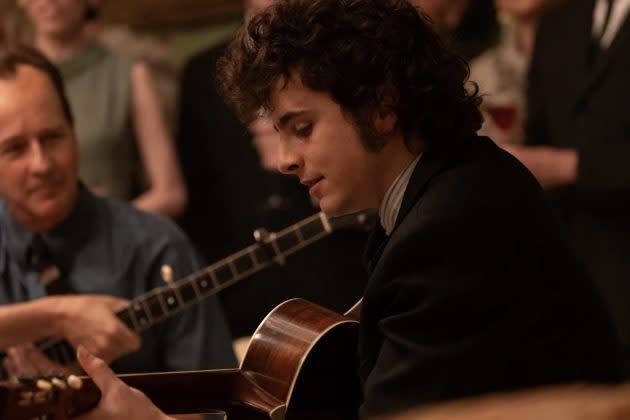 A Complete Unknown follows Dylan through a roughly four-year period, beginning in 1961 with a visit to the Greystone Park Psychiatric Hospital to meet his idol, Woody Guthrie (Scoot McNairy), and ending in 1965 following his controversial performance at the Newport Folk Festival, where his decision to perform using electric instruments is met with boos and jeers. In between, he has off-again/on-again relationships with two women, Sylvie Russon (Elle Fanning, based on real-life paramour Suze Rotolo, whose real name wasn’t used at Dylan’s request) and singer Joan Baez (Monica Barbaro), and approaches fame and fans with an inscrutable façade. He befriends Pete Seeger (Edward Norton), who gives him some of his early breaks, and Johnny Cash (Boyd Holbrook). And he allows his career to be guided by his pushy manager, Albert Grossman (Dan Fogler).
Although the movie features many of Dylan’s best-known songs, all performed by Chalamet with a better-than-passable imitation of the singer’s nasal intonations, it’s not a jukebox film or a traditional musical. Instead, it’s a drama that features music. The singing comes in logical places during studio recordings and live performances. There are no instances when characters spontaneously break into song and no choreographed dance sequences. Mangold approaches Dylan’s music much the same way that he approached that of Johnny Cash in Walk the Line.
At his best, Dylan is impassive and unfeeling. At his worst, he’s dismissive and cruel (although he probably doesn’t see the latter). He repeatedly hurts Sylvie and his relationship with Joan is such that she calls him an asshole on one occasion and a jerk on another. He shows minimal affection to anyone and turns his back on a woman who admits to loving him because he hasn’t known her that long. He is deaf to the desires of fans and afflicted with delusions of grandeur.
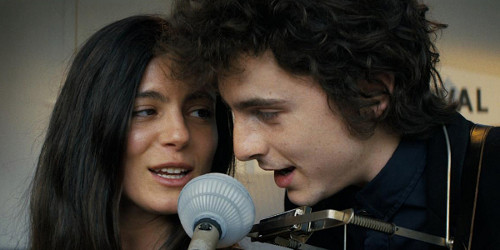
Tasked with portraying this version of Dylan, Chalamet goes full method. For two hours, he is Dylan, recapturing the look, mannerisms, attitude, and vocal inflections of the early ‘60s musician. As always with a performance like this, questions arise regarding how much of this is acting and how much is imitation. Ultimately, it doesn’t matter because A Complete Unknown gets us to believe that we’re watching Dylan wandering around ‘60s New York City. Mangold gets the details right, creating a place that’s both recognizable and alien at the same time.
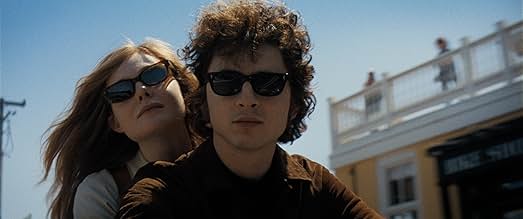
Having an affinity for Dylan isn’t necessary for A Complete Unknown to work. That’s because the movie is more about Dylan within the context of a time period than about Dylan as an individual. One could argue that he’s more of a presence than a character. We don’t know much about his past and Mangold never attempts to get into his mind or explore his motivations. Dylan comments in the film that people make up their own histories and backgrounds all the time. (Shades of The Joker in The Dark Knight.) His birth name is Robert Zimmerman but he changed it because he liked the way Dylan sounded. The screenplay uses TV news announcers as a way to pin scenes to certain critical historical events (like the Cuban Missile Crisis and JFK’s assassination).
An appreciation of Dylan’s catalog – especially his earlier songs – will enhance the movie’s effectiveness. (The title comes from a line in Like a Rolling Stone.) Still, those hoping to gain insight into this peculiar and prickly embodiment of genius will find that desire unsatisfied. A Complete Unknown isn’t shallow but the screenplay makes no attempt to psychoanalyze its subject. If there’s something to be learned, it’s how uncomfortable it could be to enter this man’s orbit. His music is iconic and speaks to many but, from the first scene to the last, he remains A Complete Unknown. [Berardinelli's rating: 3 stars out of 4]
Labels: biography, drama, music, Sixties
IMDb 73/100
MetaCritic (critics=70, viewers=72)
RottenTomatoes (critics=82, viewers=95)
Blu-ray
Berardinelli's original review
Bob Dylan wrote Boots of Spanish Leather, recorded it on August 7th, 1963, and released it on his 1964 album The Times They Are A-Changin'. The folk song is structured as a dialogue between lovers separating, often linked to his relationship with Suze Rotolo. It is noted for its poetic, bittersweet tone.

Although Dylan (played in the movie by Timothee Chalamet) was not officially involved in any aspect of the production – his name is absent from the end credits – he apparently was given an opportunity to read the script and responded by providing notes. A Complete Unknown’s take on Dylan is far from complimentary – he’s more of antagonist than protagonist – so the real-life Dylan presumably agrees with this perspective. That’s somewhat reminiscent of Robbie Williams’ self-portrait in Better Man (although Chalamet does not play Dylan as a chimpanzee).
A Complete Unknown follows Dylan through a roughly four-year period, beginning in 1961 with a visit to the Greystone Park Psychiatric Hospital to meet his idol, Woody Guthrie (Scoot McNairy), and ending in 1965 following his controversial performance at the Newport Folk Festival, where his decision to perform using electric instruments is met with boos and jeers. In between, he has off-again/on-again relationships with two women, Sylvie Russon (Elle Fanning, based on real-life paramour Suze Rotolo, whose real name wasn’t used at Dylan’s request) and singer Joan Baez (Monica Barbaro), and approaches fame and fans with an inscrutable façade. He befriends Pete Seeger (Edward Norton), who gives him some of his early breaks, and Johnny Cash (Boyd Holbrook). And he allows his career to be guided by his pushy manager, Albert Grossman (Dan Fogler).Although the movie features many of Dylan’s best-known songs, all performed by Chalamet with a better-than-passable imitation of the singer’s nasal intonations, it’s not a jukebox film or a traditional musical. Instead, it’s a drama that features music. The singing comes in logical places during studio recordings and live performances. There are no instances when characters spontaneously break into song and no choreographed dance sequences. Mangold approaches Dylan’s music much the same way that he approached that of Johnny Cash in Walk the Line.
At his best, Dylan is impassive and unfeeling. At his worst, he’s dismissive and cruel (although he probably doesn’t see the latter). He repeatedly hurts Sylvie and his relationship with Joan is such that she calls him an asshole on one occasion and a jerk on another. He shows minimal affection to anyone and turns his back on a woman who admits to loving him because he hasn’t known her that long. He is deaf to the desires of fans and afflicted with delusions of grandeur.
Tasked with portraying this version of Dylan, Chalamet goes full method. For two hours, he is Dylan, recapturing the look, mannerisms, attitude, and vocal inflections of the early ‘60s musician. As always with a performance like this, questions arise regarding how much of this is acting and how much is imitation. Ultimately, it doesn’t matter because A Complete Unknown gets us to believe that we’re watching Dylan wandering around ‘60s New York City. Mangold gets the details right, creating a place that’s both recognizable and alien at the same time.
Having an affinity for Dylan isn’t necessary for A Complete Unknown to work. That’s because the movie is more about Dylan within the context of a time period than about Dylan as an individual. One could argue that he’s more of a presence than a character. We don’t know much about his past and Mangold never attempts to get into his mind or explore his motivations. Dylan comments in the film that people make up their own histories and backgrounds all the time. (Shades of The Joker in The Dark Knight.) His birth name is Robert Zimmerman but he changed it because he liked the way Dylan sounded. The screenplay uses TV news announcers as a way to pin scenes to certain critical historical events (like the Cuban Missile Crisis and JFK’s assassination).
An appreciation of Dylan’s catalog – especially his earlier songs – will enhance the movie’s effectiveness. (The title comes from a line in Like a Rolling Stone.) Still, those hoping to gain insight into this peculiar and prickly embodiment of genius will find that desire unsatisfied. A Complete Unknown isn’t shallow but the screenplay makes no attempt to psychoanalyze its subject. If there’s something to be learned, it’s how uncomfortable it could be to enter this man’s orbit. His music is iconic and speaks to many but, from the first scene to the last, he remains A Complete Unknown. [Berardinelli's rating: 3 stars out of 4]
Labels: biography, drama, music, Sixties
IMDb 73/100
MetaCritic (critics=70, viewers=72)
RottenTomatoes (critics=82, viewers=95)
Blu-ray
Berardinelli's original review
Bob Dylan wrote Boots of Spanish Leather, recorded it on August 7th, 1963, and released it on his 1964 album The Times They Are A-Changin'. The folk song is structured as a dialogue between lovers separating, often linked to his relationship with Suze Rotolo. It is noted for its poetic, bittersweet tone.
Subscribe to:
Comments (Atom)