To find films, actors, directors, etc., use 'Search This Blog' omitting accents (à ç é ô ü). Ratings average IMDb, Metacritic and Rotten Tomatoes: ***** Excellent (81+); **** Very Good (61-80); *** Average (40-60); ** Fair (20-39); * Poor (19-). FEEDBACK: mauipeterb at hotmail dot com
Saturday, December 13, 2025
Jay Kelly (2025) [R] ****
A film review by Brian Tallerico for RogerEbert.com on Dec. 4, 2025.
Noah Baumbach’s Jay Kelly is a study of a man in the middle of a personality crisis who worries that he doesn’t have one, only the personalities which fictional characters and the glory of celebrity have granted him. It’s a deeply meta film, a movie that uses as its foundation what we know of its star, George Clooney, one of the few leading men who can coexist in the same frame with images of legends like Paul Newman and Marcello Mastroianni and we don’t immediately reject the idea. Clooney knows a thing or two about not being able to walk through public spaces without being mobbed and, one presumes, about how much the life of an actor pulls people away from other things in their lives, like friends and family.
For a story of a guy who’s willing to get messy for the first time in years, it’s an overly clean piece of screenwriting, one that too often lets its A-list star play ideas instead of a character. But there’s enough to like here to forgive a film whose ambition exceeds its reach, both in some of those ideas and a flawless supporting cast, especially another fantastic turn from Adam Sandler.
Jay Kelly opens with its titular character (Clooney) finishing his latest production, as Baumbach and his co-writer Emily Mortimer (who also has a small role) wonderfully sketch their two male leads through their work. Kelly seems to be tapping into something true as he films the emotional death scene of his character. Still, there’s a common actorly insecurity underneath, especially as he asks his director for reassurance about whether they should try again. Meanwhile, Jay’s manager Ron (Sandler) uses the same tone to comfort Jay that we just heard him using with his daughter on the phone. For Ron, Jay is almost like another child, someone whose needs are prioritized over his own, and whose insecurities need to be assuaged. He might even be Ron’s favorite child. He’s the one who pays the bills.
A series of events rocks Jay Kelly’s pattern of movie shoots and red carpets (and, by extension, Ron’s). First, Jay discovers that his daughter, Daisy (Grace Edwards), is leaving for the summer, the one he thought they would spend together. She’s off to Northern Italy, where, coincidentally, an arts festival is being held at which Jay was supposed to receive a tribute. Jay will be on his own, and we discover later that he has a borderline-estranged relationship with his older daughter, Jessica (Riley Keough, so phenomenal in just a few scenes). He’s going to be alone, although, in a funny repeated bit in which Jay is handed drinks by silent assistants after insisting he’s always alone, the celebrity alone is different than yours or mine.
A bigger shift in Jay’s personality starts to quake when he learns that the director who gave him his break, Peter Schneider (Jim Broadbent), has died. Jay remembers a Schneider at his home not long ago, practically begging to put his favorite actor’s name on his project to get funding. Jay declined. He never gave the man he owes much of his life his last shot.
Finally, Jay runs into an old friend at Peter’s funeral named Timothy (Billy Crudup, excellent as always in just one extended scene). The two go out for a drink, and what starts as playful memories of their twenties and what might have been gets dark when Timothy admits that he hates Jay. After all, Jay took his life. If Timothy hadn’t brought Jay to an audition in front of Peter Schneider, he might have gotten the job. The night ends in a flurry of bad, half-drunk choices that really send Jay spiraling. He’s not doing the next movie, he’s going to Italy to find his daughter and accept the tribute, and Ron and his publicist Liz (Laura Dern) are just going to have to keep up with him. If they can.
The first act of Jay Kelly, in which these emotional figures from Jay’s past descend on him like Scrooge’s ghosts, hints at a darker movie than the midsection, one in which Kelly travels across Italy by train to reunite with his daughter and the common people. Clooney captures the joy of an actor fascinated by those who celebrity has cordoned off from him. But the writing here dips into some odd valleys regarding his fellow travelers, including an aside about a purse theft that exists solely as a plot crutch later in the film. It’s a bit of a problem when a movie about a celebrity trying to meet real people and discover the true core inside him starts to feel calculated and manufactured. And that tone starts to infiltrate other aspects of the screenwriting, including characters played by Stacy Keach (Jay’s dad) and Patrick Wilson (Ron’s #2 client), who seem to exist solely as signposts for Jay’s journey of the soul.
The sense that too few of the supporting characters have been fleshed out is part of what makes Jay Kelly often feel a little too neat. It’s a film that works in part because it’s an actor we know looking at the traps of celebrity and the difficulty of playing yourself instead of a scripted character, but it also feels remarkably calculated. Part of that is intentional to make the undeniably powerful final lines hit with more force, but a lot of Jay Kelly feels as rehearsed as a celebrity’s sound bites at a junket. Even Nicholas Brittell’s lovely score and Linus Sandgren’s fluid cinematography add to the film’s often sterile tone when it should be a movie that’s rougher around the edges.
Thank the Celebrity God, then, for Adam Sandler, who steals the movie by feeling the most truthful. I would never purport to know Sandler’s complex emotional relationship with fame or with people in his life, but he understands, either through observation or experience, what it means to devote your life to someone in a power imbalance. Are Ron and Jay friends? They’ve been through it all together. But Jay pays Ron, and he’s not afraid to remind him of that. Doesn’t that automatically throw it off? Sandler perfectly embodies a guy who’s been hit by Jay’s emotional shrapnel over and over again. Every time Jay missed a school concert for a project, Ron probably did too. Rons don’t get tributes. It’s just another example of how good Sandler can be in the right material, his best performance since Uncut Gems (and a reminder of how good he was in Baumbach’s The Meyerowitz Stories).
There are several lines about the transparency of fame that pepper Jay Kelly. Peter’s son says at his funeral, My dad was never there. It’s something Jay’s daughters would say too, especially his older one. In one of the film’s most powerful emotional chapters, Jessica speaks of the pain of seeing her dad playing a loving parent on screen despite never feeling that at home. So does Jay find himself? Luckily, Baumbach, Mortimer, and Clooney refuse to give Jay Kelly too much of a redemption arc, ending on a note that feels more emotionally true than manipulative. It lands with a powerful sentiment that so many of us will feel when the end is near. If we’re as lucky as Jay Kelly. (Tallerico's rating: 3 out of 4 stars)
Labels: comedy, drama, filmmaking
IMDb 66/100
MetaScore (critics=67, viewers=55)
RottenTomatoes (critics=76, viewers=87)
Netflix
Tallerico's original review
For a story of a guy who’s willing to get messy for the first time in years, it’s an overly clean piece of screenwriting, one that too often lets its A-list star play ideas instead of a character. But there’s enough to like here to forgive a film whose ambition exceeds its reach, both in some of those ideas and a flawless supporting cast, especially another fantastic turn from Adam Sandler.
Jay Kelly opens with its titular character (Clooney) finishing his latest production, as Baumbach and his co-writer Emily Mortimer (who also has a small role) wonderfully sketch their two male leads through their work. Kelly seems to be tapping into something true as he films the emotional death scene of his character. Still, there’s a common actorly insecurity underneath, especially as he asks his director for reassurance about whether they should try again. Meanwhile, Jay’s manager Ron (Sandler) uses the same tone to comfort Jay that we just heard him using with his daughter on the phone. For Ron, Jay is almost like another child, someone whose needs are prioritized over his own, and whose insecurities need to be assuaged. He might even be Ron’s favorite child. He’s the one who pays the bills.
A series of events rocks Jay Kelly’s pattern of movie shoots and red carpets (and, by extension, Ron’s). First, Jay discovers that his daughter, Daisy (Grace Edwards), is leaving for the summer, the one he thought they would spend together. She’s off to Northern Italy, where, coincidentally, an arts festival is being held at which Jay was supposed to receive a tribute. Jay will be on his own, and we discover later that he has a borderline-estranged relationship with his older daughter, Jessica (Riley Keough, so phenomenal in just a few scenes). He’s going to be alone, although, in a funny repeated bit in which Jay is handed drinks by silent assistants after insisting he’s always alone, the celebrity alone is different than yours or mine.
A bigger shift in Jay’s personality starts to quake when he learns that the director who gave him his break, Peter Schneider (Jim Broadbent), has died. Jay remembers a Schneider at his home not long ago, practically begging to put his favorite actor’s name on his project to get funding. Jay declined. He never gave the man he owes much of his life his last shot.
Finally, Jay runs into an old friend at Peter’s funeral named Timothy (Billy Crudup, excellent as always in just one extended scene). The two go out for a drink, and what starts as playful memories of their twenties and what might have been gets dark when Timothy admits that he hates Jay. After all, Jay took his life. If Timothy hadn’t brought Jay to an audition in front of Peter Schneider, he might have gotten the job. The night ends in a flurry of bad, half-drunk choices that really send Jay spiraling. He’s not doing the next movie, he’s going to Italy to find his daughter and accept the tribute, and Ron and his publicist Liz (Laura Dern) are just going to have to keep up with him. If they can.
The first act of Jay Kelly, in which these emotional figures from Jay’s past descend on him like Scrooge’s ghosts, hints at a darker movie than the midsection, one in which Kelly travels across Italy by train to reunite with his daughter and the common people. Clooney captures the joy of an actor fascinated by those who celebrity has cordoned off from him. But the writing here dips into some odd valleys regarding his fellow travelers, including an aside about a purse theft that exists solely as a plot crutch later in the film. It’s a bit of a problem when a movie about a celebrity trying to meet real people and discover the true core inside him starts to feel calculated and manufactured. And that tone starts to infiltrate other aspects of the screenwriting, including characters played by Stacy Keach (Jay’s dad) and Patrick Wilson (Ron’s #2 client), who seem to exist solely as signposts for Jay’s journey of the soul.
The sense that too few of the supporting characters have been fleshed out is part of what makes Jay Kelly often feel a little too neat. It’s a film that works in part because it’s an actor we know looking at the traps of celebrity and the difficulty of playing yourself instead of a scripted character, but it also feels remarkably calculated. Part of that is intentional to make the undeniably powerful final lines hit with more force, but a lot of Jay Kelly feels as rehearsed as a celebrity’s sound bites at a junket. Even Nicholas Brittell’s lovely score and Linus Sandgren’s fluid cinematography add to the film’s often sterile tone when it should be a movie that’s rougher around the edges.
Thank the Celebrity God, then, for Adam Sandler, who steals the movie by feeling the most truthful. I would never purport to know Sandler’s complex emotional relationship with fame or with people in his life, but he understands, either through observation or experience, what it means to devote your life to someone in a power imbalance. Are Ron and Jay friends? They’ve been through it all together. But Jay pays Ron, and he’s not afraid to remind him of that. Doesn’t that automatically throw it off? Sandler perfectly embodies a guy who’s been hit by Jay’s emotional shrapnel over and over again. Every time Jay missed a school concert for a project, Ron probably did too. Rons don’t get tributes. It’s just another example of how good Sandler can be in the right material, his best performance since Uncut Gems (and a reminder of how good he was in Baumbach’s The Meyerowitz Stories).
There are several lines about the transparency of fame that pepper Jay Kelly. Peter’s son says at his funeral, My dad was never there. It’s something Jay’s daughters would say too, especially his older one. In one of the film’s most powerful emotional chapters, Jessica speaks of the pain of seeing her dad playing a loving parent on screen despite never feeling that at home. So does Jay find himself? Luckily, Baumbach, Mortimer, and Clooney refuse to give Jay Kelly too much of a redemption arc, ending on a note that feels more emotionally true than manipulative. It lands with a powerful sentiment that so many of us will feel when the end is near. If we’re as lucky as Jay Kelly. (Tallerico's rating: 3 out of 4 stars)
Labels: comedy, drama, filmmaking
IMDb 66/100
MetaScore (critics=67, viewers=55)
RottenTomatoes (critics=76, viewers=87)
Netflix
Tallerico's original review
If you enjoy the film Jay Kelly I invite you to watch the 51-minute Netflix documentary The Making of Jay Kelly. Writer / director Noah Baumbach, George Clooney, Adam Sandler, Laura Dern, co-writer Emily Mortimer and others share behind-the-scenes insights from the first shot through the final line.
As you watch it, you will appreciate that there were no special effects used in the film; everything was physical, constructed on movie sets: Jay Kelly's home, the private jet, the railroad car, all of it was physical. And the music was recorded on analog tape. None of it is digital.
But the most remarkable thing is to appreciate that while this is Jay Kelly's reality, it is also George Clooney's reality, and the viewer gains a new appreciation for what it means to be a movie star - the rewards and also the sacrifices.
Tuesday, December 2, 2025
A Walk in the Woods (2015) [R] ***
A film review by James Berardinelli for ReelViews.net on Sept. 4, 2015.
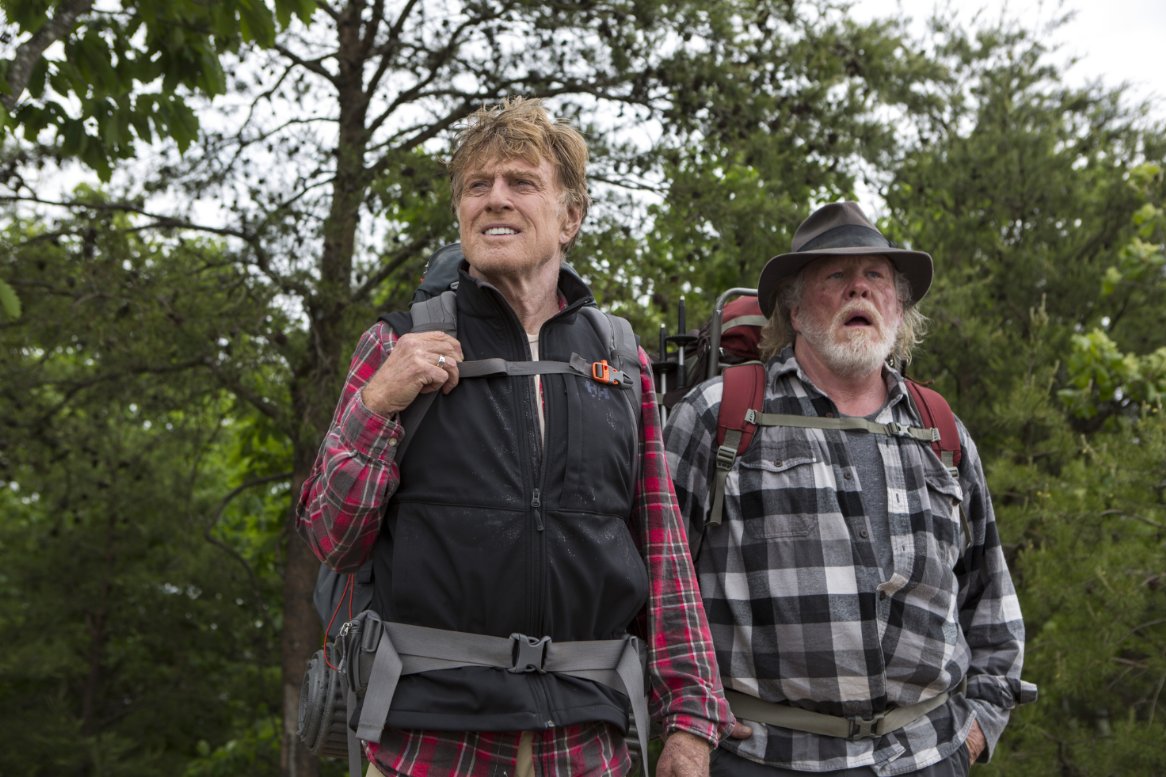
A couple of old guys taking a walk on the Appalachian Trail - it doesn't sound like a winning motion picture formula and, as it turns out, it isn't. Like all road trip movies, the success (or lack thereof) of A Walk in the Woods relies heavily on the chemistry between the two leads, in this case Robert Redford and Nick Nolte. And, although both men do a reasonable job inhabiting their characters, as an odd couple, they don't click. There's something missing. Maybe if this had been made 20 years ago by Walter Matthau and Jack Lemmon. Or even 10 years ago, as originally planned, with Redford and Paul Newman…
A Walk in the Woods is surprisingly funny at times but, like many comedies, it runs out of steam about halfway through. Some of the humor is unexpectedly lowbrow, at least insofar as anything with Redford could be considered lowbrow. The iconic actor generally takes the high road, leaving the crass comments and physical slapstick to Nolte. There are some clever, witty one-liners. I found myself laughing more than once or twice but the jokes, like the movie as a whole, lack staying power. The first half is significantly more enjoyable than the second.

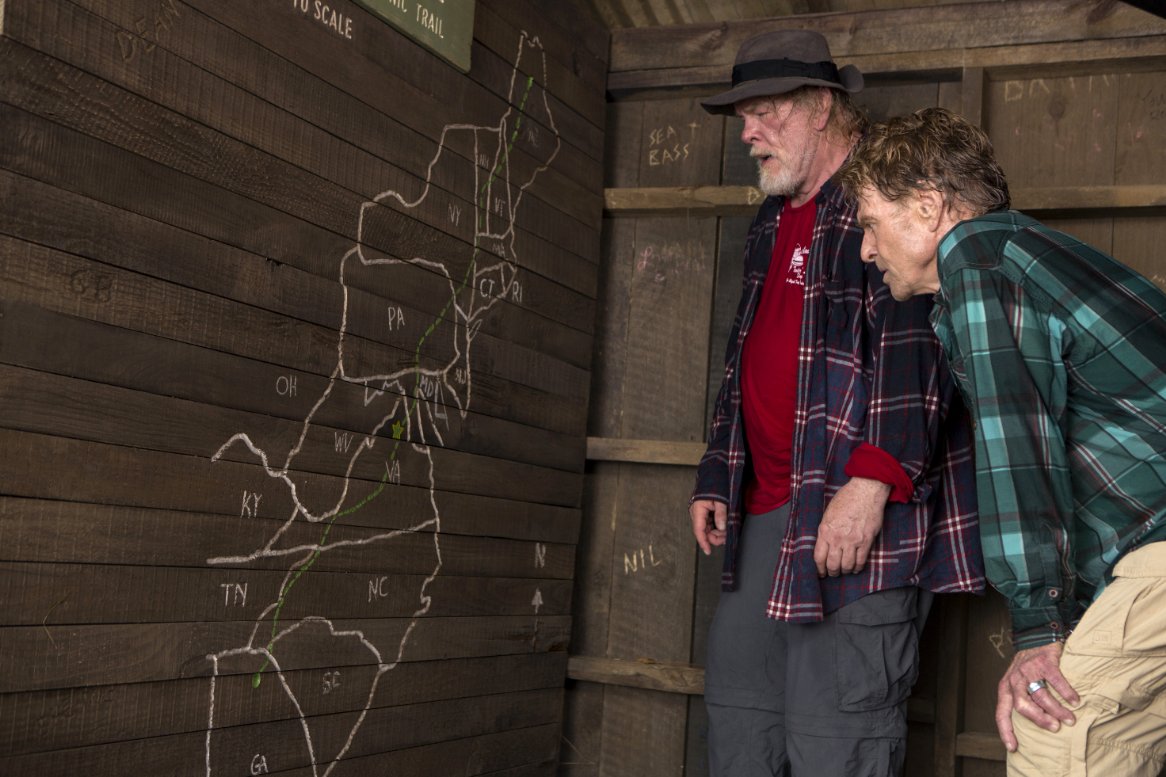
The narrative is more concerned with the predictable mismatched buddies interaction between Redford's Bill Bryson and Nolte's Stephen Katz than it is with the terrain they're crossing. Last year's Wild, with Reese Witherspoon, did a better job illustrating the perils of traveling the more than 2100-mile wilderness path from Georgia to Maine. Here, things like bears, slips and falls, and bad weather serve as punchlines. Following the road movie formula, A Walk in the Woods is divided into clearly delineated episodes: being trapped in the company of the most annoying hiker to walk the earth, flirting with an attractive motel owner, etc. The film also has a message Yoda would disagree with: trying is what really matters.
Bryson, a renowned travelogue author, decides to walk the Appalachian Trail on a whim - perhaps it's a delayed mid-life crisis or maybe he's thinking of a bucket list. His wife, Catharine (Emma Thompson), won't let him make the hike alone. After sending out feelers to most of his old friends and striking out, he is forced to invite the only one with interest - a man he hasn't seen in decades and with whom he didn't part on the best of terms. By his own admission, Katz hasn't done much with his life, and is so out-of-shape, it looks like he might have trouble hiking for a mile, let alone 2100+ of them. Together, the codgers hop on a plane to Georgia and the odyssey begins.

The screenplay was loosely adapted from Bill Bryson's nonfiction book and is directed by Ken Kwapis, who has an extensive TV resume to go along with a few big screen titles (for example, The Sisterhood of the Traveling Pants). There are times when one gets the sense Kwapis wants to capture the majesty of the trail but, even though there are some spectacular mountain shots, the postcard moments don't last long enough to inspire awe. Added to that, there's an instance in which shoddy production design undermines a scene. With ceramic rocks and an awful matte painting in the background, this key sequence is so obviously studio-bound that it becomes a distraction.
Decades removed from being considered a heartthrob, Redford is still able to command the camera's attention with his innate charisma and likability. He's a good foil for Nolte's oafishness; it's surprising the two don't mesh better in an oil-and-water fashion. The lighthearted tone keeps A Walk in the Woods from becoming too dour and, in contrast with other wilderness adventure movies (like the aforementioned Wild and the similarly-titled Into the Wild), there's never a sense that Nature is more than a cantankerous prankster. The message about mortality is underplayed - older people may be spry of mind but their bodies often don't cooperate. Any bittersweet element this might have injected into the proceedings is quickly washed away by a jokey turn. The film adamantly rejects being serious for more than a passing moment. A Walk in the Woods is pleasant but inconsequential, a passing diversion rather than a worthy cinematic destination. (Berardinelli's rating: 2.5 stars out of 4)
Labels: adventure, biography, comedy, drama, Robert Redford
IMDb: 64/100
MetaScore (critics=51, viewers=57)
RottenTomatoes Averages (critics=46, viewers=66)
Blu-ray
Berardinelli's original review
A Walk in the Woods is surprisingly funny at times but, like many comedies, it runs out of steam about halfway through. Some of the humor is unexpectedly lowbrow, at least insofar as anything with Redford could be considered lowbrow. The iconic actor generally takes the high road, leaving the crass comments and physical slapstick to Nolte. There are some clever, witty one-liners. I found myself laughing more than once or twice but the jokes, like the movie as a whole, lack staying power. The first half is significantly more enjoyable than the second.

The narrative is more concerned with the predictable mismatched buddies interaction between Redford's Bill Bryson and Nolte's Stephen Katz than it is with the terrain they're crossing. Last year's Wild, with Reese Witherspoon, did a better job illustrating the perils of traveling the more than 2100-mile wilderness path from Georgia to Maine. Here, things like bears, slips and falls, and bad weather serve as punchlines. Following the road movie formula, A Walk in the Woods is divided into clearly delineated episodes: being trapped in the company of the most annoying hiker to walk the earth, flirting with an attractive motel owner, etc. The film also has a message Yoda would disagree with: trying is what really matters.
Bryson, a renowned travelogue author, decides to walk the Appalachian Trail on a whim - perhaps it's a delayed mid-life crisis or maybe he's thinking of a bucket list. His wife, Catharine (Emma Thompson), won't let him make the hike alone. After sending out feelers to most of his old friends and striking out, he is forced to invite the only one with interest - a man he hasn't seen in decades and with whom he didn't part on the best of terms. By his own admission, Katz hasn't done much with his life, and is so out-of-shape, it looks like he might have trouble hiking for a mile, let alone 2100+ of them. Together, the codgers hop on a plane to Georgia and the odyssey begins.

The screenplay was loosely adapted from Bill Bryson's nonfiction book and is directed by Ken Kwapis, who has an extensive TV resume to go along with a few big screen titles (for example, The Sisterhood of the Traveling Pants). There are times when one gets the sense Kwapis wants to capture the majesty of the trail but, even though there are some spectacular mountain shots, the postcard moments don't last long enough to inspire awe. Added to that, there's an instance in which shoddy production design undermines a scene. With ceramic rocks and an awful matte painting in the background, this key sequence is so obviously studio-bound that it becomes a distraction.
Decades removed from being considered a heartthrob, Redford is still able to command the camera's attention with his innate charisma and likability. He's a good foil for Nolte's oafishness; it's surprising the two don't mesh better in an oil-and-water fashion. The lighthearted tone keeps A Walk in the Woods from becoming too dour and, in contrast with other wilderness adventure movies (like the aforementioned Wild and the similarly-titled Into the Wild), there's never a sense that Nature is more than a cantankerous prankster. The message about mortality is underplayed - older people may be spry of mind but their bodies often don't cooperate. Any bittersweet element this might have injected into the proceedings is quickly washed away by a jokey turn. The film adamantly rejects being serious for more than a passing moment. A Walk in the Woods is pleasant but inconsequential, a passing diversion rather than a worthy cinematic destination. (Berardinelli's rating: 2.5 stars out of 4)
Labels: adventure, biography, comedy, drama, Robert Redford
IMDb: 64/100
MetaScore (critics=51, viewers=57)
RottenTomatoes Averages (critics=46, viewers=66)
Blu-ray
Berardinelli's original review
Labels:
adventure,
biography,
comedy,
drama,
Robert Redford
Subscribe to:
Comments (Atom)