
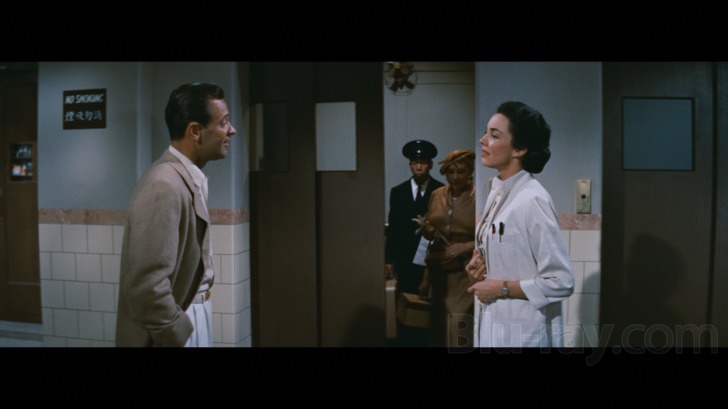
Eurasian, for those not familiar with this now kind of unused term, used to refer to those of mixed parentage, with one Asian parent and one European (meaning Caucasian) parent. Dr. Han Suyin was a real-life Eurasian who on top of being a well-regarded physician also had a rather successful writing career, penning a number of novels as well as autobiographical pieces, many of which contained fascinating nuggets of information about China in the first several decades of the twentieth century. A Many-Splendoured Thing (Han used British spelling tropes) was a 1952 novel which nonetheless was only a slightly fictionalized account of her own romantic interlude with a British journalist. The book was a best seller and Fox soon scooped up the film rights, rights that Han sold in order to facilitate health care for her sickly adopted daughter (a supporting character in the film version). Since Fox obviously wanted a domestic American connection for the film, the male character had his nationality changed, and William Holden was cast to play American reporter Mark Elliott. The oddly exotic looking Jennifer Jones required little if any make-up to inhabit the role of Han Suyin herself (Han is her surname and Suyin is her given name).
Love is a Many-Splendored Thing is at its throbbing heart nothing other than a star-crossed romance, but it's infused with a rather tart subtext of prejudice and class structure. Mark and Suyin know they're in for trouble from the get-go, and not just due to race differences. Mark is married, albeit separated, something that also makes eyes roll in the upper-crust British-Chinese society in which the two find themselves in post-World War II Hong Kong (remember, Hong Kong was still a British crown colony of sorts in that era). But it's not just the British who cast disparaging glances toward the couple. The Chinese themselves are conflicted, not just about the relationship between the two, but also about Suyin's mixed race background. The fact that this springs out of what was then the fairly recent epoch of a global battle which had a racial purity aspect from both the Germans and the Japanese makes Love is a Many- Splendored Thing's points unusually relevant, albeit not necessarily pointed directly at the geopolitical issues that informed World War II.
The film is a beautifully heartfelt piece which is perhaps surprisingly frank about the racial issues it explores. Part of what makes the film so extraordinary is its exotic setting, something that is used rather artfully with lots of second unit location photography by a sadly uncredited Charles G. Clarke, combined with the Oscar-nominated cinematography of Leon Shamroy in the studio sequences. Jones and Holden, who evidently disliked each other intensely, bring wonderfully nuanced interpretations to their roles and both deliver underplayed, very winning, performances. The supporting cast is filled to the brim with the sort of expert character actors and actresses who seem to be a dying breed nowadays. And supporting it all is the gorgeously evocative Academy Award winning music of Alfred Newman, masterfully interweaving the Oscar winning theme song (by Sammy Fain and Paul Francis Webster) with his own original compositions. This is mid-fifties' film craft of the highest order. (Kauffman's rating: 4.5 out of 5 stars)
Labels: biography, drama, romance, war, WWII, tragedy
IMDb 64/100
RottenTomatoes (critics=53, viewers=56)
Blu-ray
Kauffman's original review
Blogger's comment: Her birthname was Rosalie Mathilda Kuanghu Chou and she was also known as Elizabeth Comber, after her second husband. Han Suyin was the pen name she chose for her acclaimed autobiography, A Many-Splendoured Thing, upon which the film is based. She chose Han to honor the majority Han Chinese people. Suyin means plain-sounding.
RottenTomatoes (critics=53, viewers=56)
Blu-ray
Kauffman's original review
Blogger's comment: Her birthname was Rosalie Mathilda Kuanghu Chou and she was also known as Elizabeth Comber, after her second husband. Han Suyin was the pen name she chose for her acclaimed autobiography, A Many-Splendoured Thing, upon which the film is based. She chose Han to honor the majority Han Chinese people. Suyin means plain-sounding.

No comments:
Post a Comment