Pages

Sunday, September 13, 2009

Toy Story (1995) [G] *****

A film review by James Berardinelli, for ReelViews.net.

Ever wonder how toys apparently get from one place to another with no human help? Toy Story, Disney's first feature-length foray into computer animation, postulates that they do it all by themselves. Toys have their own magical world which comes to life any time the lights are out or people aren't around. Any who doubt this should take a look at Toy Story. You'll never again feel quite the same way about Mr. Potato Head, Monkeys in a Barrel, or Slinkies.

Of course, the visual aspect is the centerpiece of Toy Story. The computer-generated effects are a marvel. Rich in unexpected detail (the grain of a wood floor, fingerprints and chipped paint on a door, reflections in polished surfaces, and so on...), this colorful and brilliantly-rendered aspect of the film would alone be worth the price of admission. It's something of a bonus that the characters, dialogue, and story provide entertainment value of their own.

Toy Story is a buddy movie/adventure tale with an understated lesson about the value of friendship. Parents might also be able to use some of what transpires to encourage their offspring to put away toys after playtime. While the screenplay isn't a marvel of originality, it is capable of holding the attention - light, undemanding fun that never gets too immature or syrupy. There's also quite a bit of intelligent wit that will go above the heads of younger viewers - that stuff's for Mom and Dad.

The two main characters are toys: cowboy Woody (voice of Tom Hanks), the old-time favorite, and space ranger Buzz Lightyear (voice of Tim Allen), the battery-operated newcomer. The supporting cast includes a dinosaur (voice of Wallace Shawn), Mr. Potato Head (voice of Don Rickles), a piggy bank (voice of John Ratzenberger), a slinkie (voice of Jim Varney), Little Bo Peep (voice of Annie Potts), and an army of tiny plastic soldiers who scout out the new arrivals on birthdays and Christmas. The humans who appear in Toy Story are intentionally rendered to look artificial. In this movie, people are unreal; all the vividness and multi-dimensionality is saved for the toys. But that's a typical convention of animation.

Toy Story opens with Buzz's arrival. Woody is upset that this high-tech neophyte has usurped his rightful place on the bedspread and in his six-year old owner's play time. The disgruntled cowboy comes up with a plan to eliminate Buzz, but it backfires, and soon the two rivals are out in the real world, forced to help each other in their struggle to escape the clutches of a toy-torturing juvenile delinquent.

How does Toy Story compare to Disney's more conventional animated features? They're really very different types of productions. This film is less artistic and more technologically impressive. Despite a few Randy Newman songs, it's not really a musical. Of course, the target audience is the same, and everything from Disney embraces family values, but it's difficult - and unfair - to make an effective contrast of the two film making styles.

The one big negative about Toy Story involves Disney's over - commercialization. Already, Woody and Buzz dolls line store shelves. Burger King is coming out with figurines. It won't be long before the movie is drowned in hype. So, from the perspective of pure entertainment, it's a good idea to see Toy Story before the deluge of promotions becomes so excessive that it turns off every adult. Frankly, the movie deserves a less ignominious fate than the marketing overkill which will surely overcome it. [Berardinelli’s rating: *** ½ out of 4]

Labels: adventure, animation, comedy, family, fantasy, Tom Hanks


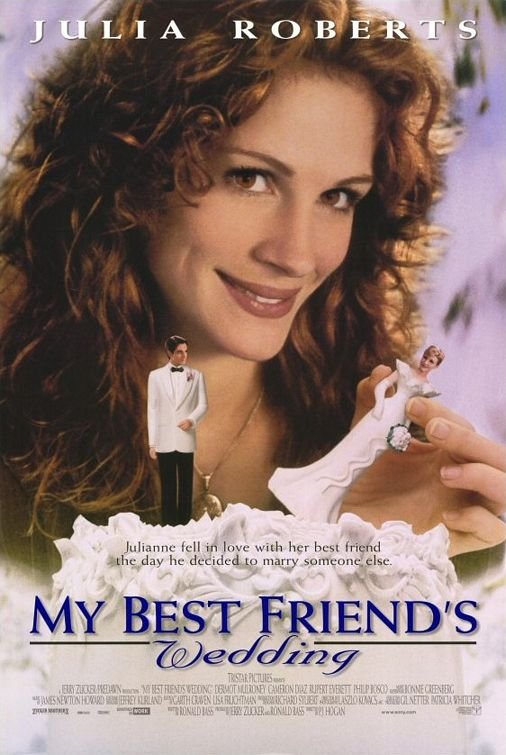
My Best Friend’s Wedding (1997) [PG-13] ****

A film review by James Berardinelli for ReelViews.net

My Best Friend's Wedding is the estrogen alternative to the vast quantity of testosterone being pumped out by the other major June (1997) releases: Con Air, Speed 2, Batman and Robin, and Face/Off. As the summer's centerpiece romantic comedy, My Best Friend's Wedding boasts a pair of A-list actresses, Julia Roberts and Cameron Diaz, dueling for the affections of the unprepossessing Dermot Mulroney (the guy from Copycat and The Trigger Effect, who is frequently confused with the equally low-key and same-initialed Dylan McDermott). Fortunately, this film doesn't fall into the overcrowded category of the traditional frothy romance. In fact, My Best Friend's Wedding has a bit of an edge and enough intelligence to keep it from drowning in the kind of mawkish sentimentality that often makes this sort of movie hard-to-swallow.

Australian director P.J. Hogan must have a thing for movies about weddings. His previous feature, Muriel's Wedding, was a black comedy about a young woman who loves ABBA songs and dreams about getting married. And, although Hogan accepted a studio project as his follow-up to the international hit, he chose something in keeping with his desire to corrupt the formula. While this movie isn't as offbeat or out there, it defies more than a few expectations without ultimately dissatisfying the audience.

As in any romantic comedy, the two most important elements are in place: the couples and the complications. Couple #1 consists of the soon-to-be married groom, Michael O'Neal (Mulroney) and his perky bride, Kimmy (Diaz). Couple #2 comprises food critic Julianne Potter (Roberts) and her gay editor, George Downes (Rupert Everett). They're not really together, but they pretend to be to make Michael jealous. Because, for the past nine years, since they had a one-month fling in college, Julianne has carried a torch for Michael. They've been best friends, but only now, when she's about to lose him to another woman, does Julianne realize that she wants to be the bride. And, to get her man, she's willing to do almost anything, including play dirty. So, when Kimmy opens her arms to Julianne and offers her the position of maid of honor, Julianne accepts, all the while plotting the best way to break up the happy couple.

Because My Best Friend's Wedding features a smart script and deft direction, it manages to keep alive the mystery of who will end up with whom. Things aren't as clear-cut as they initially seem to be, and, with every passing minute, they get murkier. The film has a high energy level and features a number of standout scenes, some of which are designed to cull laughter from the audience, others which go for the tear ducts. The best is arguably a restaurant episode where an impromptu sing-along gets everyone in the place to join in. It's clever, irreverent, and fun.

My Best Friend's Wedding starts off slowly, and it takes the better part of a half-hour before we first start getting a feel for the characters. Mulroney's Michael is an especially difficult case -- at first, there doesn't seem to be much there, which begs the question of how he managed to get two beautiful women to fall head-over-heels in love with him. The actor plays his role in a low-key fashion that's an asset late in the film, but not at the beginning. Cameron Diaz turns up the good cheer and high spirits to an almost-unbearably lively level. And Julia Roberts, returning to the genre that made her a star, embraces the part like it's a homecoming. Her performance as Julianne is competent and comfortable, but the ingénue of Pretty Woman (1990) has been replaced a more mature performer, and this results in a better-rounded character. Supporting players include a scene-stealing Rupert Everett (the Cemetery Man himself), Rachel Griffiths (who appeared as the title character's best friend in Muriel's Wedding), and M. Emmett Walsh as someone who's not the least bit creepy (for once).

Although My Best Friend's Wedding is intended to be relatively light entertainment, it briefly addresses some interesting, serious issues regarding the nature of friendship, jealousy, and love (real and idealized). There's a wonderfully evocative scene that suggests a moment passing by, which will undoubtedly cause a portion of the audience to reflect on similar occasions in their own lives. In the final analysis, My Best Friend's Wedding represents two hours of fine entertainment not because it offers a feel-good love story but because the film makers understand that it's possible for a romantic comedy to appeal not only to the heart, but to the mind as well. [Berardinelli’s rating: *** out of 4 stars = 75%]

Labels: comedy, drama, romance, wedding

Runaway Bride (1999) [PG] ***


A film review by James Berardinelli for ReelViews.net

For years now, there have been discussions about a sequel to the surprise 1990 romantic comedy blockbuster, Pretty Woman. Aside from once again propelling Roy Orbison's title tune up the pop charts, that film had the distinction of establishing Julia Roberts as an A-list star. When Pretty Woman was released, she was hardly an unknown, having already appeared in the likes of Mystic Pizza and Steel Magnolias, but her on-screen interpretation of a modern-day Cinderella rocketed her into a higher orbit. Pretty Woman turned into a box office favorite (making nearly half a billion dollars worldwide) and has since become a video staple.

Ultimately, the involved parties could not agree on a storyline for the long-anticipated sequel, so they went in another direction, re-uniting director Garry Marshall with his two leads for Runaway Bride, an uninspired romantic comedy about a commitment-fearful woman (Roberts) who spars with and then falls for, a cynical writer (Richard Gere). The best thing the movie has going for it is a built-in audience; there's not much in the screenplay, which follows the expected formulas, to get excited about. Little that transpires during the course of Runaway Bride is credible and, although some suspension of disbelief is necessary for nearly every love story, this film stretches things too far. Only die-hard romantics will find any charm beneath Marshall's often inept manipulation.

The saving grace of Runaway Bride is Julia Roberts, whose sparkling smile and shining personality rescue individual scenes - although she can't save the project as a whole. Roberts gives a genuine, heartfelt performance while everyone else drifts through on autopilot. Richard Gere is as flat as usual (although, to be fair, he is more animated than in Pretty Woman, where he could have been mistaken for a mobile telephone pole). His low-key approach doesn't serve his character well, and the lack of energy is especially noticeable in his scenes with Roberts. She carries them, and the chemistry that was evident in Pretty Woman is seen here only in short, erratic spurts - not enough to build a romance on. It's also worth noting that, with his white hair and haggard visage, Gere looks more like Roberts' father than a potential husband. These two are less believable as a screen couple than Catherine Zeta Jones and Sean Connery are in Entrapment (1999), primarily due to Connery's abundance of charisma - something that Gere lacks.

The story opens in New York City, where hotshot USA Today columnist Ike Graham (Gere) is seeking an inspiration for his latest bitter diatribe about women. He finds it in a familiar watering hole, where a disillusioned man tells him about Maggie Carpenter (Roberts), a young woman in rural Hale, Maryland who has left three men at the altar and is now preparing to try for a fourth time. Relying exclusively on the man's tale, Ike submits a one-sided piece riddled with inaccuracies. Several days later, when an irate letter arrives from Maggie, Ike is fired. However, Fisher (Hector Elizondo) the newspaper’s publisher, promises him a cover story if he can get the real scoop on Maggie and perhaps catch her in the act of jilting a fourth husband-to-be. So Ike heads south, ingratiates himself with the locals, and begins to follow Maggie around town. At first, she is irritated by his unwanted attention, but, as the two get to know each other better, a strange thing happens. Ike becomes Maggie's staunchest defender and she begins to wonder if her perfect man is really the one she intends to stand next to during the ceremony.

In general, I'm a sucker for love stories, but I never accepted the relationship between Maggie and Ike. These two should despise each other. The wounds they have dealt out should result in a War of the Roses, not a Pretty Woman 2. If a man wrote a slanderous article about me, my family and friends would not greet him with open arms. And if a woman got me fired and ruined my reputation, I wouldn't follow her around, trying to find out what makes her tick. Some contrivances are expected in a motion picture like this, but Runaway Bride mounts one upon another until, like a poorly balanced house of cards, they all come tumbling down.

There isn't a real character in this film, and that's one of its most serious flaws. The leads act as they do because they're responding to the demands of the plot. Their every action is determined not by the requirements of human nature, but by the need for a certain number of complications before the happy ending. The supporting players have even less integrity or reason for being. Maggie's best friend Peggy (Joan Cusack) is on hand for comic relief and her father Bob (Paul Dooley) serves no purpose beyond being the primary romantic stumbling block that keeps Maggie and Ike apart until the movie's final quarter. Frankly, the only one I cared about was Maggie, and that was more because of Roberts' performance than anything found in the script.

There are other things that annoyed me about this film. The dialogue in particular is a sore spot. The conversations in Runaway Bride are tedious; the characters speak in clichés and rarely have much to say that's of interest to each other or the audience. Then there's the ending... While I won't reveal the specifics here, suffice it to say that I despised the plot contortions of the final fifteen minutes. This kind of stuff isn't new to the genre, but it's especially irritating in the way it's presented here.

As a satire or a black comedy, Runaway Bride could have had promise. As a feel-good effort, it's a bust. Director Garry Marshall does not have the track record to inspire confidence. One glance at his recent resume, which includes the likes of The Other Sister, Dear God, and Exit to Eden, reveals a filmmaker who should not be allowed behind the camera. With Runaway Bride, he delivers what we have a right to expect - a clumsy motion picture that strives so hard for the perfect romantic ending that it triggers a gag reflex along the way. [Berardinelli’s rating: ** out of 4 stars = 50%]

Blogger’s comment: I agree with Mr. Berardinelli. There are so many things wrong with this film, it’s hard to know where to start. Ike Graham would never have written a piece using only one source. He would at least have contacted the Hale, MD newspaper for corroboration. And being such a misogynist, there is no way he would have become romantically involved with Maggie Carpenter. By all rights they should have been at each other’s throats.

Labels: comedy, romance, wedding


Saturday, August 29, 2009

Starter for 10 (2006) [PG-13] ****

A film review by James Berardinelli for reelviews.net


Starter for 10 is a mildly enjoyable romantic comedy that stays within the safe bounds of the genre's formula. This is a British film, which may make it feel a little quirky to American viewers. The problem with it, to the extent that there is a problem, is that the movie is only sporadically funny and lacking in the romance department. The love story is perfunctory, and seems present more-or-less because the film bears the romantic comedy label, and it's hard to be a romantic comedy without some kind of love interest.

The movie transpires in 1985-86 on a university campus in England. Those who (like me) entered college during that era will find a lot in Starter for 10 that is familiar - the clothes, the attitudes of people, and the music. All of this background material lends color to the movie, but it doesn't fully compensate for the trivial nature of the plot, which is a little stale and contains a few of what I call stupid sitcom moments. The film's general blandness should generate some appeal for those who don't like edgy material. Surprisingly, despite a high quotient of profanity, the movie somehow managed to achieve the golden PG-13 rating.

James McAvoy (Becoming Jane, Wimbledon) is Brian Jackson, a nerdy guy in his first year at Bristol University. He is studying English Literature, but his primary goal at school is to become a contestant on the popular game show University Challenge. After a few bumps in the road, he achieves this objective, becoming one member of a four-person group that includes team captain Patrick (Benedict Cumberbatch), Alice (Alice Eve), and Lucy (Elaine Tan). Meanwhile, away from the team, Brian develops a comfortable sparring friendship with Rebecca (Rebecca Hall), a girl who will attend almost any left-leaning protest. Romantically, Brian has a choice to pursue either Alice or Rebecca. Romantic comedy veterans will know who he goes after and who he ends up with. That aspect is written in stone. Other elements of the film, such as what happens to the team on University Challenge, are less predictable.

It will be hard to find anyone who actively dislikes Starter for 10. This isn't the kind of film to generate passion one way or the other. It has a small film's appeal, although there are some big guns behind it. (Tom Hanks and Sam Mendes, to name two.) Words like nice and pleasant are appropriate, although I may have stifled a yawn or two during the proceedings. The acting is solid, with McAvoy and Rebecca Hall doing nice jobs, even though there's not a lot of chemistry between them. Alice Eve manages to keep her character from falling into the stereotype pit, although she spends some time teetering on the edge. To me, this is the kind of movie that's more deserving of a rental than a trip to a movie theater, although I have definitely seen worse this year. [Berardinelli’s rating: 2.5 stars out of 4]

Labels: comedy, drama, romance
IMDb 67/100 
MetaScore (critics=69, viewers=71) 
RottenTomatoes Averages (critics=68, viewers=70) 


Sunday, July 19, 2009

Love Affair (1994) [PG-13] ***/****


This is a wonderful romance. It's also a beautiful expression of Warren Beatty's love for Annette Bening. Beatty plays Mike Gambril, an aging sports figure and playboy, who admits that he's never been faithful to anyone. Bening plays Terry McKay, a singer and teacher. They meet on a flight to Sydney that is forced to land on a remote South Pacific atoll. By chance they are near the Tahitian island of Moorea, one of the most beautiful places on Earth. Mike's aunt Ginny, played by the legendary Katharine Hepburn, lives on Moorea, and Mike takes Terry to visit her.

The film's first pivotal scene takes place between Ginny and Terry. The two women are talking about people in general, and Mike in particular, and comparing them to swans, which are unremittingly faithful and ducks, which are not only promiscuous, but terribly indiscreet. Ginny suggests that while Mike appears to be a duck, he may be the ugly duckling that doesn't realize he is a swan. It is this observation that causes Terry to think about the possibility that Mike could be faithful to her, and worthy of her love, and encourages her to take a chance on him. It isn't much of a stretch to think that Bening could have gone through the same thought process when considering Beatty as a husband. This is a movie with many lessons to teach. The casting is great. Katharine Hepburn is terrific and Annette Bening is radiant. The soundtrack is hauntingly beautiful.

Labels: comedy, drama, rom-drama-faves, reunion, romance
Internet Movie Database 60/100
MetaScore (critics=55, viewers=tbd)
RottenTomatoes Averages (critics=44, viewers=74)


Legends of the Fall (1994) [R] ****

A film review by James Berardinelli, written in 1995.

Legends of the Fall is the sort of epic melodrama that only Hollywood can do this well. It's a spectacle more than a show, with soaring moments of triumph and tragedy. Words like restraint and subtle are meaningless in this context. The latest offering from Edward Zwick, the director of Glory is the kind of movie that doesn't require much effort to surrender to and enjoy.

At the center of Susan Shilliday and Bill Wittliff's script are the three Ludlow brothers: Alfred (Aidan Quinn), the oldest and most straight-laced; Tristan (Brad Pitt), the middle child with a special affinity for nature; and Samuel (Henry Thomas), the youngest and most idealistic. The family's patriarch is Col. Ludlow (Anthony Hopkins), an officer who left the U.S. Army when he disagreed with the treatment of the Indians. The four men, along with an assortment of friends, live in the Montana Rockies, away from the trappings -- if not the presence -- of civilization.

It would be difficult to find any more affectionate and caring brothers than Alfred, Tristan, and Samuel -- until one woman turns all three lives upside down. Hailing from Boston, Susannah (Julia Ormond) is engaged to Samuel. However, the impending marriage can't prevent both of his brothers from falling for her, and she for at least one of them.

America's entrance into World War One -- and the consequential bloody price -- concludes the introductory portion of the film and unwraps the real meat of the drama. Beyond this point, tangled passions rise in a tide of betrayal and jealousy. Few crimes, whether of the heart or the body, are left unavenged. There are deaths -- some expected and some sudden -- and births. Lost opportunities give rise to mournful reflections on what might have been. And, at the end of it all, exists one final catharsis.

There is nothing deep about Legends of the Fall. Its few themes (such as the innate corruption of government) are kept in the background, giving prominence to characterization and storyline. Needless to say, this is an extravagant production, with sumptuous visuals (credit cinematographer John Toll) and a rich score (by James Horner). In look and feel, it is much like Dances with Wolves and The Last of the Mohicans.

Brad Pitt, a modern-day James Dean, brings a wealth of melancholy to his role of Tristan, the fulcrum for at least three of the film's major tragedies. The character's comings and goings represent the openings and closings of chapters. Even when Tristan isn't on screen, the movie is invariably about him. It takes little guessing to realize that his love affair with Susannah is central to everything that transpires.

Supporting Pitt is a fine cast, including Anthony Hopkins, Aidan Quinn, and newcomer Julia Ormond, whose role here offers a taste of things to come (she's in a lot of upcoming films, including a remake of Sabrina and the latest Camelot retelling with Sean Connery and Richard Gere). However, all of these actors, regardless of how respected, must (and do) surrender center stage to Pitt when he's on hand. The spotlight is his.

Manipulation is a part of any melodrama, and Legends of the Fall is no exception. In this case, however, the entertainment offered far outweighs any momentary recognition that the director is tweaking our emotions. A film maker who can pull this off once -- not to mention twice (here, as in Glory) -- deserves both respect and admiration.

It seems that there are perennial attempts at this sort of grand-scale motion picture, each with ambitions as big as the mountains that form the backdrop. Because it's so easy to overdo melodrama, successes are rare. Thankfully, there are few missteps in Legends of the Fall. You don't have to be a critic, or even have a critical perspective, to be entertained by this film. [Berardinelli's rating:***1/2 out of 4 stars = 88%]

Labels: Brad Pitt, drama, period, romance, tragedy, war, western

Intersection (1994) [R] ***


Richard Gere is perfectly cast as Vincent Eastman, 42-year-old Vancouver, B.C. celebrity architect. Vincent is an impulsive, self-indulgent, indecisive, forgetful, egotistical prima donna, whose success is mainly the result of his business partnership with his frigid, controlling wife Sally (Sharon Stone). Sally provides the structure and the stability in their corporate marriage with a child. She also has the architectural client list provided her wealthy father Neal (Martin Landau). Now after 16 years of marriage, Sally's personality bores Vincent; he is having a mid-life crisis and believes he has found the fire and sexual compatibility he's been craving, in red-haired, free-spirited Vancouver journalist Olivia Marshak (Lolita Davidovich). Vincent is torn between Sally and Olivia, torn between his responsibility to Sally and their teenage daughter Meaghan (Jennifer Morrison), and his desire to immerse himself in the passion and freedom of his new relationship with Olivia. And how will it end? Regardless of his choice, someone will be hurt.

This is a classic story – the love triangle with the tragic ending – and in order for it to work, we have to believe in the three characters, so we care about what happens to them. Unfortunately, there is nothing exceptional about the screenplay, direction, production values or the acting, and, as a result, the film critics were not kind to this motion picture. In addition, Intersection is a remake of a critically acclaimed 1970 French film Les choses de la vie (The Things of Life), and this remake suffers by comparison. Regardless, fans of Gere, Stone and Davidovich will very likely be satisfied with this film.

Labels: drama, romance, tragedy
Internet Movie Database
Tomatometer (critics=7, viewers=41)